

From Site to Sale: How Automation Is Cutting Construction Delays- Key Highlights
- Construction delays caused by weather, labour shortages, procurement gaps, and poor coordination are being reduced by up to 30% through automation.
- Automation now spans the entire construction lifecycle—from planning and design to site execution, handover, and sale, making faster delivery a strategic advantage.
- AI-driven, intelligent workflows are replacing reactive management by enabling real-time monitoring, predictive scheduling, and early risk detection.
- Technologies such as BIM, robotics, drones, prefabrication, and smart procurement are improving productivity, quality, safety, and cost certainty.
- India is leading Asia-Pacific in construction digital adoption, with higher technology use translating into revenue growth, fewer safety incidents, and better project outcomes.
Delays in construction have always been part of the environment as built. Construction projects in residential, commercial, and infrastructure segments suffer from delays that result from the projects going over the time that has been laid down for them to be completed.
The causes of the construction delays, which are mainly considered, are weather disruptions, labor shortages, procurement inefficiencies, and coordination gaps. Besides, the delays have always been a burden in terms of costs, the rupture of the relations between the parties involved and the postponement of the developers and investors receiving their income.
The construction industry is presently going through a fundamental change. Automation enabled by digital tools, artificial intelligence, robots, and data- driven systems is transforming how projects are planned, performed, and delivered. As manual processes that are fragmented are replaced by integrated and intelligent workflows through automation, it is estimated that the construction delays are reduced by at least 30%. Hence, besides the delay reduction, there are benefits to the quality, safety, and predictability.
What Construction Automation Really Means?
Construction automation is not only the automation of robots on site. Rather, it is a vast landscape of technology that aims to automate activities as much as it is possible.
At the core of automation is:
- Digitizing existing paper-based or manual work processes
- Applying Data and Algorithms in Forecasting Risks and Creating Timetables
- Automating repetitive, high-risk, or time-consuming site activities
- Integration of planning, procurement, execution, and monitoring programs into one digital platform
Rather than eliminating the involvement of humans, the aim is to enhance decision-making by humans, replace reliance on guesswork, and remove inefficiencies that end up causing delays.
Why Construction Delays Occur Without Automation?
Common causes of delays:
- Static Planning Methods, Not Adapting to Real Traffic Changes
- Lack of site visibility in terms of receiving delayed or subjective progress reports
- Procurements uncertainty; that is, material shortages and logistics struggles
- Labor constraints, like skill shortages and safety shutdowns
- Reworking due to errors, design conflicts, or communication problems

The Shift from Manual to Intelligent Workflows Fortune Business Insights Survey
According to Fortune Business Insights, major companies are increasingly realising that traditional sales workflows characterised by a fixed stage, by, stage progression and lots of manual data entry are quickly becoming outdated. The legacy systems are heavily reliant on humans to trigger, oversee, and adjust processes; hence they are getting out of sync with the speed, scale, and complexity of sales environments nowadays.
As a result, innovative companies are completely rethinking the way they do sales work. Leading organisations have already transferred up to 50% of their non selling activities to shared services teams and continue to carry out routine task automation at a frenetic pace. This move has led to the creation of an extra 20% sales capacity, and consequent productivity gains of up to 30%, thus enabling sales teams to spend more time with customers and, ultimately, increase sales.
Yet, the change is much deeper than simple automation. AI, empowered sales tools are at present capable of analyzing huge amounts of structured and unstructured datafor instance, emails, call transcripts, CRM records, market signals in order to initiate the next step themselves. Such tools can automatically check deal , risk forecast, and even suggest the best action, all without the need of waiting for the sales rep to manually input the data.
Generative AI is pushing this transformation even more. Using analysis of customer behaviour and past interactions, AI can pinpoint the best leads, rate them according to the probability of their conversion, and send ultra, personalized messages suitable for different buyer journey stages. Meanwhile, AI based input grading systems are constantly elevating data standards by alerting reps to call summaries that are too vague or incomplete and by co, creating on, the, spot enhancements as agents write up their interactions.
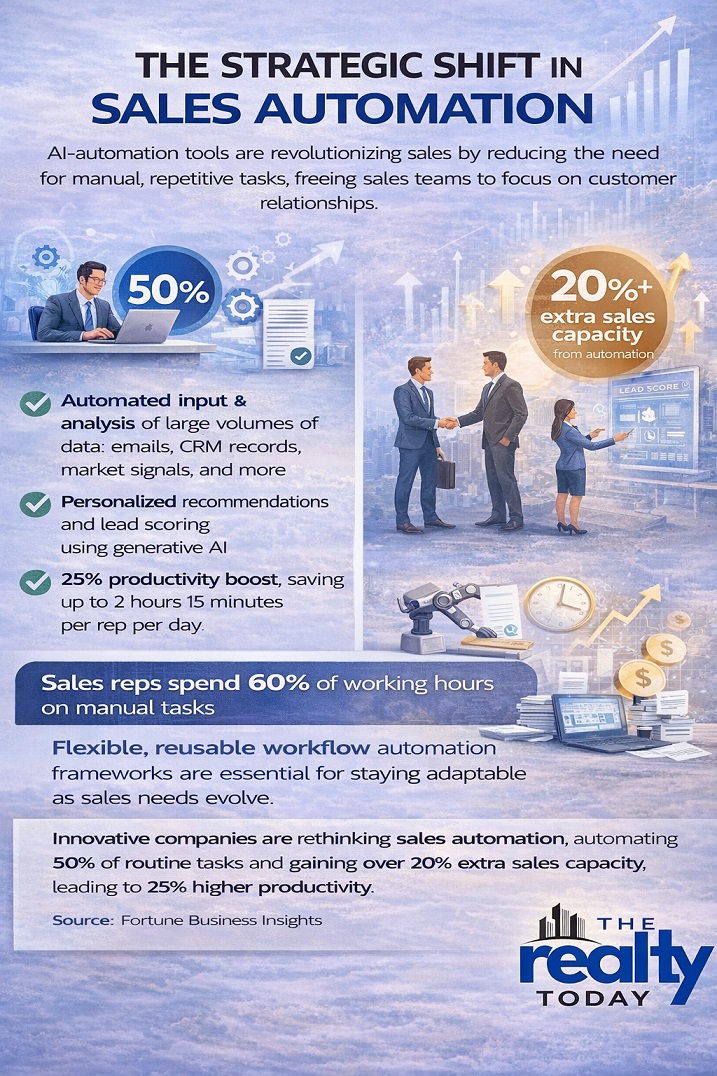
The effects of smart workflows are already taking shape in numbers. Salespeople who leverage AI powered automation report that their daily saving in work time was up to 2 hours and 15 minutes, which corresponds to 25% higher productivity of the entire team. To illustrate, a B2B company, which is in the sound technology business, cut the order entry processing time from three hours to only three minutes by implementing robotic process automation. Thus, the representatives were able to spend 30% more time with customers and the sales potential increased by 20%.
Looking at the future, the ability to be flexible is what will differentiate the most successful sales automation players. Standard sales models are held back by major bottlenecks, with sales staff spending up to 12 hours a week on tasks that can be done manually, which work out to be almost 60% of their total working time.
Why Automation Is Critical From Site to Sale?
Automation is changing not just the rate of construction but also the overall model of the real estate business.
- Faster Revenue Realization- Shorter construction periods also mean earlier completion of projects, earlier occupancy of premises, and hence earlier sales or leasing out of buildings.
- Improved Cost Certainty- Delays are one of the largest contributing factors to cost overruns. Automation helps manage timelines, which stabilizes the budget.
- Better Buyer Confidence- A consistent quality of service with timely delivery can contribute immensely to brand credibility, which remains a fundamental factor in residential real estate.
- Scalability for Developers- Automation enables companies to undertake several projects at one time without increasing their management levels proportionately.
Key Technologies Driving Construction Automation
1. Building Information Modeling (BIM)
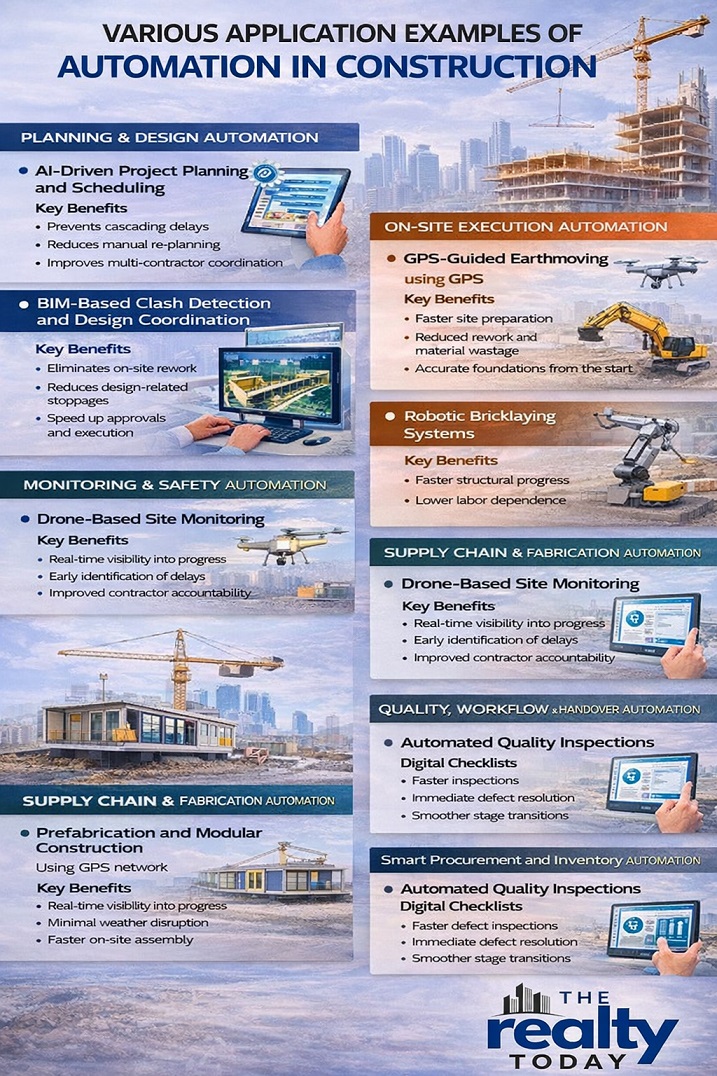
Building Information Modeling (BIM) helps in developing a digital model of the building where architectural, structural, and MEP systems are majorly coordinated and integrated into a single coordinated environment. BIM, which facilitates early clash detection, faster design approvals, 4D scheduling, and better collaboration among stakeholders, identifies issues for resolution before construction, thereby greatly reducing rework and time delays on site.
2. Artificial Intelligence and Machine Learning
AI and machine learning technologies take project data, both historical and real, time, in a very large quantity, and run analytics to enhance the accuracy of planning and the efficiency of the execution. Such systems not only forecast schedule risks but also help to put the activities in the best possible order, diagnose the points where productivity is reduced, and predict the consequences of a delay, therefore they continuously improve the results as they get new data from the project performances.
3. Automated Site Monitoring and Reality Capture
By using drones, fixed cameras, IoT sensors, and mobile reporting tools, the construction site progress tracking can be completely or partially automated. These systems collect real time data and based on the actual progress they check with the planned schedule and generate an objective report. They provide early warnings to the site managers about the deviations from the plan so that the corrective action can be taken without having to wait for the manual reports.
4. Robotics and Autonomous Equipment
Nowadays, robotic solutions and autonomous machines are more and more extensively utilized for tasks that require high repetition and high precision, e.g., bricklaying, concrete finishing, rebar tying, welding, and GPS, guided earthmoving. Such solutions help to increase the output of work, to improve the precision, to lower the dependency on labor, and to shorten the time of the whole project while safety is better.
5. Prefabrication and Modular Construction
Due to automation, the trend of prefabrication and modular construction has rapidly increased. Prefabrication is a process in which building parts are produced in a factory under controlled conditions and then shipped to the site for assembly. This allows the two processes, manufacturing and site work, to be done at the same time, thus cutting the overall project timeline. It also eliminates weather, related delays, guarantees consistent quality, and drastically reduces the time taken for on, site construction.
6. Smart Procurement and Supply Chain Automation
Smart procurement platforms automatically integrate material requisition with project schedules and thus equip them with real time delivery tracking and predictive shortage scenarios. They analyze supplier performance and anticipate disruptions, which helps keep material availability on a high level and prevents delays caused by supply chain inefficiencies.
7. Workflow Automation and Digital Approvals
A construction project is characterized by a large- scale documentation flow and thus approvals and regulation verification, which may restrain the implementation process. Workflow automation is a tool that can be used to simplify these tasks and it covers aspects like digital document management, automated approval cycles, mobile inspections, and real time compliance tracking. Hence, it can be expected that administrative barriers are reduced to the minimum, which normally hinder the progress on the site.
Applications across the construction lifecycle
- Planning and Design- Automation enables greater accuracy, decreases design blunders, and streamlines approvals.
- Execution and Site Management- Improved productivity and safety through real-time monitoring, robots, and equipment are observed.
- Quality Control- Automated inspections and digital checklists help to eliminate defects.
- Handover and Post-Construction- Digital documentation and asset data facilitate handover, maintenance planning, and occupancy.
Precision Automation at Scale: How Shriram Properties Transformed Core Business Workflows?
As per uipath.com, Shriram Properties has undertaken a significant digital transformation by embedding intelligent automation across finance, HR, IT, and vendor management functions. By leveraging UiPath and deep SAP integration, the company has built a scalable, hyper-automated operating ecosystem that delivers speed, accuracy, and real-time visibility across mission-critical workflows.
Invoice Processing Automation (SAP MIR7): Driving Speed and Accuracy
Invoice parking under SAP MIR7 was earlier dependent on manual data entry, resulting in delays and data inconsistencies. By deploying UiPath bots with Optical Character Recognition (OCR) and Intelligent Document Processing (IDP), Shriram Properties has reduced human intervention by nearly 70%.
Today, the automated system processes over 150,000 invoices annually, achieving 99% data extraction accuracy and an 80% validation success rate. Invoice turnaround time has reduced sharply, while errors and rework have been minimized, strengthening financial control.
Bank Reconciliation & Statement Downloads: Real-Time Financial Visibility
Access to up-to-date financial data is crucial for capital-intensive real estate operations. Automated bots now securely log into multiple bank portals on a daily basis, download statements, and store them in designated network folders. This automation has reduced manual effort by 25%, streamlined bank reconciliation, and enabled near-real-time cash-flow visibility—allowing finance teams to take faster, data-driven decisions.
Vendor Registration & SAP Integration: Faster Supplier Onboarding
Vendor onboarding was earlier a manual, error-prone process impacting supplier relationships. With automation, bots now extract vendor details from Microsoft Forms, validate information with internal teams, and create vendor master records directly in SAP.
Automated notifications provide vendor names and business partner codes to the Accounts Payable team, cutting processing time and errors by 50% and significantly improving supplier collaboration.
Complex Financial Transactions (F-02, FV70, FB65): Precision at Speed
High-volume SAP transactions such as F-02 (tax-coded entries), FV70 (posting demands), and FB65 (bill reversals) earlier took approximately two minutes per entry. UiPath bots now complete these transactions in one minute, delivering a 50% reduction in processing time. The automation ensures real-time updates, higher transparency, and reduced manual dependency—allowing finance teams to focus on strategic tasks rather than repetitive execution.
HR & IT Automation: Proactive, Zero-Touch Operations
Automation has extended beyond finance into HR and IT operations.
- Password Reset Automation monitors helpdesk emails, resets credentials automatically, and notifies users instantly.
- Demand Release Automation validates sales orders across SAP and Salesforce and releases demands autonomously.
These unattended workflows operate without human prompts and have reduced resolution times by 60%, showcasing the power of proactive automation.
Trial Balance Report Automation: Faster Financial Reporting
Trial balance generation earlier involved manual SAP extractions, spreadsheet consolidation, and macro execution. Using UiPath Apps integrated with SAP, the entire process is now automated.
Finance users submit inputs through a custom UiPath App, after which bots extract P&L and balance sheet data, apply macros, and generate final reports. Manual effort has reduced by 85%, accuracy has improved, and reports are now delivered in minutes instead of hours.
SG&A Budget Addition & Reallocation: Stronger Governance and Control
Managing SG&A budget additions and reallocations across WBS elements was previously slow and lacked real-time visibility, increasing compliance risk. A fully automated solution using UiPath Apps and SAP integration has transformed this workflow.
The new system ensures faster approvals, real-time tracking, and stronger compliance—providing management with enhanced financial control and audit readiness.
By strategically deploying intelligent automation, Shriram Properties has moved beyond incremental efficiency gains to achieve enterprise-wide operational transformation. The initiative has delivered measurable improvements in speed, accuracy, compliance, and scalability—setting a strong benchmark for automation adoption in India’s real estate sector.
Reimagining Construction with L&T: A Real-World Digitization Project Site Managemment Case Study
India’s construction and infrastructure sector has witnessed massive growth over the last decade. Mega roads, complex urban infrastructure, and large-scale projects have become the norm. While machinery and engineering techniques have evolved rapidly, site-level processes and coordination have largely remained manual, creating inefficiencies in execution.
This gap between physical capability and digital maturity became evident even for industry leaders like Larsen & Toubro (L&T)—highlighting the need for practical, on-ground digitization rather than theoretical digital transformation.
Larsen & Toubro: Managing Complexity at Scale
Larsen & Toubro Construction is India’s largest construction organization and ranks among the top 30 contractors globally, with over 8 decades of experience. Its operations span:
- Heavy Civil & Infrastructure
- Transportation & Road Projects
- Smart Cities & Urban Infrastructure
- Power, Communication & Industrial Projects
Despite its scale and expertise, field operations across distributed project sites, especially in road construction, presented operational challenges—particularly within L&T Transportation & Infrastructure (TI).
The On-Site Challenge: RFIs & Field Coordination
Road projects are inherently complex. Unlike vertical construction, they span long distances with multiple chainages, requiring frequent inspections and approvals at different stages.
At L&T project sites:
- Site Engineers regularly raised RFIs (Requests for Inspection)
- RFIs were managed through manual and paper-based workflows
- Each RFI required internal approval before work could continue
- Engineers often had to pause work while waiting for approvals
This process consumed a significant portion of daily site time and was not scalable for large infrastructure projects.
The Turning Point: Digitizing Field Operations
To address these challenges, L&T TI adopted Pro-Inspector, a cloud-based platform designed to automate site inspections, audits, safety walks, and RFIs.
The objective was simple:
Eliminate paper, reduce approval delays, and enable real-time site execution.
Key Workflows Digitized at L&T Project Sites
- Cloud-Based RFI Management- RFIs raised directly from site via mobile devices and routed instantly for approval.
- Digital Inspection Checklists- Safety, quality, and audit inspections executed using customizable digital checklists.
- Real-Time Approvals & Notifications- Planning teams approved RFIs instantly; site engineers received push notifications to proceed without delay.
- Photo & Video Evidence Capture- Built-in camera enabled visual documentation of non-conformities and compliance.
- Offline Functionality- Inspections conducted in low-connectivity areas and synced automatically once online.
- Automated Reports & Dashboards- Instant audit reports, compliance summaries, and performance dashboards for management.
- Task & Issue Tracking- Non-conformities assigned, tracked, and closed with clear accountability.
Measurable Impact on L&T Project Sites
Before Digitization
- Paper-based inspections and RFIs
- Slow communication between site and planners
- Delayed resolution of non-conformities
- Limited insights from static checklists
- Productivity loss due to approval delays
After Digitization
- 100% digital inspections and RFIs
- Cloud-based approvals with real-time visibility
- Faster issue identification and closure
- Insight-driven checklists with analytics
Results Achieved:
- 40% more inspections completed
- 75% improvement in site productivity
- Significant reduction in paperwork and manual coordination
- Faster execution across long road stretches
This is a live, real-world automation case from Indian construction sites—not a pilot or experiment. L&T’s experience proves that practical digitization at the site level directly improves speed, productivity, and control, even in highly complex infrastructure projects.
Digitization didn’t replace engineers—it removed friction from site execution.
Indian construction firms lead Asia-Pacific in digital technology adoption: Autodesk–Deloitte
Indian construction companies are taking the lead in adopting digital technologies in the Asia, Pacific region, which is highlighted in the State of Digital Adoption in Construction 2025 report by Autodesk and Deloitte. The report reveals that Indian companies are not only using a wider range of digital tools but are also making bigger investments in technology compared to their regional competitors, thereby turning digitalisation into real, measurable benefits in terms of revenue, safety, and operational efficiency.
- 54% of Indian construction firms are leveraging AI and machine learning
- Firms utilize a mean of 8.6 digital technologies, the most among the surveyed countries
- 35% of the total spending is going towards new technologies.
This level of adoption is indeed yielding real business results.
The report further reveals that companies with revenues above $100 million, the implementation of each new technology, correlates with an average revenue growth of $1.14 million.
Besides that, organisations that are more digitally mature have witnessed a 50% decrease in safety incidents, thus demonstrating how digital tools can help enhance safety and risk management on the site.
The most used technologies in India are data analytics (72%), construction management cloud software (66%), and mobile applications (66%)
BIM, IoT, and smart sensors are becoming very popular both in big and medium, sized projects
However, the report points out that a few challenges that may restrain the pace of the progress still exist.
Several, remaining key barriers, are the lack of digital skills among employees (36%), uncertainty around required technical capabilities (31%), and concern about the high cost of digital technologies (29%). Furthermore, limited access to technology providers and the pressure on budgets make the adoption even more complex.
Construction is a major contributor to the Indian GDP and is the source of employment for about 12% of the total workforce. Hence, the report highlights that the continuous deepening of digital technologies in this industry will mainly determine the success in safety, accuracy of project delivery, and the ability of the sector to sustain the economic growth over the years.
Challenges for Construction Automation Adoption
- High initial investment, especially for smaller firms
- Integration with legacy systems
- Adaptation of the workforce through reskilling and training
- Cultural resistance against shifting traditional workflows.
The Road Ahead
Automation will probably become a standard thing rather than a luxury as technologies develop and get cheaper. Understanding that faster and more reliable construction is crucial to meeting the needs of urbanization, housing, and infrastructure, governments, developers, and contractors are aligning themselves with the idea.
The industry is slowly moving towards a world where delays would no longer be considered an inevitable part of the production but something that can be easily resolved with the help of smart systems. Automation is transforming the construction industry from one that is reactive and delay, prone into a more predictable and data- driven. Using digital planning, AI, assisted decision making, robotics, and intelligent supply chains together can help projects reduce delays by 30% and at the same time achieve higher quality results.
Automation increases speed, certainty, and value creation in each phase of the process, from site execution to final sale. Automation is no longer simply a technology option but a strategic imperative for developers, contractors, and investors who are forward looking.
Image- freepik.com





.png)