

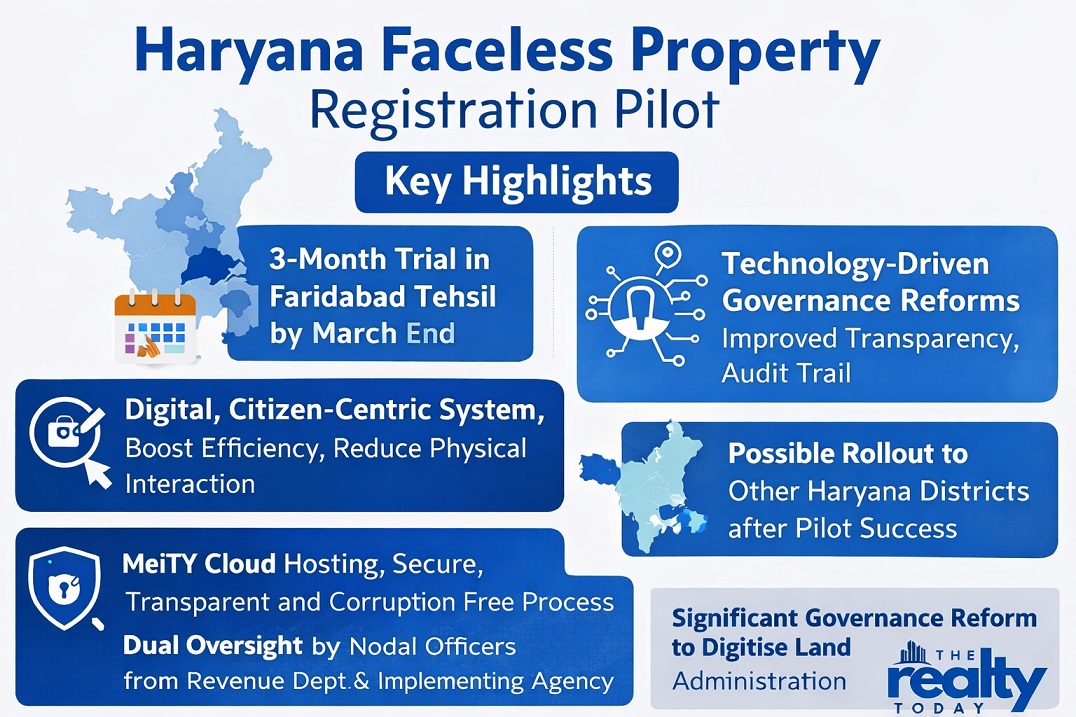
Haryana to Pilot Faceless Property Registration in Faridabad: Key Highlights
- Pilot Launch: Haryana will implement a faceless property registration system in one tehsil of Faridabad by the end of March, as a three-month trial before possible state-wide rollout.
- Citizen-Centric & Digital: The initiative aims to digitally streamline property registration, reduce physical interactions, enhance convenience, and improve efficiency.
- Secure & Transparent: The system will be hosted on MeitY Cloud, with a comprehensive digital workflow, dual oversight, and reduced human discretion to minimize corruption and delays.
- Governance Reforms: The faceless system promises a transparent, accountable process with a comprehensive audit trail, strengthening public trust in property transactions.
- Phased Expansion: Based on pilot outcomes, operational efficiency, and user feedback, the government will consider extending the system to other districts across Haryana.
Haryana will soon implement a faceless property registration system with a pilot in Faridabad by the end of March. This will be the first step towards digitising land administration and bringing more transparency in property transactions. The pilot project will be run for three months before the government of the state thinks about rolling it out to other districts.
While declaring the news, Sumita Misra, Financial Commissioner, Revenue & Disaster Management Department, said the pilot in Faridabad will be Haryana's step towards a fully digital, citizen, centric property registration system that will greatly reduce physical interactions and make it more convenient for the citizens to get the services.
“This is scheduled to begin by the end of March,” Misra said, adding that the initiative reflects the government’s broader push towards governance reforms driven by technology.
According to the state government, the faceless registration system is intended to digitally streamline the entire process of property registration, thus allowing for quicker processing, better efficiency, and less human discretion. The decision is likely to solve old problems of delay, lack of transparency, and corruption in the land and property registration work. Misra stressed that the project would totally change the way people deal with the land administration system.
Faridabad pilot, according to her, is a clear indication of the state's intention to implement a transparent, efficient, and technology- driven system of property registration.“The Faridabad pilot marks the state's ambitious move towards a fully digital, faceless and citizen-centric property registration process, aimed at further enhancing transparency, minimising physical interface and improving ease of service delivery,” she said.
The pilot project will be rolled out in one tehsil of Faridabad district and will be closely monitored during the three-month testing phase. Based on its performance, operational efficiency, and user feedback, the state government will take a decision on expanding the system to other districts across Haryana.
Key features of the pilot include:
- Secure hosting on the Government of India's MeitY Cloud
- Comprehensive digital workflow with reduced human discretion
- Dual oversight by nodal officers from Revenue Department and implementing agency
“This technological advancement promises to make property transactions more transparent and hassle-free for citizens while maintaining the highest standards of security and data protection,” an official statement said.
Misra said that all approved features and functionalities will be deployed during the pilot phase, while certain non-critical features may be added later based on operational requirements and user feedback.
The three-month pilot period will commence after completion of technical work by the project team and successful User Acceptance Testing (UAT) sign-off by the concerned Sub-Registrar. Server hosting support will be provided by the Revenue Department’s IT team.
Terming the initiative a “significant governance reform,” Misra said the faceless registration system is expected to strengthen transparency, reduce procedural delays, and enhance public trust in property transactions.
“The digital system will also create a comprehensive audit trail, making the entire process more accountable and transparent,” she said. Based on outcomes and feedback from the Faridabad pilot, the system may be rolled out across other districts in a phased manner, reinforcing Haryana’s commitment to technology-driven, citizen-friendly governance.