
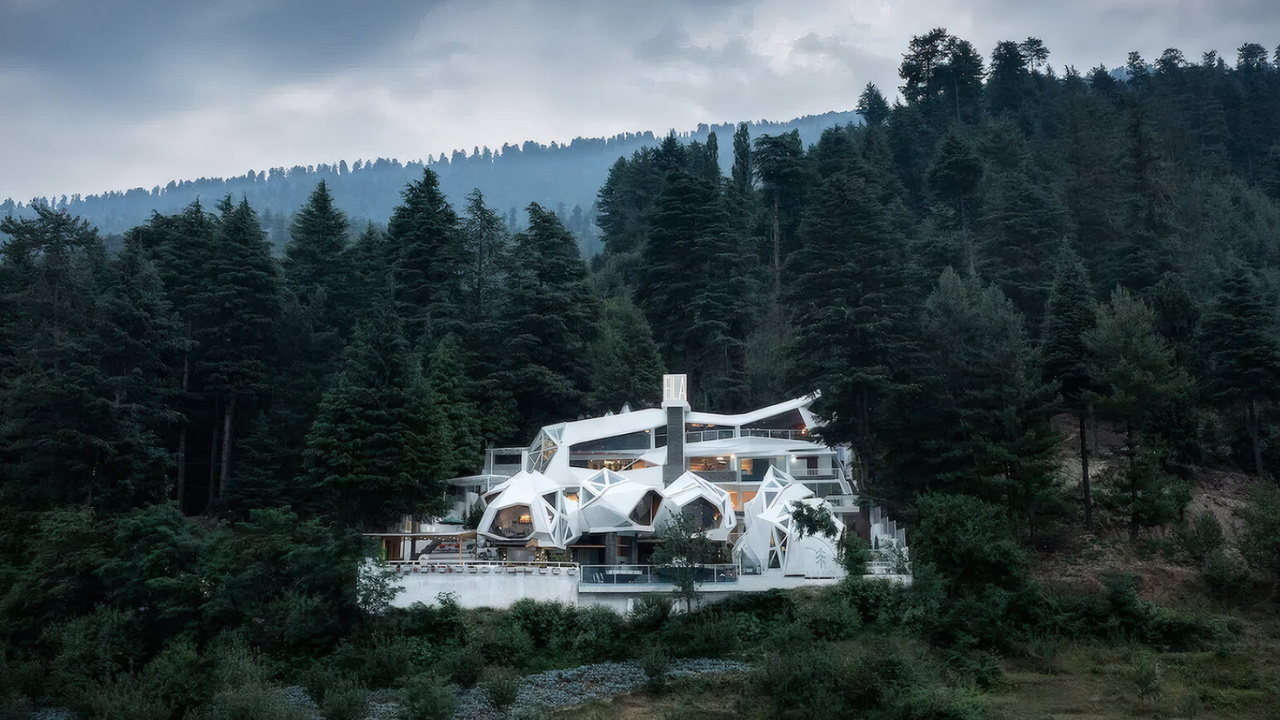
Key Highlights – Eila by MOFA Studio
- Terrace-Based Planning: The retreat follows the natural contours of Naggar Valley, preserving topsoil and natural water channels instead of flattening the slope.
- Biomorphic Pod Cottages: Designed by MOFA Studio, the thin-shell concrete cottages reinforced with lightweight steel blend organically with the hillside.
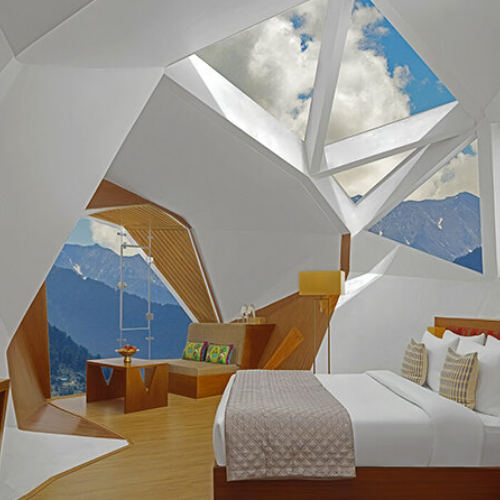
- Framed Himalayan Views: Strategically placed windows and skylights act as visual instruments, connecting interiors seamlessly with the surrounding mountains.
- Art-Integrated Architecture: Murals, curated interiors, custom lighting, and communal spaces make art an essential part of the spatial experience.
- Ecological & Passive Design Approach: Use of local materials, reduced embodied carbon, passive orientation, and minimal site disturbance ensure environmental sensitivity and long-term sustainability.
Eila is an art retreat located on a steep slope in Naggar Valley, Himachal Pradesh that tries to blend with the natural environment. MOFA Studio considered the location as a chance for the architecture to trace the landscape's natural contours instead of breaking them.
The retreat arrangement is on terraces that save the original topsoil and natural rainwater paths, thus restricting the damage to the local ecosystem. There is a strong focus on the flow, with cottages that resemble pods and light structures that give the built form the ability to live together with the hillside.
Instead of developing one iconic building, the whole land was considered as a potential building for an extension of nature. The location of the buildings allows them to take full advantage of the views of the valley while at the same time enabling the connection of the indoor spaces with the mountains outside. Such a strategy makes the works of architecture become a part of the environment and at the same time, it offers visitors a reflective and deeply engaging experience.
Site- Responsive Masterplanning
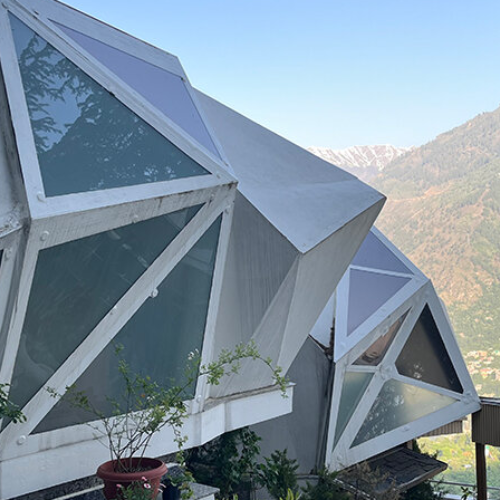
The steepness of the hill was a major factor that necessitated great care in planning. The masterplan is a layered one, with each step going down the hill slowly so as not to break the hill too much or disturb it too much. The entrance pathway is from the Gate of Confluence pavilion and then visitors can go through a series of terraces and pathways, with the final point being the pod, like cottages.
Some of the key reasons to be responsive to the site are:
- Conserving topsoil and natural water courses
- Using terraced land instead of flattening it
- Spacing buildings to reduce visual impact
This terraced design also enables visitors to move through the site, providing each visitor with a layered experience of the site instead of a single view.
Biomorphic Architecture and Structural Approach
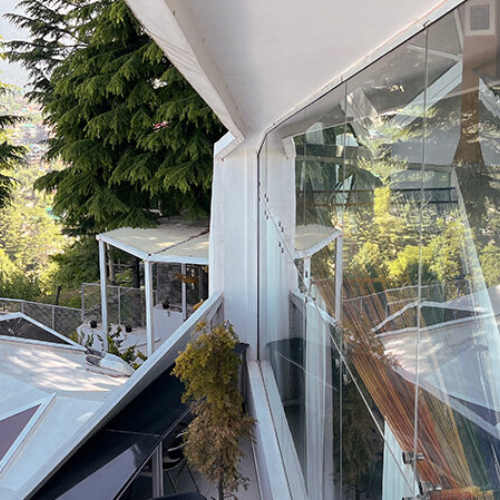
Conforming to its nature, inspired theme, Eila is best known for its line of biomorphic, pod, like cottages. These pieces of architecture feature thin concrete shells reinforced by lightweight steel frames which not only reduces the amount of the material used but also keeps strength and insulation at a good level. The smooth, natural shapes respond both to the terrain and to the way people move around, thus blending the indoor and outdoor areas.
Each of the cottages is set up to have the best possible view of the Naggar Valley, and the geometrical shapes were optimized for both structural sturdiness and environmental performance by means of computational design tools. The shells help to spread the weight of the structure over the slope, thus lessening the load on the foundations and, at the same time, lowering the amount of embodied carbon in comparison with the traditional heavy masonry systems.
Openings as Visual Elements
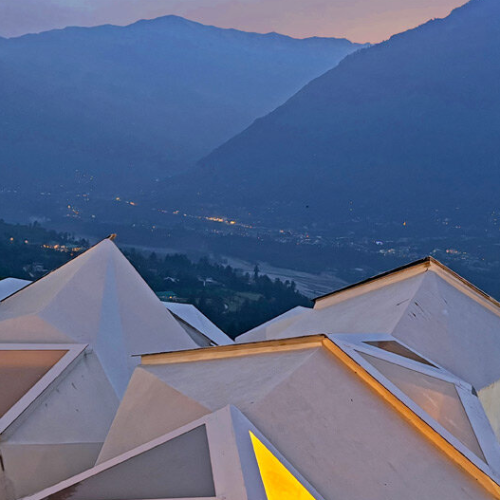
Windows and skylights are strategically located throughout the retreat to frame certain views of the valley and mountains. Instead of using openings as regular elements, they function as visual instruments that extend the landscape inside.
The strategy has several advantages:
- Natural light is extended deep inside the living areas
- Control of heat gain through orientation
- Intentional framing of panoramic views
- Interior spaces are always linked to the exterior environment
The strategies of framing views ensure that the mountains and the surrounding environment are always a part of the retreat experience, making the architecture seem alive and in touch with nature.
Art as Integrated Experience
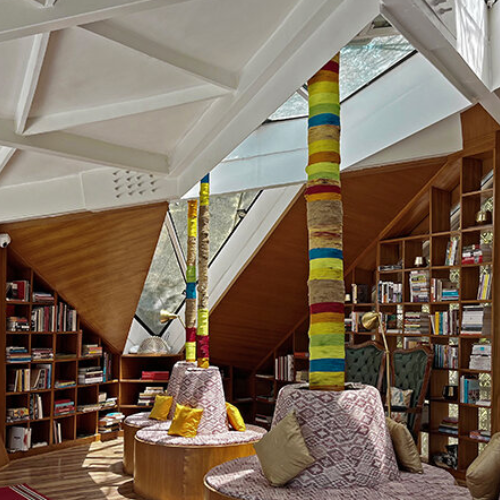
Art is not something that is added at the end at Eila, rather it's deeply woven into the architectural experience. The interiors, facades, and communal spaces under the art direction of Shri Rama Shankar Singh and Palak Singh not only depict a curatorial approach but also a way of life where art has been seamlessly embedded in daily living. Take the Kitaabkhana library, for instance, where the light filtered through jaali screens and custom lamps creates ever changing patterns; the open air amphitheatre and infinity pool, on the other hand, are oriented towards the horizon to keep the landscape visually connected.
Artistic interventions are present in:
- Interior murals and facades
- Lighting fixtures and spatial sequences
- Outdoor spaces and communal areas
This combination turns art into a functional aspect of architecture, thus benefiting both the visual and the experiential.
Materiality and Ecological Considerations
Local materials are prioritized to lower the carbon footprint of transportation and at the same time to make the project more connected to the region. The use of lightweight steel and thin, shell concrete not only helps in reducing the total amount of materials used but also gradually allows for ecological recovery. It is likely that eventually, plants will grow on the concrete shells, thus the forms will become less harsh and the architecture will naturally blend into the landscape. Passive design strategies, top, notch insulation, and correct orientation work together to keep the energy use to a minimum while at the same time the retreat remains a discreet visual element against the Himalayan backdrop.
Design Philosophy and Vision for the Future
MOFA Studio's five, fold design philosophy encompasses spatial, ecological, social, temporal, and systemic fluidity. At Eila, these principles reveal themselves through circulation, environmental responsiveness, structural efficiency, and communal programming. The getaway is an outcome of a continuing partnership between Manish Gulati and Shri Rama Shankar Singh where most of the emphasis is on context, restraint, and experiential quality rather than on spectacle.
Through terrace planning, biomorphic shapes, rightly opened and framed windows, and art, guided integration, Eila proves that architecture on the slope can be a perfect union of ecology, innovative design methods, and artistic expression. It is a present, day exemplar of a landscape and human experience, responsive architecture that simultaneously offers both efficiency and harmony with the environment.
Image- designboom.com



.png)