
India Real Estate Horizons – Retail 2026 provides a data-led view of how organised retail is evolving across 12 major Indian markets, covering 186.2 msf of organised retail stock across Shopping Malls, Office Led Amenity Retail and High Streets. The report examines the next phase of growth through supply, rentals, vacancy, tenant mix, lease structures and city-level performance, highlighting the rise of larger destination malls, the expansion of 51.7 msf of Office Led Amenity Retail, the growing share of experience-led categories and the increasing divergence between retail markets across India.
Highlights
1.India’s organised retail stock stands at 186.2 msf across the 12 tracked markets, increased by 9x in two decades, comprising 114.3 msf of Shopping Malls, 51.7 msf of Office Led Amenity Retail and 20.2 msf of High Streets.
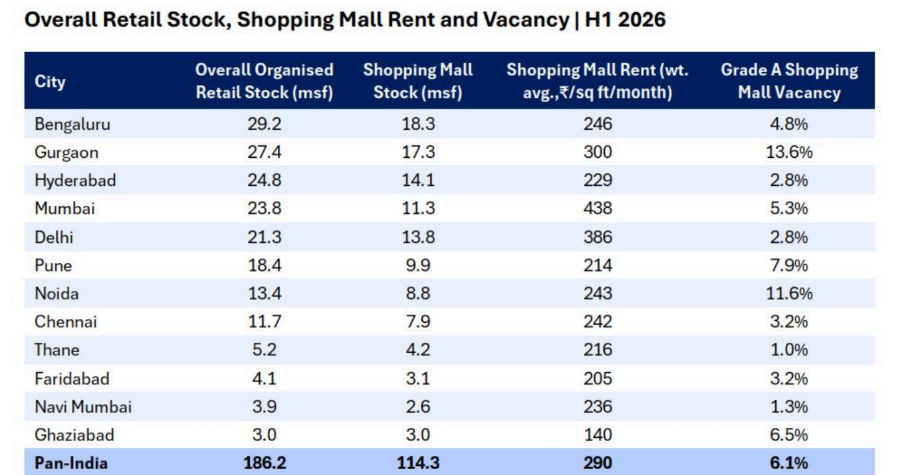
2.Bengaluru is the largest organised retail market at 29.2 msf, followed by Gurgaon at 27.4 msf, Hyderabad at 24.8 msf and Mumbai at 23.8 msf.
3.India has 40.4 msf of upcoming Shopping Mall supply through 2030, with Hyderabad and Gurgaon together accounting for 51% of the identified pipeline.
4.The average size of new Shopping Malls is rising sharply, from 0.25 msf in the Pre-2000 era to a projected 0.59 msf during 2026-30.
5.Experience-led categories, including Fashion, F&B, Entertainment, Leisure and Wellness, are gaining a larger share of mall leasing to 72%, Up from 54% a Decade Earlier.
6.Traditional anchor categories have become less dominant, with Department Stores & MBR and Essentials & Grocery together declining from 31% to 11% of leasing demand compared to the last decade.
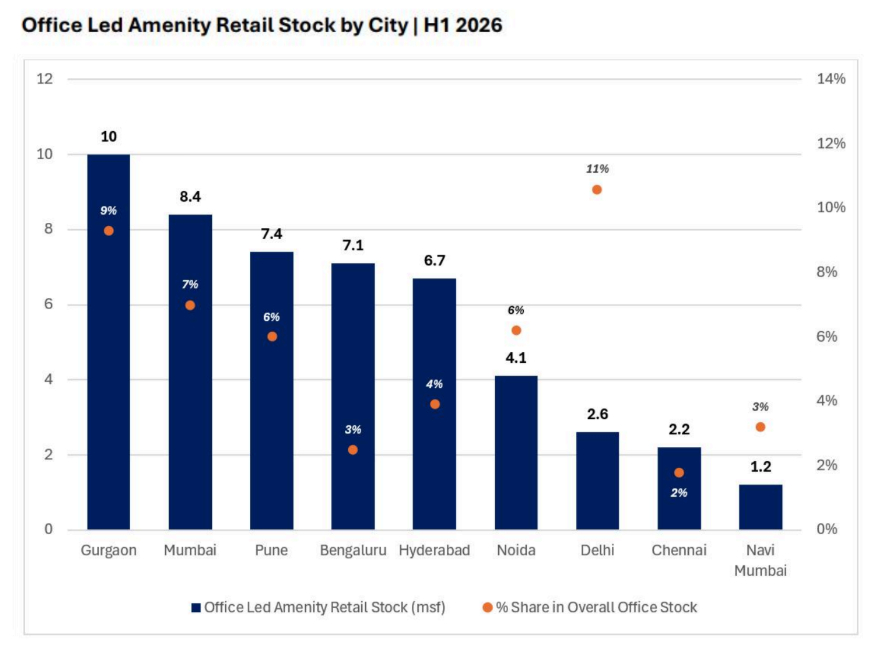
7.Office Led Amenity Retail has emerged as a meaningful retail format, with 51.7 msf of stock and a record 15.4 msf added during 2021-25.
8.Gurgaon leads Office Led Amenity Retail with 10.0 msf, followed by Mumbai at 8.4 msf and Pune at 7.4 msf.
9.Grade A Shopping Mall vacancy also shows wide divergence, from 1.0% in Thane to 13.6% in Gurgaon, highlighting the importance of asset quality, catchment strength and supply discipline.
10.Mumbai and Bengaluru recorded the strongest three-year Shopping Mall rental growth at 22%, compared with Pan-India growth of 11%.
11.Prime High Streets continue to command significant premiums, with rentals ranging from 400 – 3,000 INR/sq ft/month.
• NCR – 3,000 INR/sq ft/month
• Mumbai – 1,500 INR/sq ft/month
• Pune – 800 INR/sq ft/month
• Bengaluru – 800 INR/sq ft/month
• Hyderabad – 400 INR/sq ft/month
• Chennai – 400 INR/sq ft/month
12.Retail lease structures are changing, with average lease tenure declining from 75 months in 2021 to 70 months in H1 2026, while average lock-in increased from 22 months to 29 months.
13.Lock-in now represents 40.9% of the average retail lease term, up from 29.6% in 2021.
14.Leasing outpaced new Shopping Mall supply in five of the seven half-year periods since H1 2023, indicating that demand has remained ahead of fresh completions through most of the recent cycle.
Report Summary
India’s retail real estate market is entering a more mature and differentiated phase. Across the 12 markets tracked, organised retail stock stands at 186.2 msf, but the composition and performance of that stock varies significantly by city. Bengaluru leads overall retail stock, Mumbai commands the highest Shopping Mall rents, while Gurgaon has the largest Office Led Amenity Retail base. The market is therefore becoming less uniform, with each city developing a different mix of Shopping Malls, High Streets and workplace-linked retail.
The next Shopping Mall cycle is also becoming larger and more concentrated. India has 40.4 msf of upcoming mall supply, with Hyderabad and Gurgaon together accounting for 51% of the pipeline. At the same time, the average size of new malls is projected to increase to 0.59 msf during 2026-30, compared with 0.25 msf in the Pre-2000 era. This points to a shift toward larger destination-led assets capable of supporting a wider mix of fashion, dining, entertainment, leisure and wellness.
Tenant demand is changing in parallel. Experience-led categories increased from 54% to 72% of mall leasing between 2013-15 and 2023-25, while Department Stores & MBR and Essentials & Grocery together declined from 31% to 11%. Apparel & Fashion alone increased from 25% to 35%, while F&B rose from 11% to 15%, indicating that malls are becoming less dependent on traditional anchors and more diversified around categories that support dwell time and repeat visitation.
Office Led Amenity Retail has emerged as another important part of the organised retail ecosystem, with 51.7 msf of stock across the tracked markets. A record 15.4 msf was added during 2021-25, reflecting the evolution of Grade A office developments from workplaces with convenience retail into broader consumption environments.
Rental and vacancy trends reinforce the growing divergence between markets. Mumbai leads Shopping Mall rents at ₹438 per sq ft per month, while Ghaziabad stands at ₹140, creating a ₹298 per sq ft gap. Vacancy ranges from 1.0% in Thane to 13.6% in Gurgaon, suggesting that future performance will depend increasingly on asset quality, catchment strength and the pace of new supply.
Lease structures are evolving as well. Average tenure declined from 75 months in 2021 to 70 months in H1 2026, while average lock-in increased from 22.2 months to 28.6 months, taking lock-in to 40.9% of the average lease term. Together, these trends point to a market that is becoming larger, more experience-led and more selective, with greater differences emerging across cities, formats and asset quality.