
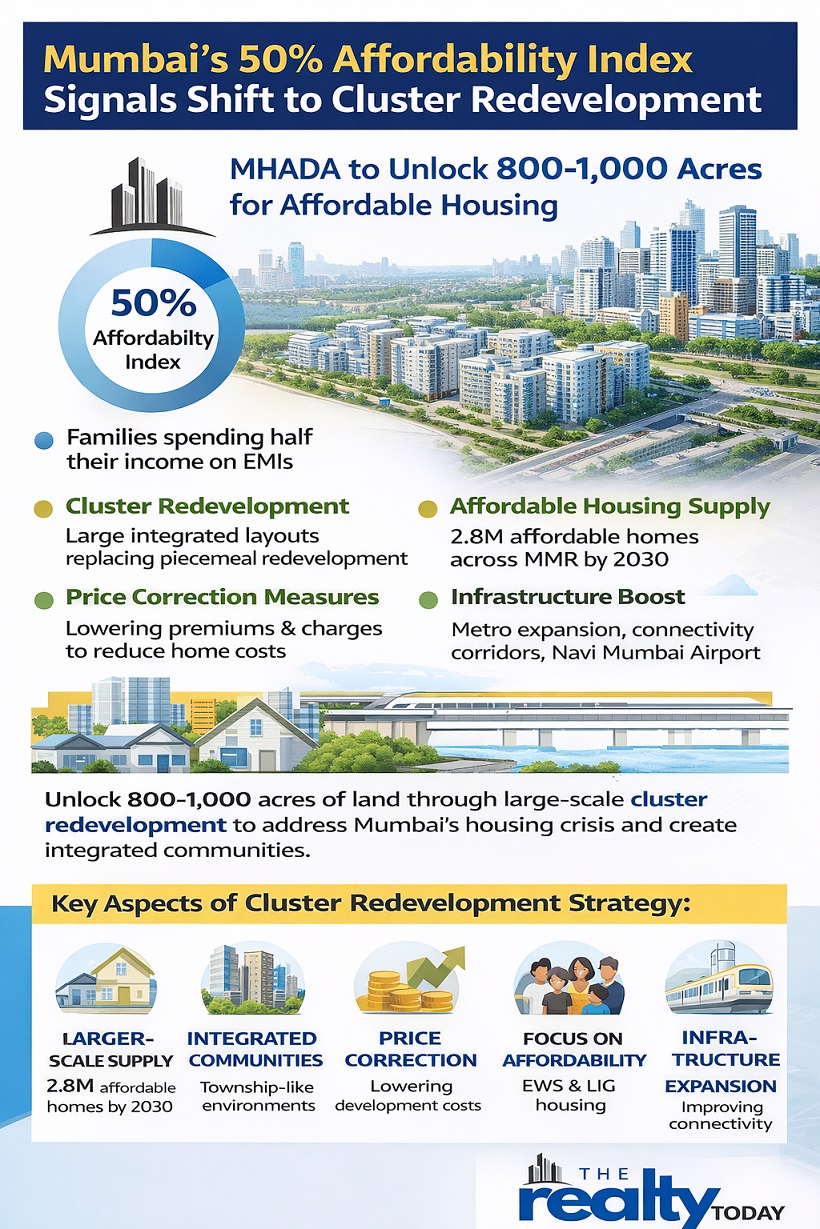
The challenge of housing affordability in Mumbai has come to a head as the city's affordability index has climbed to nearly 50%. This means that an average household is spending almost half of its income on home loan EMIs. On one hand, there is a shortage of land and, on the other hand, the existing building stock is getting older and the Maharashtra Housing and Area Development Authority (MHADA) has decided to focus on large, scale cluster redevelopment as a way of structurally addressing the city's deeply rooted housing problems.
At a real estate industry forum in Mumbai, Sanjeev Jaiswal (IAS), Vice, President and CEO of MHADA, gave a detailed speech about a visionary plan of action that aims to change the way things have been done so far in terms of renewal and regeneration of old buildings and instead, create bigger and better integrated communities by unlocking 8001, 000 acres of land through cluster redevelopment a scale never seen before in the citys urban planning history.
Why the shift is so necessary?
Almost 90% of Mumbai's developable land has been utilised. As land shortage is getting worse and redevelopment is becoming difficult especially in cess buildings and old housing stock, traditional redevelopment methods are no longer effective. Piecemeal projects result in congested layouts, a lack of open spaces, and infrastructure stress. On the other hand, cluster redevelopment brings together several land parcels into large integrated layouts of 60, 100 acres. It allows for the creation of residential ecosystems with better roads, adequate open spaces, modern amenities, and improved civic infrastructure.
The idea is to develop township- like environments within the existing city fabric, not just isolated vertical towers packed into small plots. GTB Nagar and Abhyudaya Nagar are the projects that have reached advanced stages, and several other clusters are in the pipeline. These projects will presumably be instrumental in changing the redevelopment approach of Mumbai.
Addressing the Affordability Crisis
The affordability index of 50% in Mumbai indicates the severe financial stress of the middle class and first, time homebuyers. Many households, in fact, are spending almost half of their income on EMIs. Sanjeev Jaiswal, emphasised that the implementation of structural reforms would go a long way in lowering the burden on the people. The property prices in certain segments could go down by as much as 25% if affordable housing is agreed upon in a sensible way with regard to the removal or reduction of premiums, development charges, and taxes. This, in turn, would hugely increase the extent to which a greater number of buyers can afford such properties.
To EWS and LIG who are the most vulnerable groups and whose problem is aggravated by the increase in the prices of land and construction materials, these reforms have a direct link to their survival. As part of its housing sector master plan, the Maharashtra government has declared its intention to provide 2.8 million affordable houses all over the Mumbai Metropolitan Region (MMR) by the year 2030, with the Maharashtra Housing and Area Development Authority (MHADA) being the main body responsible for the implementation of this plan.
Key aspects of the strategy include:
- Price Correction Measures: Reduction and rationalisation of premiums and statutory charges to lower end-user costs.
- Large-Scale Supply Target: 2.8 million affordable homes planned across MMR by 2030.
- MHADA’s Direct & Indirect Role: Approximately 0.8 million units expected through various schemes and redevelopment models.
Almost 50, 000 homes have been delivered over two, and, a, half years, according to a report, reflecting steady progress. Moving forward, 60-70% of new housing supply is expected to be sourced from approved or pipeline cluster redevelopment projects. Hence, integrated, large, scale redevelopments have become essential to long, term affordability and housing expansion goals in Mumbai.
Infrastructure As Growth Multiplier
Along with the plans to redevelop, the expansion of the infrastructure is also expected to be a big help. Extensions of the metro rails, development of the connectivity corridors, and the Navi Mumbai International Airport, all three will probably be factors that will spread the demand over the different MMR areas. Once the accessibility is made easier, the markets on the outskirts will get unlocked and there will be less pressure on the main city areas.
Mr. Jaiswal warned that the increase in supply should be done in a very measured way. If new houses are built at a fast rate without the demand growing at the same pace, there can be a situation where there is too much stock for some time. Therefore, the market absorption patterns will have to be looked at very closely so that the risk of having unsold properties does not arise.
A Broader-Diversified Housing Vision
To be more specific, the MHADA's 2025 housing policy framework not only concentrates on ownership housing but also puts out a diversified residential ecosystem. This includes rental housing, student accommodation, working women's hostels, and industrial housing, the formats that are of increasing relevance in a rapidly changing urban economy.
Such diversification acknowledges that there isn't one single type of demand for modern housing. Different categories of people such as migrant workers, young professionals, students and women joining the workforce all need living options which are flexible and affordable. It is possible to achieve community balance through the integration of these formats in cluster redevelopment layouts rather than creating housing pockets of a single segment.
Balancing Luxury and Inclusion
Luxury housing despite maintaining its strong performance in Mumbai's prime micro markets, MHADA has directed developers to concentrate their efforts back on middle, income and first, time buyers. Jaiswal emphasised that inclusive growth is crucial for the eventual urban stability. Embedding some affordable units in high, end projects could be a way of balancing the act between commercial profitability and social responsibility.
Such a strategy is consistent with the worldwide best practices in inclusionary zoning, whereby mixed, income communities lead to economic diversity and social cohesion.
From Fragmentation to Integrated Urban Transformation
In the past, redevelopment in Mumbai has largely been characterised by disjointed interventions. Each old building is redeveloped in isolation, which frequently results in an increase in density that is not supported by corresponding infrastructure upgrades. The cluster approach is indicative of a fundamental shift from merely waiting for the need to be reconstructed to designing cities in a continuous and thoughtful manner.
Should it be realised properly, the release of 8001, 000 acres has the potential to change the face of housing in the financial capital of India. It is a means to increase the stock of affordable housing, bring urban infrastructure up to date, and finally, provide quality housing to those who have been denied it for so long.
Mumbai is a city that is running out of space and getting more and more expensive. In such a scenario, the cluster concept led by MHADA is not just a tool for redevelopment but also a way to structurally reset. The next five to seven years will be crucial in deciding if this bold scheme can turn the policy into a real, massive urban transformation which will change affordability and access for millions of people across different income levels.





.png)