

Karnataka relaxing KIADB norms and its impact on Bengaluru’s industrial & real estate sector:
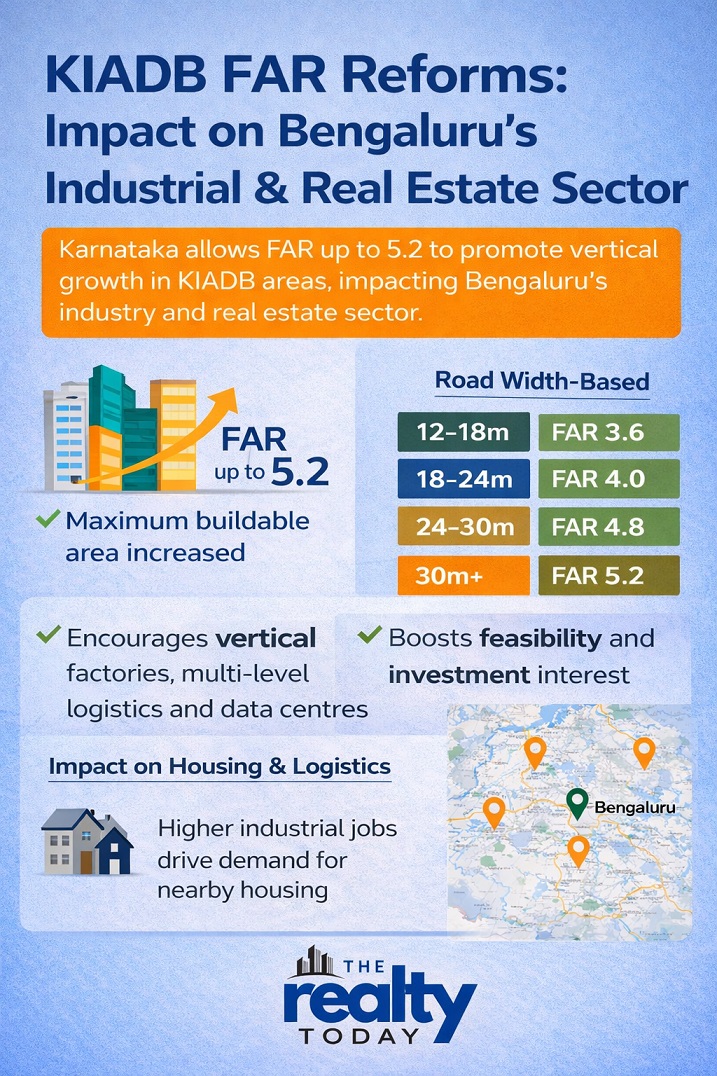
- Karnataka’s decision to allow FAR up to 5.2 in KIADB-notified areas marks a major shift towards vertical growth, significantly increasing buildable potential on existing industrial land parcels.
- The new road-width–based FAR structure (3.6 to 5.2) encourages smarter urban design, better accessibility, and higher land productivity across industrial estates, special investment regions, and integrated developments.
- KIADB hubs in Bagalur, Devanahalli, Hoskote, Bidadi and other Bengaluru outskirts are expected to see faster project launches, higher land feasibility, and stronger investor and occupier interest.
- Higher FAR enables vertical factories, multi-level logistics parks, data centres and mixed-use industrial townships, benefiting sectors like electronics, aerospace, automotive, and supply-chain infrastructure.
- While inner-city housing impact remains limited, rising industrial employment is likely to drive demand for nearby housing, rental accommodation and worker townships, supporting decentralised and balanced urban expansion.
Karnataka's move to introduce very liberal building norms for areas under Karnataka Industrial Areas Development Board (KIADB) is undoubtedly a turning point in the state's industrial and real estate ecosystem. By permitting a floor area ratio (FAR) of up to 5.2 through the payment of a premium, the government has effectively allowed development of taller, denser and more integrated projects along the industrial corridors and emerging peripheral zones of Bengaluru.
The reform is seen as a major structural change mainly aimed at making land use more productive, increasing the pace of industrial development, and making Karnataka more attractive as a manufacturing and investment destination. People from the industry are of the opinion that the new rules might change the layout of factory floors as well as commercial complexes, logistics parks, data centers, and residential townships whose mainstay is industrial activities.
What has changed after the new KIADB rules?
Industrial plots adjacent to roads with a width of over 30 metres were earlier allowed an FAR of 3.25. As per the new regulations, these plots may now get an FAR of as high as 5.2 with the payment of premium FAR. This considerably raises the total permissible constructed area on the same piece of land.
The updated rules introduce a graded FAR structure based on road width:
- Roads wider than 30 metres allow FAR up to 5.2
- 24–30 metre-wide roads permit FAR up to 4.8
- 18–24 metre-wide roads allow FAR up to 4.0
- 12–18 metre-wide roads permit FAR up to 3.6
Importantly, the changes are not limited to industrial estates only but also cover special investment regions, single, unit industrial complexes, infrastructure projects, and integrated developments within KIADB, notified areas. This includes projects with commercial and residential components, thereby enlarging the sphere of impact significantly.
The evolution to vertical growth and increasing land productivity
Vertical growth is the main focus of the reform. Since land in and around Bengaluru is getting more and more limited and costly, the government is thus motivating the industries and developers to make multi- storied buildings instead of extending the area horizontally.
This shift is expected to encourage:
- Vertical factories and multi-level warehouses
- Integrated logistics and data centre campuses
- Mixed-use industrial hubs combining workspaces and support infrastructure
This is especially true for electronics manufacturing, aerospace, automotive, data centres, and supply chain infrastructure, industries which demand big built up spaces but at the same time tend to work on very restricted land footprints.
The policy, according to the officials, is in line with the overall ease of doing business agenda of Karnataka. The state is encouraging through this policy the efficient use of land for manufacturing, employment generation, and economic activities, increasing productivity and at the same time lessening the need for land acquisition.
Impact on Bengaluru’s industrial corridors
One of the most direct effects will be felt in the industrial corridors of Bengaluru and its peripheral growth zones where KIADB estates are concentrated. Consequently, places like Bagalur, Hoskote, Devanahalli, Bidadi, and other nearby areas might experience a spike in development activity.
The increased FAR gives a big boost to the feasibility of projects at these locations. The main advantage is that developers don't have to resort to land purchases of huge size, which is very costly and time, consuming, in order to create bigger, integrated projects. So, this is likely to accelerate the initiation of projects and attract institutional investors as well as big occupiers who are looking for the scale."
At the same time, the value of land in these micro markets is likely to not only hold steady but also gradually go up as the potential for development increases and the local infrastructure improves.
What does this imply for the housing sector?
Initially, the influence on the already existing residential neighborhoods of Bengaluru will probably be slight because the policy mainly targets KIADB, notified industrial areas and not inner, city residential areas.
Still, the potential consequences for the housing market might be medium to long term. With the densification of industrial clusters and the rapid generation of employment, the demand for nearby housing is likely to increase. This, in turn, can motivate the creation of well, planned residential townships, rental housing, and worker accommodations in the vicinity of industrial hubs.
Such mixed- use developments can contribute to significantly reducing the long commuting time, alleviating the pressure on central Bengaluru, and facilitating more balanced urban expansion.
Benefits and potential risks
Industry experts list the clear advantages of the revised norms as better land utilisation, improved project economics, less dependency on land aggregation, and the facility to develop mixed, use industrial ecosystems that feature manufacturing, logistics, offices, housing and retail.
A higher FAR is also conducive for more efficient infrastructure planning since the services can be concentrated in the defined zones instead of being dispersed in sprawling developments.
Nonetheless, some experts warn that higher densities should be backed up by the right kind of infrastructure. Roads, power supply, water, sewage systems and public transport facilities will have to support the pace of development. If no one plans it well, the problems of congestion and overload of civic amenities may not be limited only to the centre but can spill over to the suburbs as well.
Urban planners further maintain that it is of high significance to keep track of the cumulative density effects, especially in situations where the residential component is mixed with industrial uses.
A long, term change in Karnataka's growth strategy
Essentially the easing of KIADB building regulations indicates that Karnataka is making a fundamental change in its industrial and urban development policy. The state, by encouraging vertical growth, integrated planning, and land use efficiency, is preparing itself to embrace further economic growth without the resulting uncontrolled spread of urban areas.
In case the changes to the FAR regulations are accompanied by timely infrastructure improvements and proper implementation, they have the potential to dramatically alter the cityscape of Bengaluru, give new life to the industrial corridors, and lead to the development of more sustainable and employment oriented urban areas throughout Karnataka within the coming decade.





.png)