

Infosys' deal to sell a 53.5-acre land parcel in Anekal Taluk near Bengaluru for ₹250 crore has triggered a political and public debate over the origin of the land and whether the IT major benefited from any government concessions. Following the row over the nature of acquisition of the land-some questions were raised on social media and by political leaders-the software major Infosys firmly denied allegations that the property in question was allotted by the Karnataka government at concessional rates.
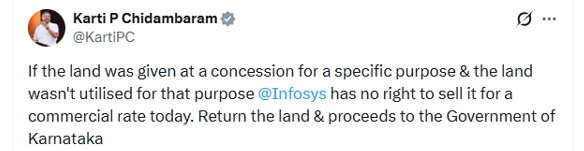
The land sale, a large parcel in Attibele Hobli of Anekal Taluk, came into the limelight after Congress MP Karti Chidambaram asked if Infosys had the right to commercially sell land allegedly given for a specific purpose at subsidised rates. His remarks brought wider scrutiny of the deal, and clarifications from Infosys and former company executives.
Details of the land deal
As reported, Infosys has sold this land to Bengaluru real estate developer Puravankara group for ₹250 crore. The land possesses a total saleable area of around 6.4 million square feet, along with a potential Gross Development Value (GDV) exceeding ₹4,800 crore. This land deal has been one of the most notable in and around Bengaluru in recent times.
The acquisition was announced by Puravankara in a stock exchange filing, where it said, “The acquisition is in line with the company’s strategy of augmenting the land pool in the micromarkets of Bengaluru, where the land is expected to be utilized for the development of large sustainable residential communities.”
It’s a disciplined approach to growth, and it’s an endorsement of the fundamentals that exist in this stretch of land between Attibele and Anekal, where there is increasing demand for residential property because of its connectivity to places where there are employment opportunities,” Ashish Puravankara, Managing Director, Puravankara Limited, stated.
Why the controversy arose?
The controversy began when Congress MP Karti Chidambaram stated on social networking site X that land allocated to governments at concessional rates and meant for particular intentions cannot be sold commercially, failing which those specified intentions. As Infosys got this land at concessional rates, it must return both the land and the amount from the sale to the state government of Karnataka.
These statements led to several online debates, where journalists and commentators queried whether Infosys had received any subsidies or favored treatment from the governing body in acquiring the land itself in its original buy-out deal. These debates got promoted in light of discussions on land allocations to other multinational corporations, as well as monetization of unused resources.
Infosys’ Response
Infosys had refuted these charges, making it clear that the land was not allotted by the government. Instead, it was purchased from the open market. The company made it clear in an official statement that it was part of the divestment of assets in order to optimize the use of real estate.
"The land was acquired as non-commercial, non-industrial, at market price, and not allocated by the government," Infosys explained, adding that the acquisition was also consistent with its internal policies.
The firm also asserted that it preserves its ability to divest assets if it no longer needs them, specifically as a result of shifts in working models and campus requirements.
For Puravankara, the acquisition makes its development pipeline much stronger. The group stated that over the first half of FY26, it has increased its developed potential by 6.3 million square feet in Bengaluru and Mumbai, with a GDV of ₹9,100 crores. With this acquisition of Attibele land, the total developed potential of the group for the year so far stands at 12.7 million square feet, marking a GDV of ₹13,900 crores.
Puravankara CEO (South) Mallanna Salasu commented that the firm has been aggressively pursuing expansion opportunities via outright purchases, joint developments, and collaborations. This includes a collaboration with KVN Property Holdings LLP on a 24.5 acres of land in KIADB Hardware Park, North Bengaluru, and joint development of a 5.5 acres of land in Balegere, East Bengaluru.
Broader context
The Anekal-Attibele area has established itself as the primary development corridor in the southern peripheral area of the Bengaluru zone. The land prices in Bengaluru have become so high that the inner city regions have started becoming an obstacle for developers to develop a large format residential project.
The transaction also shows the trend of large corporations re-evaluating their real estate properties based on fast-changing strategies regarding workspaces as well as the allocation of capitals.
Though the political debate has pushed this deal into the limelight, it appears that Infosys' explanation has clarified the major issue of this allocation made by the government. However, it is pertinent to note that several land deals involving corporate entities in the domestic market seem very sensitive, especially in situations where the land area is large.
Such land-use-related transactions as above, and particularly so given the current focus on the issues of land use, transparency, and good corporate governance, are bound to continue attracting the attention of the general public and politicians alike despite the consummation of the transaction through the private marketplace mechanisms.






.png)