
For decades, residential real estate in India has largely been viewed as a capital appreciation play. Investors bought homes expecting property values to rise over time, while rental income remained modest and often struggled to keep pace with soaring prices. The latest ANAROCK Research findings suggest that this long-standing equation is beginning to change.
Between 2019 and Q2 2026, India's top 11 residential markets witnessed simultaneous growth in both home prices and rental yields, signalling that rising property values are now being supported by stronger rental demand rather than weakening it. The shift points to a more mature housing market where end-user demand, employment growth and infrastructure development are working together to create sustainable investment opportunities.
Among all cities analysed, Noida and Gurugram emerged as the biggest gainers in capital appreciation. Residential prices in Noida increased from ₹4,795 per sq. ft. in 2019 to ₹10,780 per sq. ft. in Q2 2026, reflecting a 125% jump, while Gurugram recorded a 117% increase, with average prices climbing from ₹6,150 per sq. ft. to ₹13,350 per sq. ft. What makes these markets stand out is that rental returns also improved during the same period. Rental yields in Noida rose from 3.2% to 3.9%, while Gurugram saw yields improve from 3.5% to 4.3%, challenging the traditional belief that rapid capital appreciation inevitably compresses rental returns.
The trend extends well beyond NCR. Bengaluru and Hyderabad recorded the sharpest improvement in rental yields among India's major cities, with both markets witnessing a 100-basis-point increase. At the same time, capital values rose by 90% in Bengaluru and 93% in Hyderabad, reflecting the role of technology-driven employment, GCC expansion and sustained office leasing activity in supporting both home ownership and rental demand.
Even the country's more mature residential markets are showing healthier investment fundamentals. Mumbai recorded a 64% increase in capital values while rental yields improved by 80 basis points. Delhi, despite relatively slower price growth of 47%, registered a 100-basis-point rise in rental yields, suggesting that rental demand is strengthening across established urban markets as well. Pune, Navi Mumbai and Thane also posted simultaneous gains in both property prices and rental income, although at a relatively moderate pace.
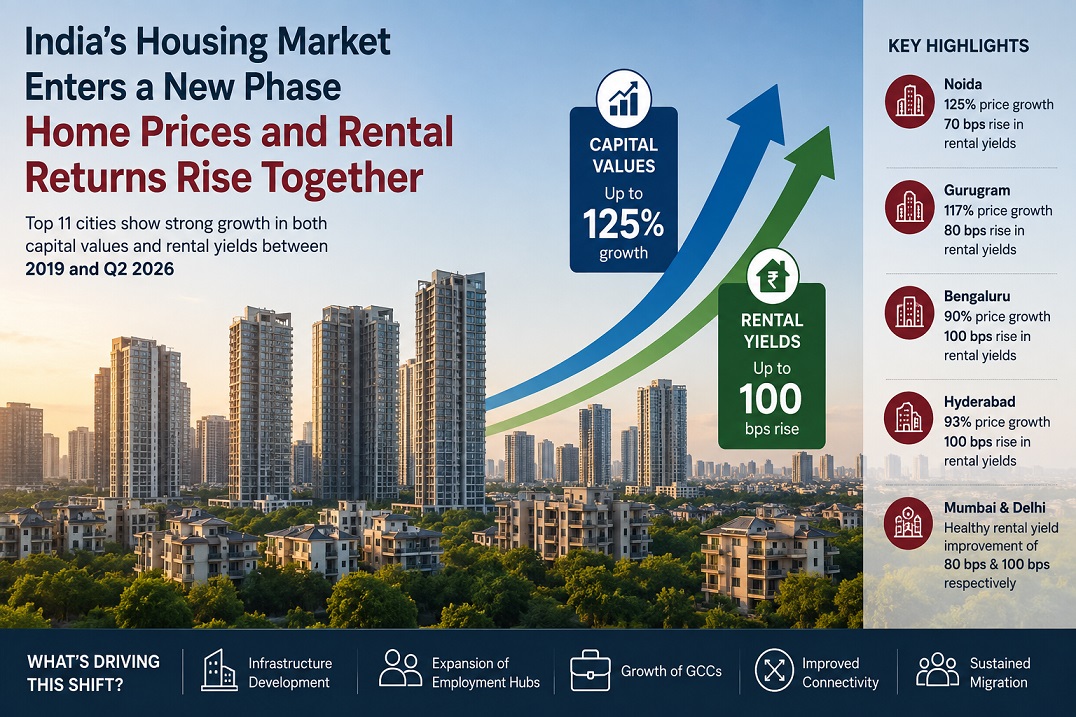
According to ANAROCK, the trend is being driven by a combination of infrastructure investments, expanding employment hubs, improved connectivity and continued migration into India's major cities. Better transport infrastructure has widened residential catchments around commercial districts, enabling new micro-markets to emerge as both residential and investment destinations. The report notes that economic growth fuels employment, employment attracts migration, migration supports rental demand and sustained housing demand ultimately drives capital appreciation, creating a reinforcing cycle for residential real estate.

Commenting on the findings, Ashok Singh Jaunapuria, MD & CEO, SS Group, said, "The report brings forth an interesting trend in the evolution of India's residential real estate sector. For many years, investments in real estate in the country were based on capital appreciation returns. However, today, markets like New Gurugram show how capital appreciation and good rental demand can co-exist successfully. It is indicative of the city's solid economic fundamentals, presence of companies and infrastructure development, which have been attracting more professionals and families into the city. With an increasing number of people moving to Gurugram, the demand for quality homes continues to sustain itself and help support end-user transactions as well as rentals.
Infrastructure projects like the Dwarka Expressway, Southern Peripheral Road, the upcoming Gurugram-Rewari Highway and the Delhi-Gurugram-SNB-Alwar RRTS would further strengthen the connectivity advantage of New Gurugram. For investors, it represents a chance to earn through capital appreciation and rental income as well."
The findings indicate that residential real estate is increasingly evolving from a single-return investment into a dual-income asset class. For homebuyers, it reflects stronger market fundamentals driven by genuine housing demand. For investors, it suggests that India's leading residential markets are now capable of generating both long-term capital appreciation and healthier rental cash flows—a combination that has become increasingly rare across traditional investment avenues.