

Balancing Airport Height Norms with Urban Growth
- Ministry of Civil Aviation has launched a pan-India study with the International Civil Aviation Organization to review building height restrictions near airports.
- Existing regulations by the Airports Authority of India impose strict height caps, 150m no-construction zones, and mandatory NOCs across 165+ airports.
- Major metros such as Mumbai, Hyderabad, Kolkata, and Chennai are significantly affected, restricting vertical urban expansion.
- Key projects like Navi Mumbai International Airport and Noida International Airport are fueling large-scale real estate and economic growth.
- The study aims to balance aviation safety with sustainable urban development, enabling responsible vertical growth while enhancing environmental quality and overall well-being.
The Union Civil Aviation Ministry has taken up a survey across the country to find solutions for the problem of restrictions on the height of buildings near airports and to work out a balance between cities' growth and aviation safety. Union Civil Aviation Minister K Ram Mohan Naidu revealed the step during the National Urban and Real Estate Development Conclave 2026 held in New Delhi on February 13.
“We have engaged the International Civil Aviation Organization and are conducting a nationwide study, across existing and future cities, to develop technological advancements and appropriate regulations that enable safe air travel, and cities can also grow," Naidu said as per HT.
What Are the Building Height Restrictions Near Airports in India Presently?
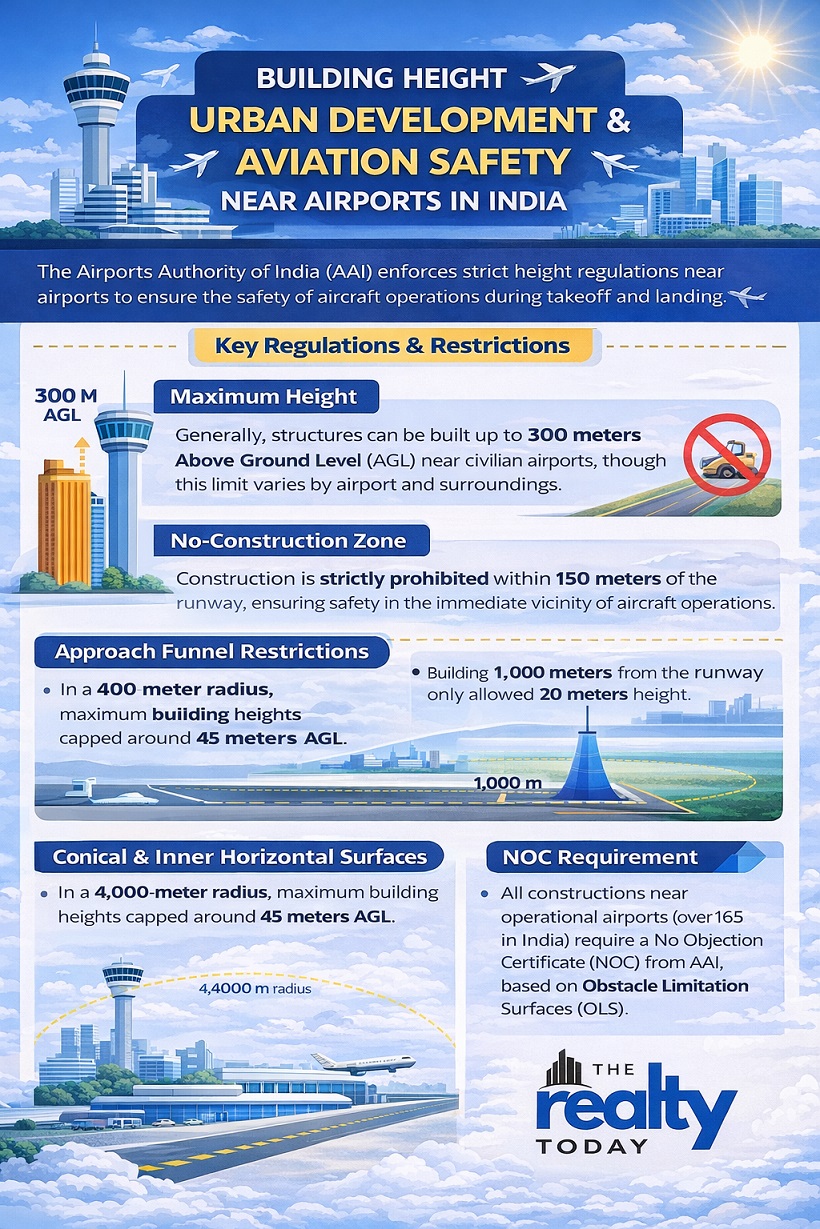
Building height regulations near airports in India are strictly monitored by the Airports Authority of India (AAI) to ensure the safety of aircraft operations. These rules are designed to prevent obstructions in flight paths, particularly during takeoff and landing.
Key Regulations and Restrictions
- Maximum Height: Generally, structures can be built up to 300 meters Above Ground Level (AGL) near civilian airports, though this limit varies depending on the specific airport and its surroundings.
- No-Construction Zone: Construction is strictly prohibited within 150 meters of the runway, ensuring safety in the immediate vicinity of aircraft operations.
- Approach Funnel Restrictions: Buildings in the direct approach path are subject to highly restrictive height limits, often following a 2% gradient rule. For example, a building 1,000 meters from the runway may be allowed a height of only 20 meters.
- Conical and Inner Horizontal Surfaces: In the surrounding inner horizontal surface, usually a 4,000-meter radius from the airport, maximum building heights are capped around 45 meters AGL.
- NOC Requirement: All constructions near operational airports (over 165 in India) require a No Objection Certificate (NOC) from AAI, based on Obstacle Limitation Surfaces (OLS).
The minister pointed out that the study would look into not only the current urban areas but also the future cities, thus maintaining a holistic approach that integrates safe air travel and sustainable urban development.
The reason behind the study
India's civil aviation industry is witnessing a steep rise, however, the development of cities around the airports is still very limited due to the enforcement of very strict height regulations. Localities like Mumbai, Hyderabad, Kolkata, and Chennai are among those heavily impacted, where these norms not only delay the growth of the real estate sector but also disallow the city to go up vertically.
“The civil aviation sector is growing continuously, but the challenge is the height restrictions on buildings around airports, especially in metros like Mumbai, Hyderabad, Kolkata, and Chennai,” Naidu said.
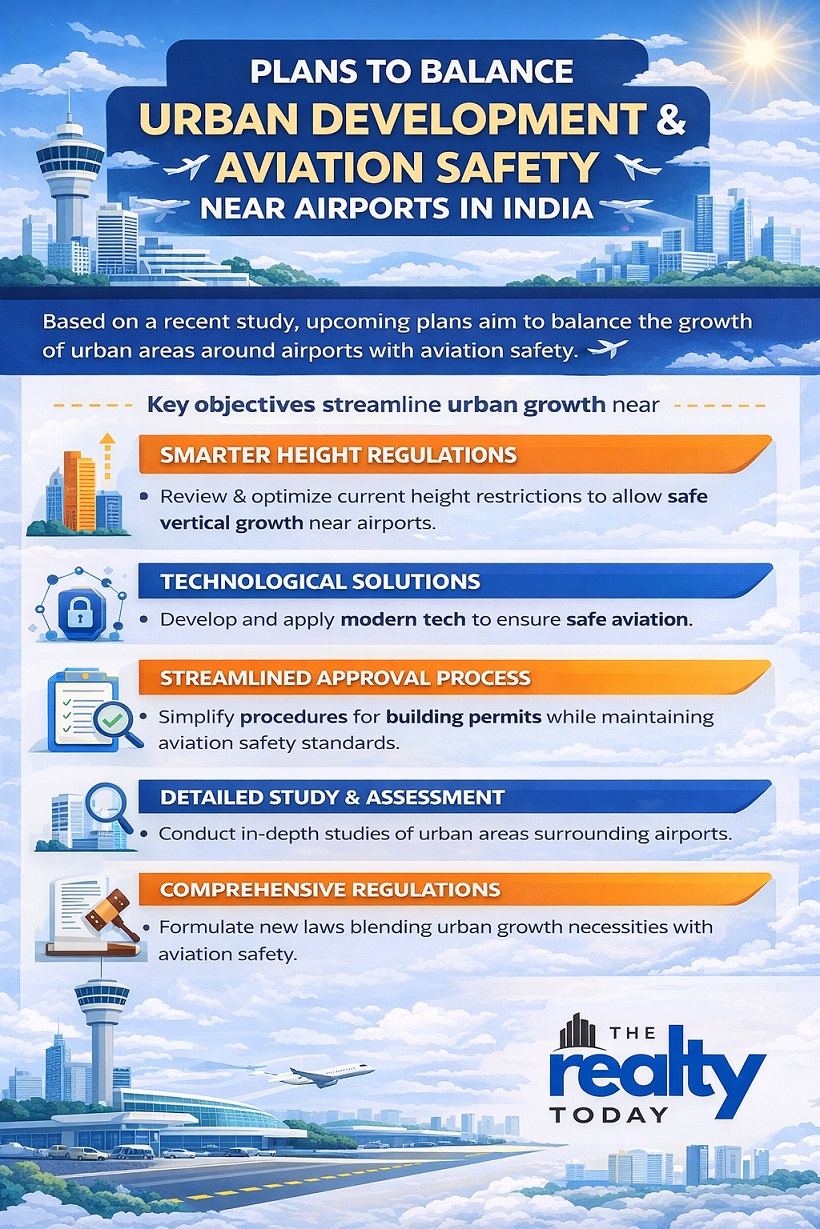
To tackle this, a team of experts is visiting all major cities to study aviation operations, urban landscapes, and technological interventions. The insights gained will form the basis of a detailed report, recommending solutions that maintain aviation safety while allowing cities to grow vertically where feasible.
Some key aspects of the study include:
- Evaluating both existing and planned urban areas near airports.
- Studying technological solutions that ensure aviation safety.
- Providing regulatory recommendations for safe vertical growth.
“Once the report is ready, efforts would be undertaken to create an environment that allows the infrastructure to grow in all these urban cities. I am actively working on a solution for this area,” the minister said.
Airports as Catalysts for Urban Development
Naidu highlighted the transformative role airports play beyond transportation. He described them as “scaffolding” for surrounding urban growth, driving economic and infrastructural activity.
- Navi Mumbai International Airport is expected to catalyze nearly 25 million square meters of residential, commercial, and logistics development.
- Noida International Airport has already triggered an eight- to tenfold increase in real estate activity in nearby areas, even before commencing operations.
“This is why I say that the airports are not only just mere transit hubs, they are dynamic engines for economic activity and urban development," Naidu observed.
A single airport influences multiple sectors:
Real estate and urban infrastructure
- Tourism and hospitality
- Trade and commerce
- Healthcare and education
Such influence positions airports as critical drivers of economic growth for entire cities and regions.
Focusing on Quality and Well-Being
While structural growth is important, the minister stressed prioritizing the quality of life.
“The need of the hour is to focus on the quality of life alongside living standards in real estate development. Through this, we will be creating well-being," he said.
Modern homebuyers are increasingly concerned with environmental and lifestyle factors rather than merely the square footage of their homes.
“When I speak to young home buyers, they are no longer talking about the square footage of the home they want to own. They are talking about air quality,” Naidu added.
Luxury today is defined not just by imported materials or lavish interiors but by the overall environment around residential and commercial spaces.
Key takeaways on quality of living:
- Focus on air quality and environmental sustainability.
- Promote well-being, not just assets.
- Redefine luxury through lifestyle and surroundings.
“Focusing only on standards results in merely creating assets. But if we are focusing on quality, we are creating well-being. And that is why it is important that all of us focus on the standard of living also with quality of living. And Viksit Bharat must be about well-being at scale,” Naidu remarked.
Looking Ahead
India is presently endowed with 165 operational airports, and a fresh airport or terminal is scheduled to open approximately every 33 days. The examination of the height restrictions forms an integral part of the comprehensive move aiming to bring the urban planning and civil aviation sector expansion in the same direction.
The research intends to utilize the mix of technological solutions, regulatory reforms, and urban planning strategies. The ambition is to build urban settings which are safe, lively, and economically thriving. Ensuring aviation safety while accommodating urban growth will be conducive to economic development as well as an enhancement of the life quality.
As pan India research is progressing, the locales adjacent to the airports might shortly experience the next stage of their development, where aviation and urban growth will go together. Through environmentally and socially sound urban development, India is getting ready to tap the entire economic, social, and environmental advantages of its fast, rising civil aviation sector.






.png)