

India's construction, manufacturing, real estate, and infrastructure sectors are governed by numerous rules of government and require many government department approvals before actually undertaking any construction. Depending upon the type of the construction work, project developers may be required to obtain permissions in what comes next manner from various bodies:
- Urban local bodies, development authorities
- Pollution control boards, fire departments, airport authorities
- Environmental agencies, electricity distribution companies, water supply authorities, labour departments
- Other statutory organizations
In the past, getting all these clearances used to entail submitting separate applications to various departments, which not only made processing very slow but also resulted in duplicate documentation, lack of uniform procedures, and unpredictability in the schedules of the projects. These delays had negative effects on project costs, investment confidence, and the country's overall business-friendly environment. To tackle this problem, the Indian Government with the State Governments have initiated what is called as the Single Window Clearance Systems (SWCS).
Concept of a Single Window Clearance System in India
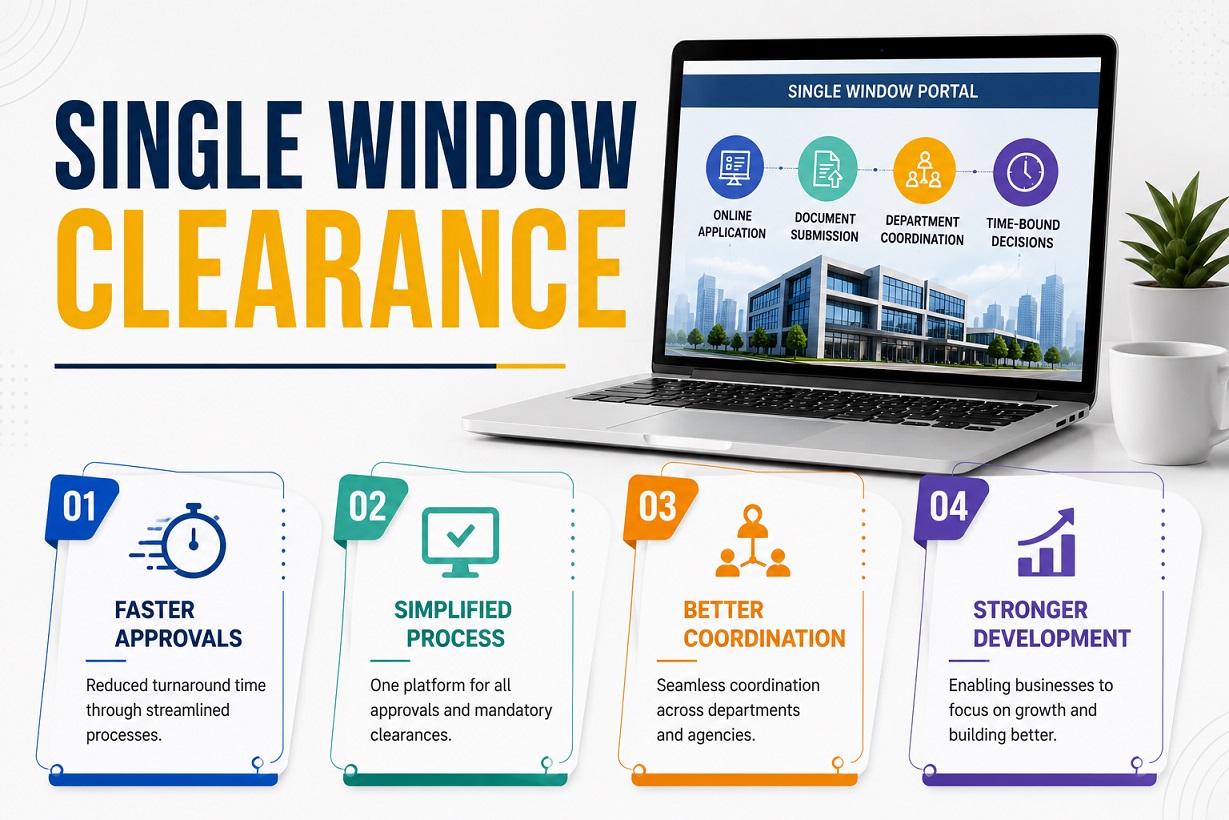
Single Window Clearance System brings a single online platform where businesses and builders can apply for various licenses and permits from different government departments at one go. By this means, applicants have to only fill the form once, after which the portal sends it around for the departments dealing with each part of the issue.
The concept has got rid neither of the requirements for the licenses nor of the inspections by the departments. On the contrary, departments can work simultaneously without any hindrance to the whole process of approval by way of integration of the process only and the right for the department to independently assess the applications under the laws regulating the matter has remained intact.
Almost all the Indian states now have a system of Single Window Clearance in place that they employ as another factor in the industrial investment and also administrative efficiency.
Single Window Clearance in India has a rich history
The Indian government introduced the concept of Single Window Clearance mainly to help industrial development and simplify the regulatory procedures. This move became more and more widespread due to the economic liberalization and continues to be reinforced by such programmes as the Ease of Doing Business, the Digital India, the Make in India, and the National Single Window System (NSWS) launched by the Government of India.
By connecting the different ministries and departments of the central government to the respective state portals, the National Single Window System aims to provide a convenient one-stop access facility and service for all the investors from information search and form submission to approval tracking stages.
Many states like Gujarat, Telangana, Karnataka, Maharashtra, Tamil Nadu, Andhra Pradesh, Uttar Pradesh, Odisha, and Rajasthan have developed state-of-the-art single window systems at the level of states in keeping with their industrial policies.
Approvals Typically Covered
Depending on the state and project type, Single Window Clearance Systems may include approvals related to:
- Industrial land allotment
- Building plan approvals
- Factory licence registration
- Environmental clearance
- Consent to Establish from Pollution Control Boards
- Fire safety approval
- Water supply connection
- Sewerage connection
- Electricity connection
- Groundwater extraction permission
- Labour registrations
- Boilers inspection
- Hazardous waste authorization
- Trade licences
- Occupancy certificates
- Incentive applications under state industrial policies
The exact approvals available differ from one state to another.
How the System Works?
To begin, those seeking to invest or launch businesses can register with the online portal and set up their project profiles by entering all the necessary project details, investment amount, location, employment figures, description of land, and relevant technical data.

The information provided will help the system identify which kind of approvals are needed and the application will be sent automatically by e-mail to the departments that have a stake in the matter.

Every department looks into the case separately, asks questions if they need additional information, and maintains contact with the person who submitted the application via the portal.

When all the statutory requirements have been fulfilled, it will be announced by the authorities that the approvals have been granted and applicants will be able to trace the progress through the internet. No visiting the government offices multiple times will be necessary.
Perks for India's Construction and Infrastructure Industry
Speedy Project Clearances
The greatest benefit in using Single Window systems is that they shorten delays in the process of paperworks by the administrative department(s). Working side by side with different departments saves considerable time for getting all permissions done in total contrast to the conventional and time-consuming way of going through a list of different departments one-by-one offline.
This is just the way it will be after the planning phase and the implementation phase starts.
More Openness
Beside seeing the progress of their case, applicants can get alerts, learn which departments are yet to give their green light, and reply online when a particular department has a question.
Such openness will reduce uncertainty at the stage of getting permission for the project.
Less Paperwork
If we submit documents digitally, then we can get rid of filing identical documents many times for physical filing in front of different departments.
Storing, finding, and retrieving documents get even easier when we digitize them.
Better Environment for Business
Streamlined approval mechanisms not only motivate homegrown businesses to invest in India but also attract international investors because they make investment easier through the elimination of a lot of bureaucratic paperwork and processes.
Digital transformation of the regulatory processes has been one of the initiatives that have led to the upgrading and improvement of India's business environment in recent times.
Lower Project Expenses
Due to the high cost of finance, the mobilization cost of the contractors or any other delay in the production of materials, the cost of inflation in raw construction materials or the revenue generation delay from the project approval, the cost of the project goes A lot up due to a delay period of approval.
Approval speed up brings to an end a lot of the negative financial effects from a delay.
Success Stories of Different Indian States
A number of Indian states are reaping visible benefits from their well-organized Single Window system.
Telangana
Telangana introduced the Telangana State Industrial Project Approval and Self-Certification System (TS-iPASS) to provide time-bound approvals backed by legislation. The platform streamlined the approval process through a single application mechanism and self-certification provisions, significantly reducing delays. TS-iPASS has played an important role in attracting investments across pharmaceuticals, electronics, food processing, and manufacturing sectors.
Gujarat
Gujarat has long been recognized for its efficient investor facilitation framework, integrating approvals from multiple government departments through a Single Window mechanism. The system has simplified the process of obtaining industrial permits, reduced administrative delays, and supported investment in sectors such as chemicals, automobiles, engineering, textiles, and renewable energy.
Karnataka
Karnataka has strengthened its investment climate through digital approval initiatives such as Karnataka Udyog Mitra and the state's Single Window Clearance platform. The online system enables investors to obtain approvals from multiple departments through a common portal, improving transparency and reducing processing time. These initiatives have encouraged investments in manufacturing, information technology, biotechnology, aerospace, electronics, and startup-driven industries.
Andhra Pradesh
Andhra Pradesh implemented its Single Desk Portal to provide investors with a unified digital platform for obtaining approvals from various government departments. The portal offers time-bound clearances, online application tracking, and simplified documentation, helping attract investments in manufacturing, logistics, renewable energy, electronics, and food processing.
Tamil Nadu
Tamil Nadu operates a comprehensive Single Window Clearance System through Guidance Tamil Nadu, enabling investors to secure approvals from multiple departments on a single platform. The initiative has improved the ease of doing business by reducing approval timelines and has supported investments in automobiles, electric vehicles, electronics, textiles, aerospace, and data centres.
Maharashtra
Maharashtra's MAITRI (Maharashtra Industry, Trade and Investment Facilitation Cell) portal serves as an integrated Single Window platform for industrial approvals. It allows investors to apply for multiple clearances online, track application status, and receive approvals digitally. The system has facilitated investments across manufacturing, infrastructure, logistics, information technology, and financial services.
Challenges That Still Exist
- And with considerable development, some practical obstacles are still there.
- Partial Integration
- Manual Scrutiny
- Variations Between States
- Coordination Problems
- Infrastructure Problems
- Capacity of Government Departments
Has the National Single Window System Solved the Problem?
The National Single Window System has made a major leap by consolidating the various Central Government ministries to approve an application and also include the State Governments participating services.
Through all these developments the system is still in its developmental stage. The complete synchronization of all the states, departments, and local bodies has not yet been materialized. Lots of local government approvals, municipality services, and utility clearance continue functioning separately.
Expansion of departments will definitely lead to making the system more efficient in time.
Technologies Enhancing One Stop Services
Modern clearance systems are increasingly equipped with digitization tools through the use of:
- Geographical Information Systems (GIS)
- Digital signatures are used
- Managing documents electronically
- Paying Fees Online
- Workflow automated management
- Monitoring dashboard
- Alerts via SMS and EMail
- Link with land records data
- Building plan scrutiny software
- Storage of documents on cloud
Do These One-Stop Shop Permit Approvals Work?
The answer is "yes," though to a different degree in the various states of India.
When the departments of the government are fully interconnected, there's a clear definition of processing timelines and digital flows are executed in a satisfactory manner. Single Window Clearance Systems have made things more transparent, the amount of paper work has been Quite a bit reduced and regulatory procedures have been streamlined.
Yet, in places, where some clearances are not digitized, or where manual processing is still necessary, the potential benefits are not fully exploited. Differences in how systems are implemented, availability of personnel and level of coordination are factors that contribute to Really the quality of service may A lot differ from a state in the north to a town in the south.
Meaning while the availability of a digital tool is part of the answer, the main factors that will determine the success of these systems are the operational skills of the staff, the degree to which the departments coordinate with each other and the extent of implementation of timelines prescribed.
The Way Forward
To extract the maximum advantage from Single Window Clearance Systems in India, what comes next key improvements need to be done:
- Incorporate all the Central, State, and local approval authorities as one single platform.
- Make the application formats standard and ensure that all documents that need to be filed during the clearance procedure are consistent across the states.
- Grow land use verification based on GIS (Geographic Information System) and digital scrutiny of building plans.
- Use automated methods for everyday compliance checks wherever possible.
- Interdepartmental cooperation can be better achieved through data sharing done safely.
- Rather clearly prescribe and strictly enforce legally the different time periods for obtaining various approvals.
- Equip the different regulatory agencies with well-trained technical people.
- Hold a number of training programs for government workers as well as for people who apply for licenses.
Ensure the integrity and confidentiality of the digital platforms through measures like better cyber security and protection of data.
Conclusion
The launch of Single Window Clearance Systems has provided a big leap forward for Indian authorities as they strive to streamline operations and enhance the business environment to lure investment into construction, manufacturing, and infrastructure sectors.
Plus cutting the volume of physical documents down and making the process easier to follow for all concerned parties, these platforms allow the applicants to reach the authorities responsible for different licenses via one digital channel. Despite their shortcomings in addressing the whole gamut of issues that might appear during the project execution phase and also not fully covering certain aspects of the regulatory system, these systems are a major advancement from the past procedures and are going to lead the way in streamlining the clearance processes.
As India's plans for the modernisation of physical infrastructure and heavy industry become clearer and demand the delivery of big-scale projects more rapidly than ever, having an efficient Single Window Clearance System will stand out as a vital factor for the timely realisation of new developments and long-term economic gains.