
As per Vestian report, India’s urban economy has undergone a significant transformation over the past decade, driving the growth of office markets in major metropolitan cities. However, the soaring demand for both commercial and residential assets has intensified pressure on urban capacity in these cities. As a result, Tier-2 cities are rapidly emerging as the next frontier for scalable growth, offering businesses the opportunity to expand operations while maintaining efficiency and sustainability.
Flex Spaces Expand to Emerging High-Growth Urban Corridors
Capitalising on the growing allure of Tier-2 cities, flex operators are consistently expanding. As per Vestian’s latest report, Tier 2 cities accounted for over 575 centres and 8.8 Mn sq ft of flex stock, representing nearly 29% of the nation’s total flex centers and over 9% of pan-India flex stock.
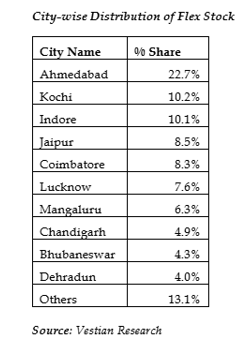
Note: Others include Vadodara, Surat, Trivandrum, Vizag, Guwahati, Goa, Kozhikode
Data as of February 2026
Flex Spaces in Non-metro Cities Provide Cost Arbitrage, Attracting GCCs
Beyond offering agile and scalable workspace solutions, flex spaces in Tier-2 cities deliver cost arbitrage of up to 50% compared to the metropolitan cities. Driven primarily by the IT-ITeS sector, followed by Consulting Services, BFSI, and Engineering & Manufacturing sectors, more than 200 companies have already established over 300 GCC bases across major Tier-2 cities.
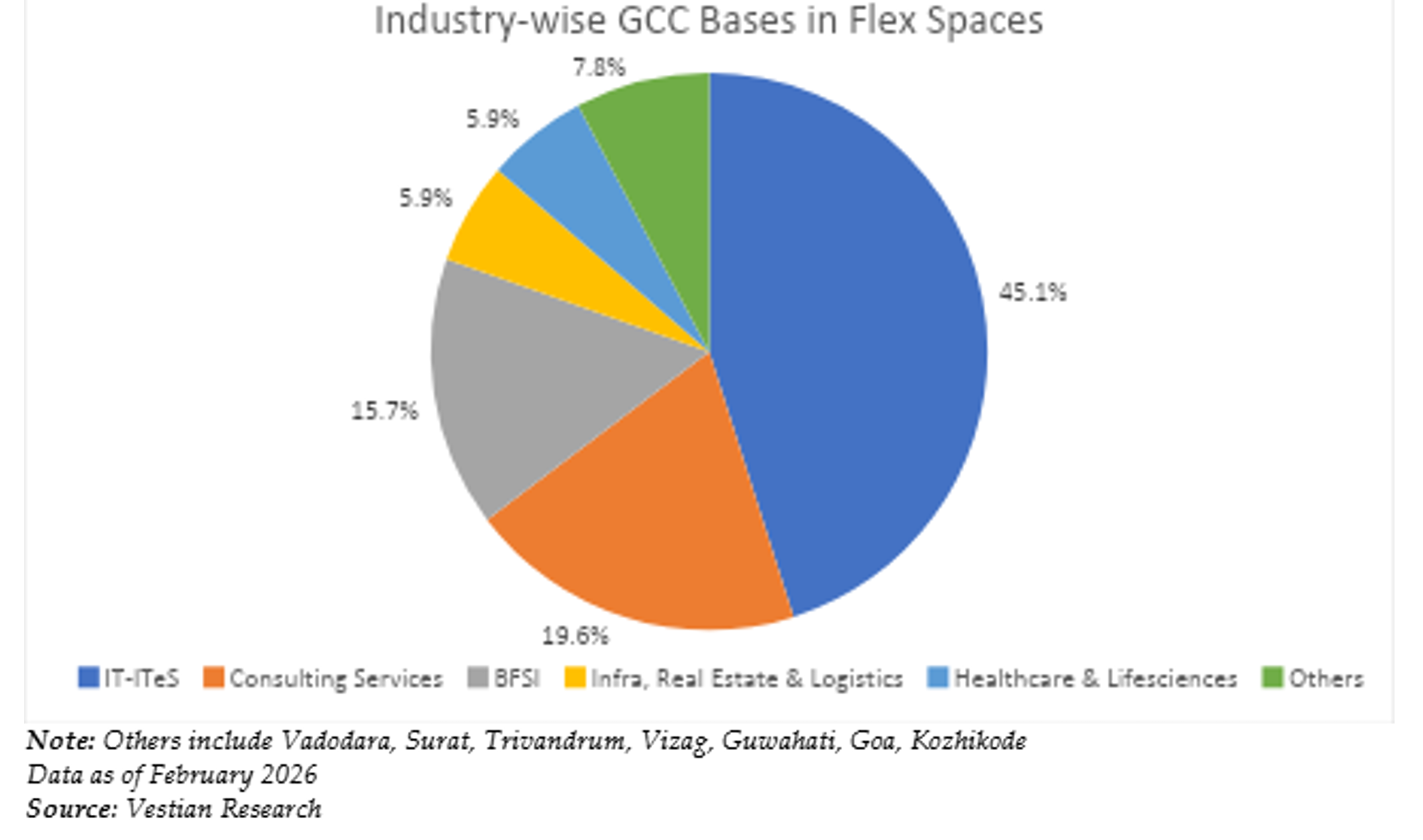
Note: Others include FMCG/FMCD, Engineering & Manufacturing, Chemicals & Petrochemicals
Data as of February 2026
Furthermore, the report also stated that nearly 9% of flex centres in Tier-2 cities cater to GCC-led operations, while 16% of GCC bases in these markets operate from flexible workspaces, indicating that even though GCCs are not the major demand driver for flex spaces, flex spaces have emerged as a preferred workspace option for several GCC companies.
Demand for Enterprise-Grade, Sustainable Office Spaces to Increase in Tier-2 Cities
Unlike metro cities, only 60% of flex centres in Tier-2 cities are located in dedicated office buildings, with just 26% situated in Grade-A assets. Over 53% of flex centres occupied by GCCs in these cities are situated within Grade-A buildings, and 19% operate from green-certified spaces. This reflects higher-quality and ESG-aligned real estate assets is now the primary catalyst for Tier-2 office market growth.
Shrinivas Rao, FRICS, CEO, Vestian, said: "The rise of Tier-2 cities is a defining shift in India's expansion strategy. As infrastructure improves and flex ecosystems mature, the decentralization of GCCs will become a cornerstone of the Viksit Bharat 2047 vision."






.png)