

The Stella Office Building located in Nagpur, Maharashtra is a living proof of a well, planned architecture that considers climate, context, and urban constraints. The project was finished in 2026 and the 14 storey commercial building presents a perfect harmony of sustainability, beauty, and efficient planning of the spaces. It was masterminded by Sanjay Puri Architects, who had a fresh take on the typically glass office buildings that are found in Indian cities particularly the ones that have scorching weather.
Project Overview
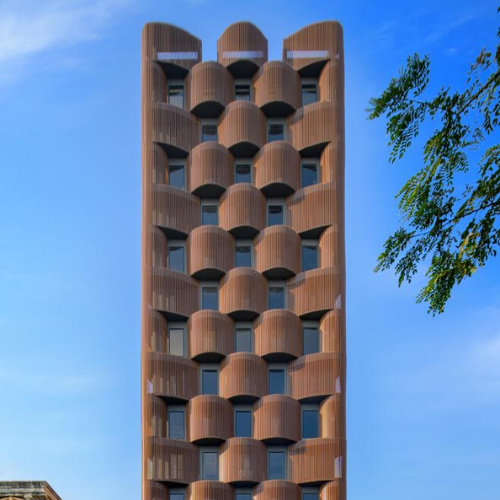
On a compact urban plot of around 836 square meters, the Stella Office Building hosts almost 5, 575 square meters of office space. Given the requirements for statutory open spaces and the small size of the site, the building was designed to rise vertically for 14 levels. Each floor is made up of four office units, thus allowing the building to be used by several tenants at the same time while making the most of the space.
The small footprint was not seen as a limitation but rather as a challenge that the designers took on by deciding to go up while at the same time keeping the environmental features of the building. The outcome is a slender and architecturally impressive building that makes the most of each square meter without giving up on the comfort and eco-friendliness of the space.
Responding to the harsh climate of Nagpur
Nagpur is listed among Indias hottest cities, with summer temperatures soaring up to 48 degrees Celsius. Under such weather conditions, fully glazed buildings usually encounter the problem of heat gain from the sun, thus turning to air conditioning more and more which leads to greater energy consumption.
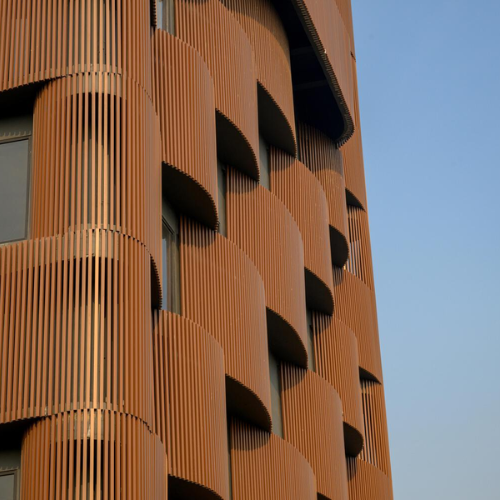
The Stella Office Building meets this issue with its layered, climate, responsive skin. The architects, instead of covering the whole building with glass, decided to wrap semicircular decks in aluminum louvers which were then introduced along the facade of the building. These curved projections are alternated from one floor to another thus providing not only depth but also shadow.
This faade solution allows the building to play several environmental roles at the same time:
- Reduces direct solar radiation
- Minimizes internal heat gain
- Creates shaded outdoor extensions
- Enhances airflow around the structure
- Improves thermal comfort within office spaces
By integrating passive cooling strategies, the building significantly reduces operational energy demands.
Creative Faade Concept
The projects envelope is one of those distinct features that set it apart. Half, moon, shaped balconies are fitted with planters, thus bringing nature to the different levels of the building. Besides serving as architectural elements, these green terraces also work as natural air conditioners by cooling the air that is funneled inside the spaces.
Sunlight is modulated by aluminum louvers which not only prevent glare but also allow an adequate amount of daylight. This interaction of light and shadow varies during the day, thus the building always looks different.
Whereas traditional office buildings mainly focus on transparency through glass faades, Stella is more of a contextual kind. The faade is far more than just an attractive surface. It is a efficient environmental component. Every detail in the design aimed at saving the environment.
Spatial Planning and Functional Efficiency
The interior arrangement is a reflection of the building's green plan. The service and circulation core is deliberately located on the east side of the building. Thus, the three facades, north, west, and south are left for the office areas and can therefore take advantage of natural light and air
Key spatial features include:
- Four office units per floor
- Larger offices positioned at the front and rear
- Access to outdoor decks for each office
- Cross ventilation through multiple exposures
- Flexible layouts adaptable to tenant needs
The alternating of typical floor plans between even and odd levels introduces diversity in the layout while still keeping the structural efficiency intact. This kind of smart planning allows offices to get indirect sunlight instead of the harsh direct exposure.
Mixing Greenery
Incorporation of plants and landscaping of decks is not just for beautification. In regions with hot weather, plants are very important for temperature control. The surrounding plants of the building help lower the surface heat, increase the air quality and make the working environment more attractive.
Also, the green terraces contribute to the occupants' wellbeing, providing them with a view and even the possibility of accessing semi-open spaces. Without leaving the building, the employees can go out into the shaded decks that are just in front of the windows and thus create a healthier and more attractive working environment.
Sustainability Through Passive Strategies
The Stella Office Building demonstrates that sustainability can be achieved through intelligent design rather than heavy dependence on advanced mechanical systems. Some of the passive strategies employed include:
- Shaded façade projections
- Filtered daylight penetration
- Cross ventilation planning
- Reduced glazing exposure
- Thermal buffering through green decks
By minimizing heat gain at the source, the building reduces cooling loads and lowers long-term energy consumption. This approach aligns with contemporary sustainable architecture principles while remaining grounded in local climatic realities.
Architectural identity and urban presence
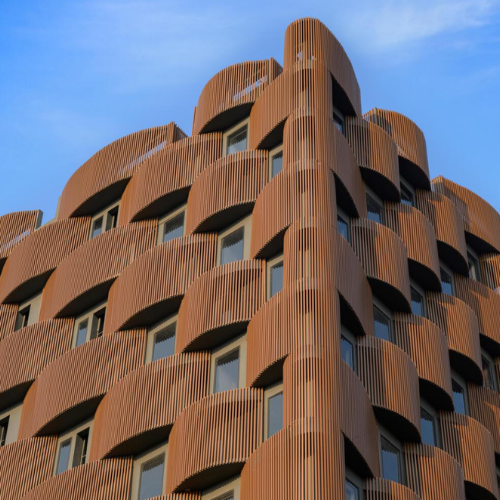
Meanwhile, besides its environment, friendly features, Stella makes a daring visual statement in Nagpur's cityscape. The undulating rhythm of half, circle, shaped elements literally brings the front to life. Diverse material palette featuring concrete, steel, aluminum louvers, and greenery creates a look that is both modern and sensitive to the climate.
It is the highly aesthetic building that forms a sharp contrast to the surrounding commercial developments. The structure communicates this idea and mission rather than just being the typical corporate box.
A Prototype for Future Commercial Architecture
Indications show that mega cities in India are going to continue to expand at a rapid pace. Correspondingly, office spaces that are environmentally friendly will be in greater demand. The Stella Office Building is a great showcase of what can be expected in terms of architecture for hot climate areas. It demonstrates that commercial edifices can be both striking aesthetically and responsible in terms of environment.
Pursuing the options of passive cooling, daylighting, and local adaptation, Sanjay Puri Architects, have made more than a conventional office building. They have proposed a climate, conscious, comfortable, and energy, reducing solution to a modern work environment. Stella Office Building is a fine example of how architecture can aid in the optimizations of limitations. At the same time, the building, through its innovative faade design, master planning, and sustainable concepts, serves as an archetype of climate, aware commercial architecture in India.



.png)