
Amidst Mumbai’s evolving cityscape, the Unscripted Pavilion by Abin Design Studio is a temporary architectural work that expresses the city’s complex and uncertain character through spatial design, using movement, disorder, and spontaneity to create a flowing experience instead of directly depicting the city.
Mumbai, Being Inspired by Its Chaotic Rhythm
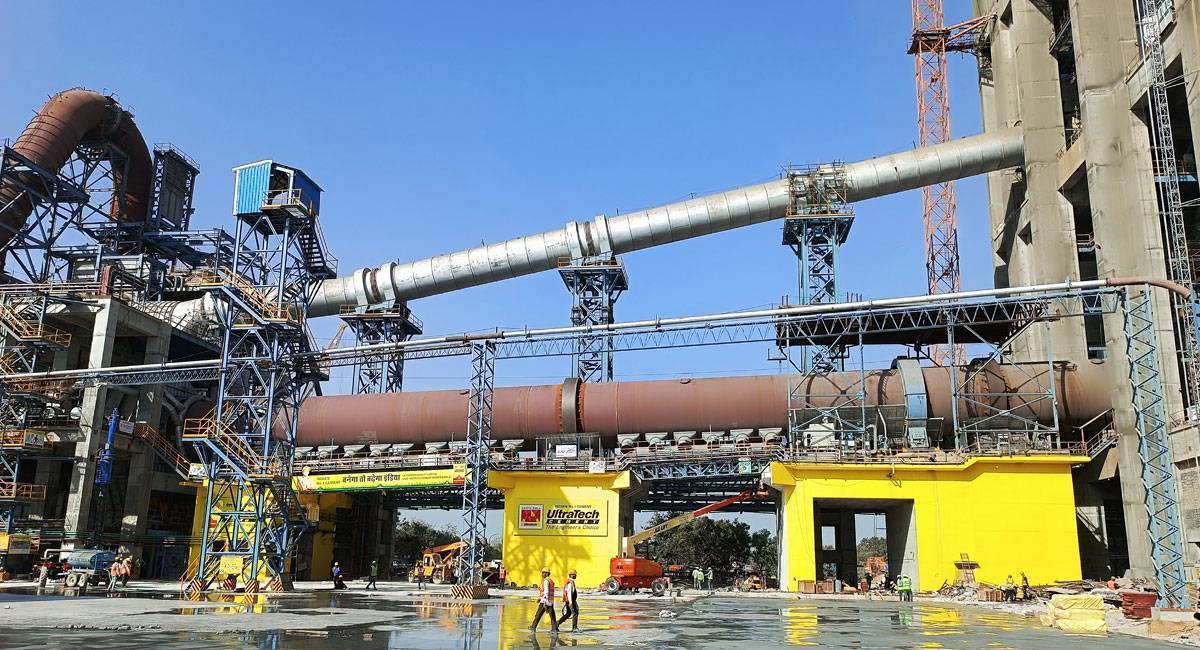
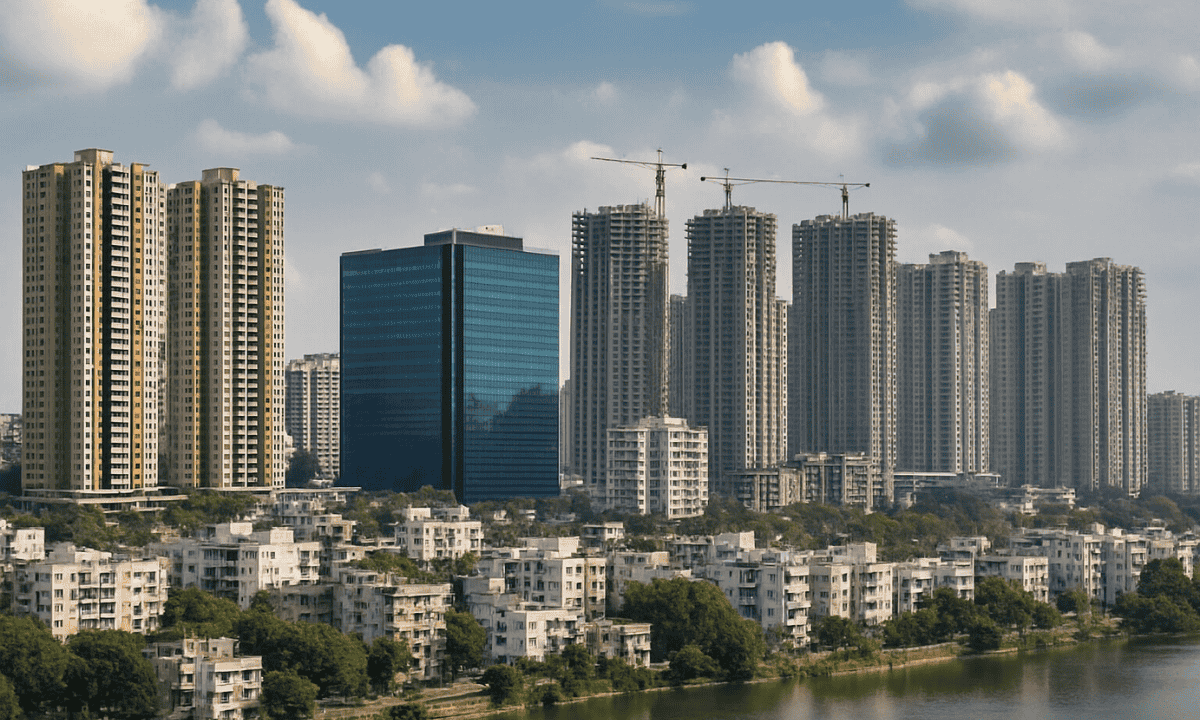
Mumbai is definitely a city on the move. There are indications of its continual movements all around. From people running on congested walkways, cars moving amidst the chaos, many things happening at once and more. Movements in the city are never basic or straightforward; in fact, they are based on spontaneity, pause and face-to-face encounters among many others. Such a scenario is the basis of the pavilion.
In place of creating a forced rhythm, there is an opportunity to explore the idea of spontaneity. The pavilion is a representation of the evolving urban life in Mumbai without a fixed story to tell. It is a record of the temporary things and evolving trends and it offers visitors an experience that can be interpreted by them.
A Grid Disrupted
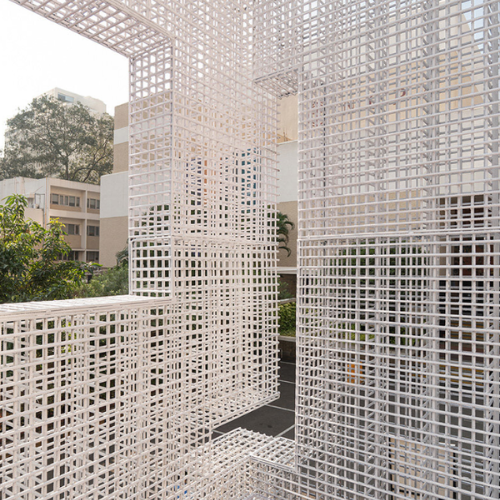
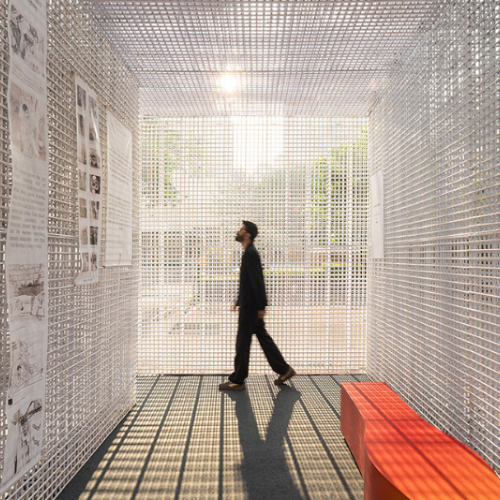
A geometric grid - a widely used tool that architects most often associate with order and rationality - is what a pavilion's centre is focused on. Nevertheless, this grid is not merely a passive object in the pavilion; it is a kind of architect's protagonist. In fact, the grid is rotated by 48 degrees, that is to say, it is 'disrupted' and 'introduced tension'. The resulting change in the space is so great, that people will feel it even if not consciously.
The altered geometry will also change the flow of movement - not in a way that simply leads to one destination, but it will instead stimulate one's curiosity and desire to probe the surroundings. People will be walking along the routes that are curving and changing, in the same way that the tracks one makes when walking through the streets of Mumbai are not simply straight lines. Moreover, the rotated grid serves as a sort of optical illusion: it makes one see things differently.
Besides, surfaces are inclined, lines cross at strangely thrown angles, and the whole appearance is more of a smudge than a defined clear outline. The fact that order and disorder are fighting for supremacy makes the whole scene an analogy for the city itself - where on the one hand there is a framework, but on the other hand it is always being changed by people's experiences and interactions.
Voids as Spatial Actors
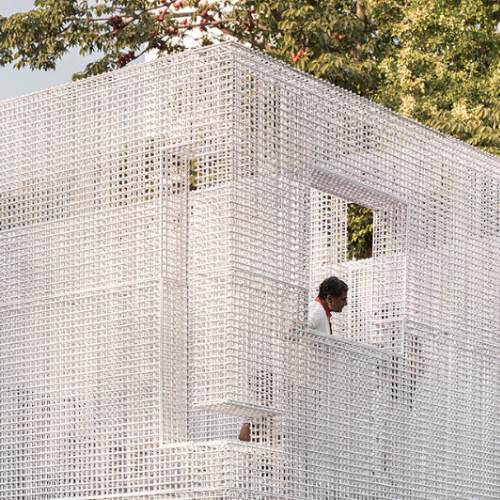
One of the defining aspects of the Unscripted Pavilion is the use of voids, deliberate holes made to the building. These voids are more than just empty spaces; they are energetic components that influence light, air circulation, and visual links. Locating the openings within the grid in a thoughtful manner, the pavilion allows the environment outside to infiltrate it. The sunlight penetrates through these openings and lights up the interiors with changing patterns. Besides, frame and refraction of the city views give rise to the moments of pausing in the otherwise accelerated spatial flow.
This method is in line with the concept that Rem Koolhaas touched upon in Elements of Architecture: walls and other architectural elements are not stiff boundaries but rather conditions that can change. In the pavilion, the surfaces are cut and broken up, which very well may be a metaphor for the fact that architecture could be made to be porous and changeable, rather than solid and everlasting.
Role Swapping Stage
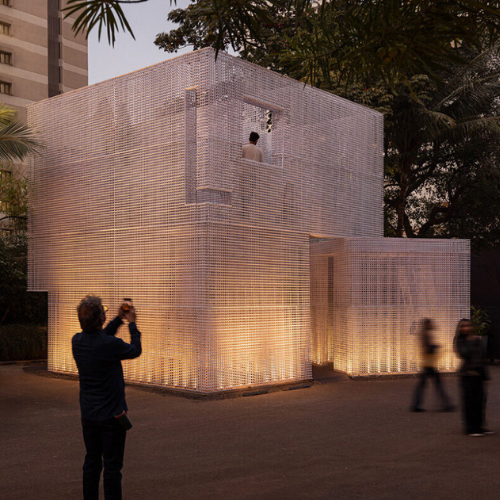
More than just formal elements, the pavilion also becomes a stage that plays out its role through performance. People who walk inside it become performers while they watch others, shifting from being observed to observers in the process.
The constant swapping of roles also reflects the reality of social life in Mumbai. The lives of people in this environment are characterized by their presence in multiple scenarios; they either observe or get observed.
There is no set program or defined activity here, nor does there need to be one. Activities could range anywhere from interaction to pausing to simply walking through.
Bringing Improvisation into Form
The distinguishing feature of the Unscripted Pavilion is its capacity to materialize something abstract, namely improvisation. The rotated grid, planes, and voids create a language of architecture that corresponds to the theme.
The Unscripted Pavilion does not reduce Mumbai's complexity to something easy to understand; rather, it acknowledges the complexity of the urban space by creating a dialogue between order and disruption.
The pavilion designed by Abin Design Studio becomes an example of how architecture is able not only to perform some practical purposes and be aesthetically pleasing but to also reflect on culture and city.
The Unscripted Pavilion becomes an intriguing attempt at studying the role of architecture in response to the immaterial aspects of urbanism. Using the patterns of life in Mumbai, the architects created a spatial experience that was simultaneously rigid and chaotic.
With its geometry, voids, and environment that invite action and observation, the pavilion defies any traditional sense of order and enclosure. Instead, it encourages people to act, watch, and understand the world around them, just as they would in the city. The project serves as an example of the power of temporary architecture in communicating complicated concepts through simple means.
Image- manansurti.wixsite.com