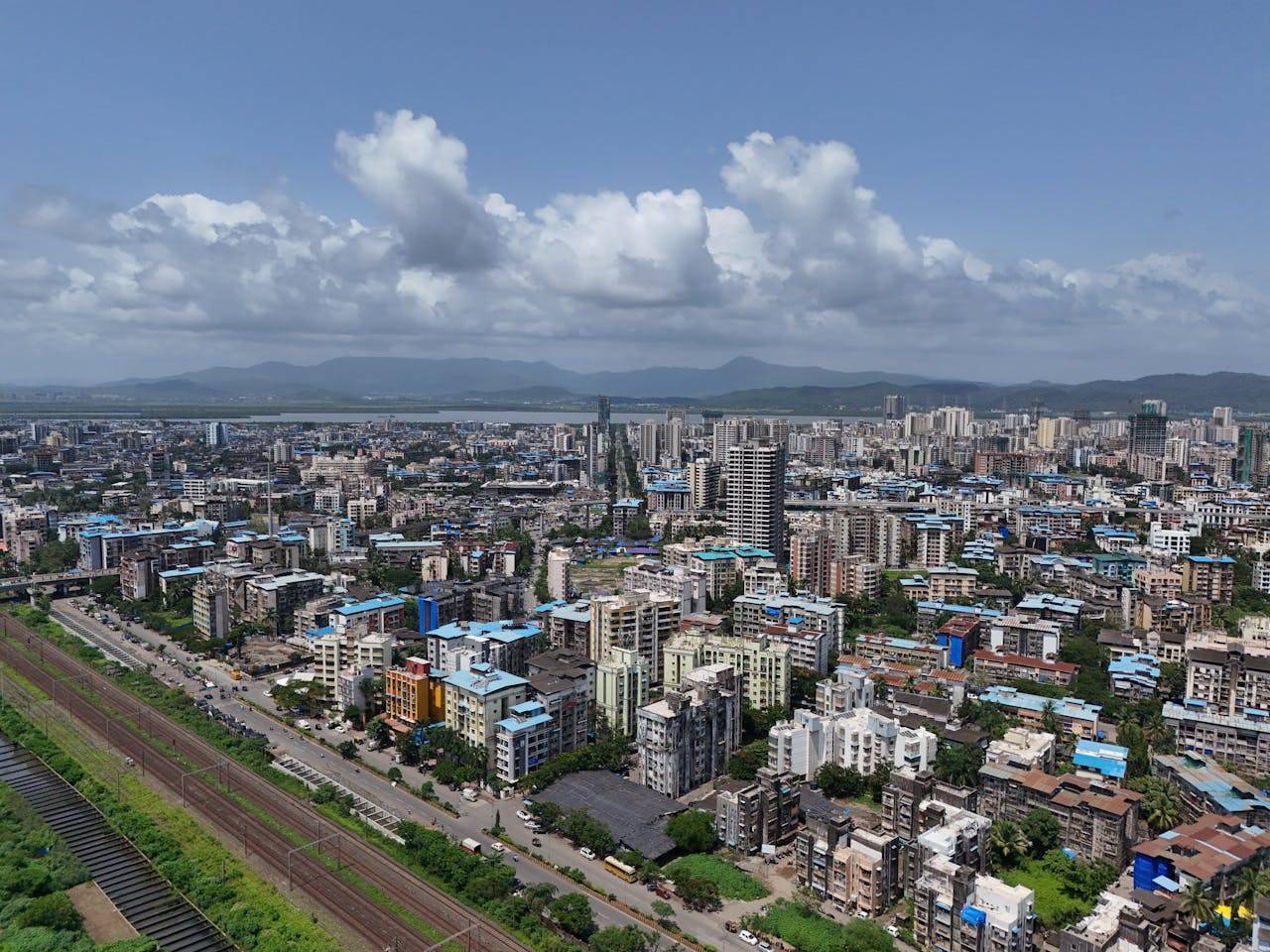
CIDCO has proposed a ₹16,250 crore budget for the fiscal year 2026-27, focusing on a futuristic budget, with a clear vision that focuses on infrastructure, airport-centric development, and housing in Navi Mumbai. It shows a clear-cut strategy aimed at making Navi Mumbai a globally competitive city while at the same time ensuring sustainable development in all sectors.
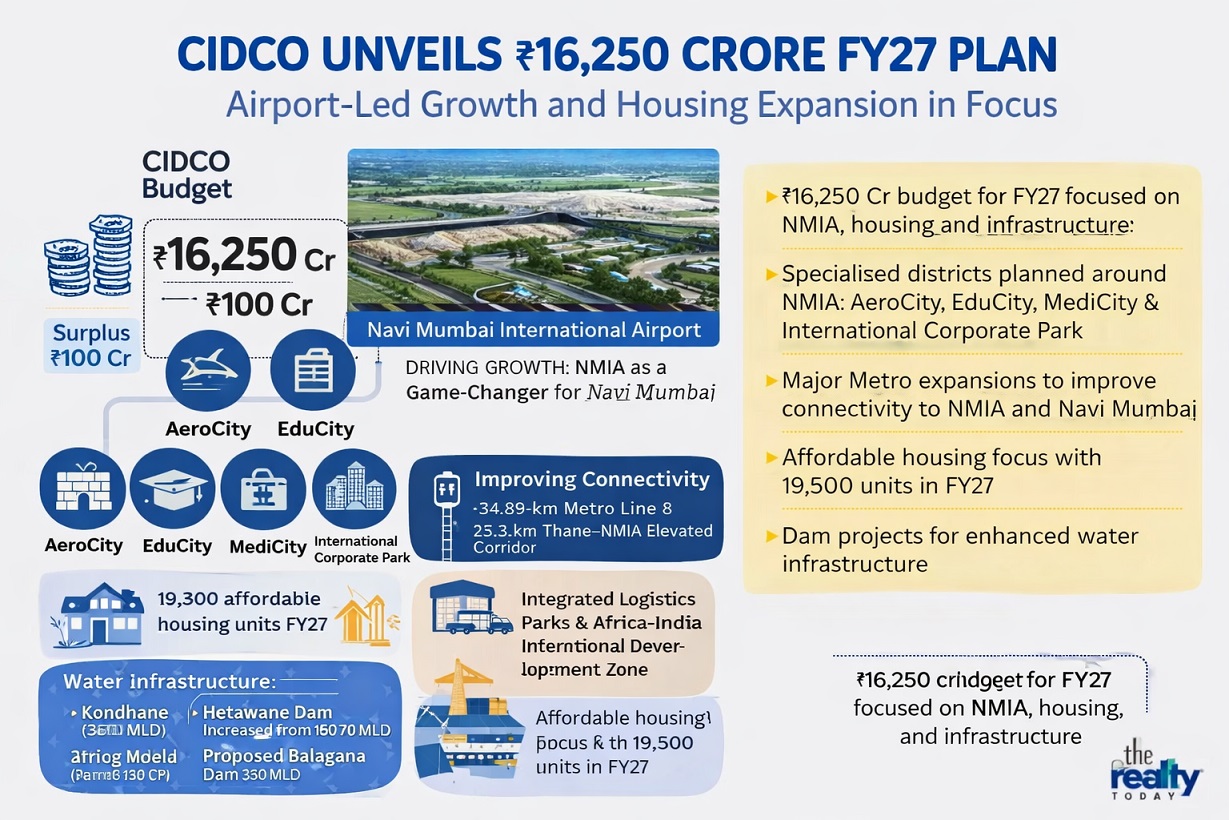
CIDCO’s financial position is expected to improve significantly. For FY 2026–27, the total income is estimated at ₹16,250 crore, which is slightly higher than the expected expenditure of ₹16,150 crore. This means there will be a surplus of about ₹100 crore. In comparison, the revised estimates for FY 2025–26 showed a much smaller surplus of only ₹3.97 crore, with receipts at ₹9,774.23 crore and expenditure at ₹9,770.26 crore. This improvement shows that CIDCO is becoming more capable of managing large infrastructure and urban development projects and handling its finances more efficiently.
The Navi Mumbai International Airport (NMIA) is the central piece to the growth strategy that CIDCO has planned. According to CIDCO, NMIA will be a game-changer which will bring new opportunities not just to the city but the entire region. The airport is going to be more than just a means of travelling from one place to another. It will be the core of a big economic environment around which everything will revolve. Through the implementation of the airport, a Parisian level investment will be made available, a pool of worldwide corporations will be brought in, and the various sectors of the economy will be stimulated to induce more production and use of not only commercial but also residential and industrial facilities."
To take advantage of this opportunity, CIDCO is mapping out the creation of several specialised districts surrounding the airport. Aerocity EduCity MediCity, and an International Corporate Park are among the options. Each one of these areas has a specific goal--from commercial development along the aviation industry to international education centers, healthcare facilities, and company headquarters. Combined, they intend to establish a mixed-use and self-sufficient urban setting that can go head to head with the major international cities.
Connectivity remains a key pillar supporting this vision. CIDCO is prioritising large-scale transport infrastructure to ensure seamless access to the airport and surrounding regions.
- The 34.89-km Metro Line 8 will connect NMIA with Mumbai’s existing international airport, with an expected daily ridership of nearly 9.8 lakh passengers by 2031.
- Additional metro corridors, including Line 1A (Belapur–NMIA) and Line 2 (Pendhar–NMIA), are also being planned to strengthen last-mile connectivity.
- The proposed 25.3-km Thane–NMIA elevated corridor, estimated at ₹6,521 crore, is expected to reduce travel time from 90 minutes to around 30 minutes, significantly improving regional accessibility.
Besides metro and road facility, CIDCO is at present working on 16 main projects in areas of Navi Mumbai, Panvel, and Uran. These projects are aimed at laying a strong urban skeleton that facilitates industrial development, logistics, and expansion of residential areas. For example, a 155-hectare International Corporate Park at Kharghar which could bring multinational companies and large-scale job creation is one of the major projects under discussion.
Another major initiative is the plan to build a 560-hectare Integrated Logistics Park between Jawaharlal Nehru Port Authority (JNPA) and NMIA. This project is well-located to improve supply chains and turn the area into a major logistics and warehousing hub. Besides this, CIDCO has also suggested the establishment of an AfricaIndia International Development Zone which is expected to serve as a venue for the trade, investment and cultural interchange between the two regions thereby increasing Navi Mumbai's global connectivity.
The development activities are also being ramped up in the Navi Mumbai Airport Influence Notified Area (NAINA), which covers around 225 square kilometres. Besides focusing on sustainable urbanisation, CIDCO is putting large sums of money into water infrastructure so that the supply can match the demand in the future.
- The Kondhane dam project with a capacity of 350 MLD is under development.
- The Hetawane dam is being augmented from 150 MLD to 270 MLD.
- A new Balganga dam with a capacity of 350 MLD is also proposed.
These projects are essential to ensure a reliable and long-term water supply for both residential and industrial growth, particularly as the region undergoes rapid urbanisation.
In the housing sector, CIDCO still gives housing a big priority. It mainly targets the demand for the affordable and mid-income segments. The authority is geared up to announce the launch of nearly 19,300 housing units in FY27. This is after getting a great response for the 16,876 units that were offered last year. These continuous housing efforts are a reflection of CIDCO's larger mission of fostering inclusive development as well as meeting the requirements of a growing population.
Besides infrastructure and housing, the development plan gives major weight to upgrading urban lifestyle and social infrastructure. Planned initiatives are a 20,000 seat international-level indoor arena, enlarging the Kharghar Valley Golf Course into an 18-hole championship course, and building Unity Mall. It is expected that these will improve the quality of life, bring more tourism, and make the city a good place for both work and fun.
The FY27 plan of CIDCO offers a detailed and holistic outline for city development. Through pairing focused infrastructure provisioning, broadening of economic sectors, and housing boost alongside the major development of the Navi Mumbai International Airport, the authority is preparing the foundation for the extensive growth of the area. Additionally, the plan fortifies Navi Mumbai's status within the Mumbai Metropolitan Region and simultaneously prepares the area for its rise as a world-renowned center for business, residential area, and technological advancement.



.png)