

Real estate investment carries various kinds of risks such as variations in property prices, variations in rental demand, vacancy variations, interest rate variations, construction delay and change in regulations. The risks are usually recognized through research of the market, financial modeling, inspection of the properties and data on transactions that have taken place in the past. However, there are certain risks and changes in the market that might not be possible to identify and predict. Machine learning (ML) technology has started being used to solve the problem of analyzing risks associated with real estate investments through data.
Application of Machine Learning in Real Estate Investment
Machine learning is a subset of artificial intelligence whereby computers are enabled to make predictions based on data patterns without being explicitly programmed to do so. In the case of real estate investments, there are numerous variables that affect the performance of assets.
A machine learning model can make predictions about a property by taking into consideration many factors including the location, the acquisition cost, the revenue from rentals, occupancy rate, the presence of amenities, the rate of population growth and more. It can also indicate the red flags like low rental demand, overvaluation of the property and increased risk of project delay.
As opposed to spreadsheet analyses, ML models can handle large amounts of data both structured and unstructured. Moreover, their predictions can be updated based on newly acquired information.
Key Applications of Machine Learning in Real Estate Risk Assessment
Property Valuation and Risk Market Analysis
Overvaluing properties is one challenge faced by property investors. Machine learning models are capable of analyzing past sale prices, the features of properties, location, neighborhood growth, and prevailing market condition in order to value the property.
Using regression models such as random forest and gradient boosting makes it possible to observe correlations between the features of the property and the market price. One can therefore evaluate the asking prices of properties against their market value in order to ascertain whether the property is being overvalued.
The buyer of commercial property that wants to invest in a certain asset can use data on past sales price, changes in occupancy of offices in the region, and infrastructure growth in order to ascertain whether the asking price is realistic.
Forecasting Rental Income and Vacancy Risks
Rental income is an indicator that affects the financial results of residential and commercial properties' assets. The information related to employment, tenant demand, business activity, and new local development will affect the amount of rental income and occupancy.
Machine Learning algorithms can help to analyze past rentals, tenant turnover, vacancy history, location demand, and economic information in order to predict future rental results. Models for time series analysis can be applied to reveal trends and seasonality in rental demand.
The projections are helpful for investors to evaluate the risks of rental income loss, long-term vacancies, and difficulties in the tenant booking process.
Prediction of Investment Returns and Cash Flows
The prediction of cash flows is essential in considering an investment in real estate. Machine learning algorithms can predict the returns from investments using cash flows considering rental income, costs of operation, property taxes, cost of financing, occupancy rate, and market trend among others.
Models used for forecasting could help in predicting net operating income, capitalisation rates, and cash flows among other variables.
Assessment of Credit & Financing Risks
Many real estate investments come with the need to borrow funds such as loans from financial institutions or other sources of credit.
Changes in interest rates, borrower repayment capacity, and property markets can have effects.
A machine learning model can analyze borrower’s income, debt to income ratio, credit score, loan to value ratio, and property valuation values to predict the possibility of default.
These models are useful to banks and financial organizations that want to facilitate the underwriting of loans and monitor their existing portfolios of property backed loans.
Construction and Project Completion Risk
The projects are vulnerable to construction and procurement delays, fluctuating material prices, speed of labour and approval times. Using machine learning, the project schedule, past construction data and pricing data can be used to predict delays or overspend.
These insights could support real estate investors and developers to gauge the risk of project execution when funding an asset. Identifying the likely delay at this stage enables project teams to revisit procurement programmes, contractor agreements and financial provisions.
Risk of Location and Infrastructure Development
Location is very important with regard to the appreciation of property, demand of rental, and also investment performance. Machine learning algorithms can incorporate Geographic Information System (GIS), satellite imagery, transportation, population, employment dynamics, and future infrastructure development.
With the aid of this analysis, real estate investors will be able to know about the changes in development trends of the location and how the development trend impacts the value of the property in that area.
Machine Learning Models Used in Risk Assessment
The following machine learning models are used based on the nature of risk involved in the real estate investment.
- Linear & Logistic Regression: Used in estimating property prices, rental predictions, and determining probability of risk outcomes.
- Random Forest: It is used in analyzing various property and market data to determine what impacts investment.
- Gradient Boosting: Used in improving predictive power in property valuation, credit risk evaluation, and investments prediction.
- Support Vector Machines (SVM): They are used in classifying various investments under different risk levels.
- Time Series Models: They analyze past market movements in order to predict rentals, property prices, and occupancies.
- Neural Networks: They process complicated data sets to establish nonlinear relations between property attributes and investment outcomes.
Data Sources Required for Machine Learning Analysis
The reliability of the machine learning prediction is affected by the data for analysis, which should be complete, readily available, and appropriately structured. A real estate investment risk evaluation depends on acquiring data from various sources to determine the performance of property, market conditions, and financial risk. Sale and rental transactions data from past properties indicate the property's price, trends, and market behavior, property attributes, like age. location, volume of floor space, and quality of the property, allow valuation. Rental rates, vacancy rates, and the rental rate turnover provide an indication of income risk.
Market data, like interest rates, inflation, and employment rates, are an indication of general market circumstances. Data for infrastructure, road access and public transportation are relevant to assessing the impact of location enhancements on property values. Construction data, project expenditure and the status of permits also are of interest when trying to assess risks to development. Financial information for the borrower, credit history, construction draw history and property supply and demand information all are useful in assessing credit risk and investment return performance.
In India, these datasets are available from RERA project disclosures, state property registration offices, government infrastructure departments, financial institutions, property portals and real estate market research publications. By comparing data sets it is possible to get a more extensive picture of the investment environment and its risks. But data inconsistencies across different cities and states can have an impact on the quality of the analysis.
Benefits for Real Estate Investors and Developers
Machine learning helps investors and developers evaluate property-related risks through faster data processing, predictive analysis and market comparisons. One of its main advantages is early risk identification, as models can analyse market movements, rental trends and financial indicators to detect potential problems before they affect investment performance. It also supports improved property valuation by comparing historical transactions, property characteristics and location-specific factors to estimate market values and identify possible overvaluation.
On investment forecasting, machine learning models can project rental income, operating costs, vacancy rates and cash flow shifts so investors can make intelligent decisions on whether or not a property is a sound investment. Portfolio analysis can help identify multiple properties as well as pinpoint excessive risk resulting from concentration in certain locations, asset classes or client groups. Automated data processing expedites the analysis and comparison of properties and investments.
Case studies another important application is scenario analysis. This approach allows investors to see what impact changes in interest rates, property prices, demand, and operating costs might have on the return they could expect under different scenarios. This information can help developers and investors compare different investments, create financial projections and make decisions.
Market Potential
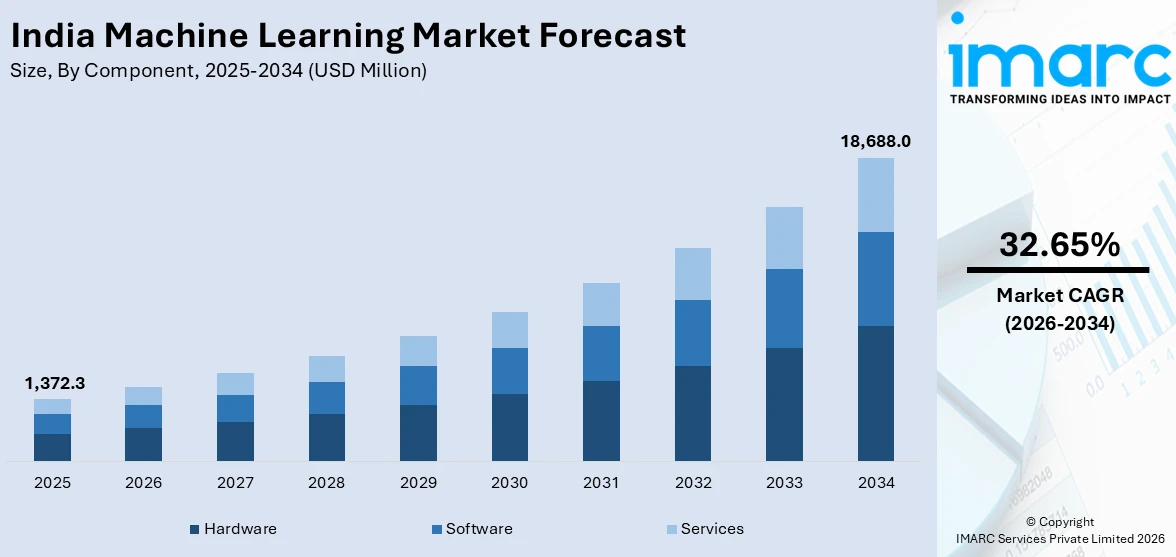
India machine learning market size reached USD 1,372.3 Million in 2025. MARC Group report expects the market to reach USD 18,688.0 Million by 2034, exhibiting a growth rate (CAGR) of 32.65% during 2026-2034. The increasing growth of big data and the availability of massive datasets that provide machine learning algorithms with more information to learn and make accurate predictions, is driving the market.
According to the State of Digital Adoption in Construction 2025 report, 54% of Indian construction firms are now using AI and machine learning. This puts India ahead in adopting advanced technologies like IoT, smart sensors, and BIM—signaling a rapid digital transformation within the industry.
Challenges and Limitations
Machine learning, while useful, cannot replace professional property evaluation, due diligence or financial analysis. First, there is the question of data quality. Poorly documented transactions, insufficient rental data and disparities between state-level registration systems may influence model accuracy.
Model bias may also be a problem. Predictions made based on historic data that shows unequal access to housing, regional disparities in development or incorrect valuation may reinforce these biases. Unexpected political decisions, economic shifts and delays in construction projects may also reduce the value of trends observed in past data.Therefore, investors need to employ clear models and consistently validate their predictions.
Conclusion
Machine learning provides new avenues for assessing risks in real estate investments in India through data analysis. Property valuations, renting forecasts, credit risk assessments, construction supervision, and location risk assessments can be carried out using such technologies to allow investors to identify possible risks before committing money.
With an increasingly data-driven real estate market, combining machine learning with GIS, financial modeling, property management software, and digital transactions can provide more information. Nonetheless, machine learning will be effective if there is reliable data, proper model choices, and human intervention. It should be used for decision-making purposes only and not as an assurance of investment performance.