Transforming Billboards into Sustainable Urban Spaces- Key Highlights
- Green Integration: Billboards designed with built-in greenery to promote eco-conscious urban spaces
- Functional Design: Structures provide shade and comfort for pedestrians, not just visibility
- Human-Centric Approach: Encourages interaction and creates meaningful public engagement
- Sustainability Focus: Supports climate-responsive and environmentally responsible design
- Beyond Advertising: Transforms outdoor media into purposeful, community-driven installations
Godrej Properties’ #LiveWithNature campaign reimagines the potential of outdoor advertising by providing an eco-sensitive and purpose-driven alternative to traditional billboards. In an era where cities are defined by factors like congestion, pollution, and loss of green cover, this initiative seeks to redefine outdoor advertising not merely as an advertising platform but as an enabler of city living.
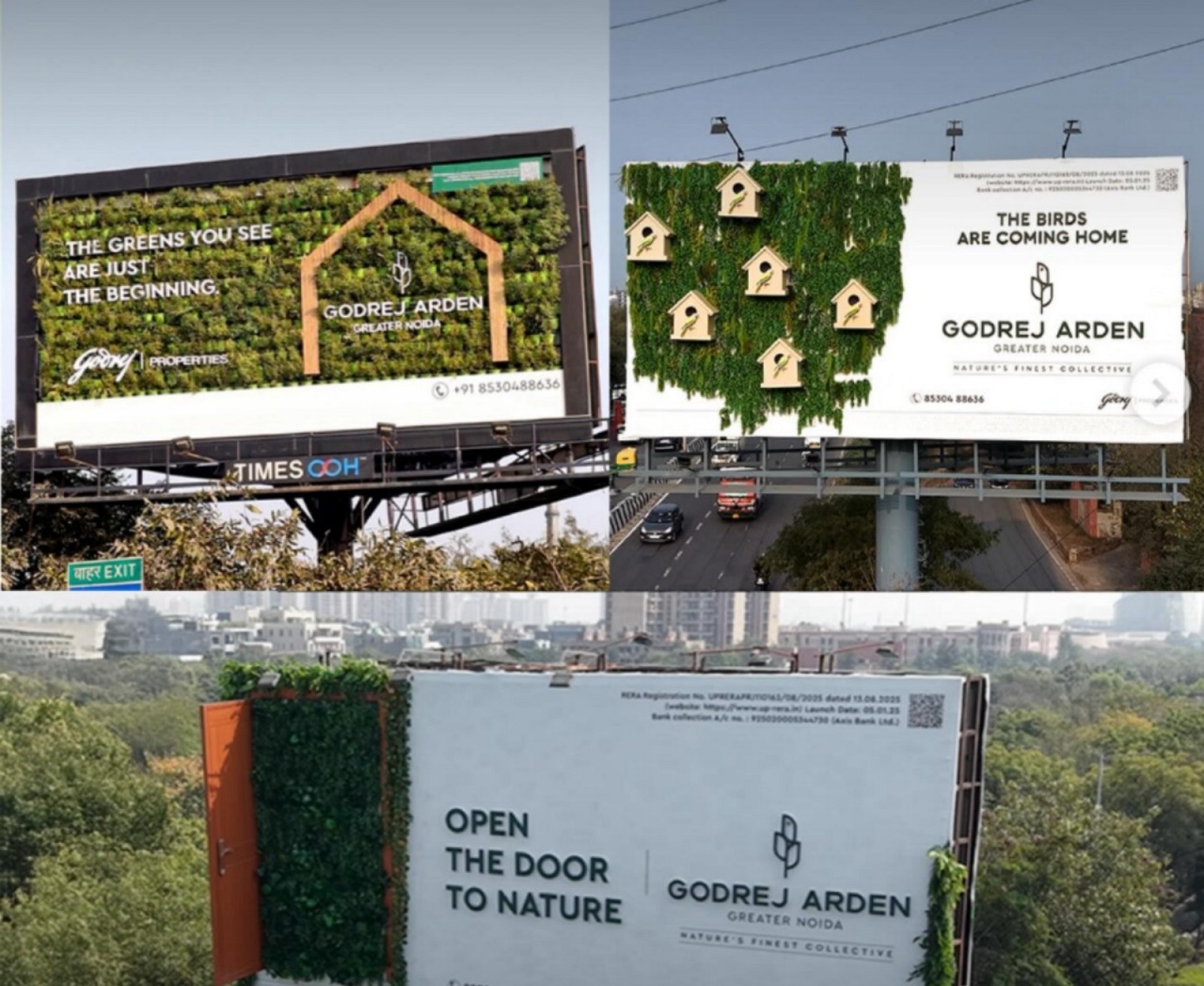
Traditionally, billboards are static, eye-catching structures, which frequently contribute to visual pollution. The campaign breaks away from the conventional approach by combining greenery and practical design features in outdoor advertising. Rather than occupying space, the structures attempt to enhance it, infusing a sense of space and environmental awareness in the city.
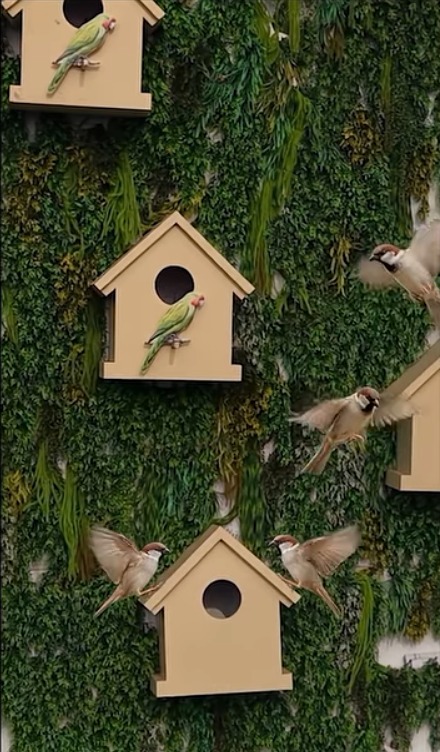
The structures have been designed as breathable, interactive structures, which respond to their environment. The structures do not just convey a message; they create a dialogue. Many structures offer a source of shade, greenery, and a momentary pause in the hectic pace of life.
Key features of the installations include:
- Integration of greenery within billboard structures
- Shade-providing elements for pedestrians
- Open, breathable designs that reduce visual heaviness
- Interactive or experiential components that invite engagement
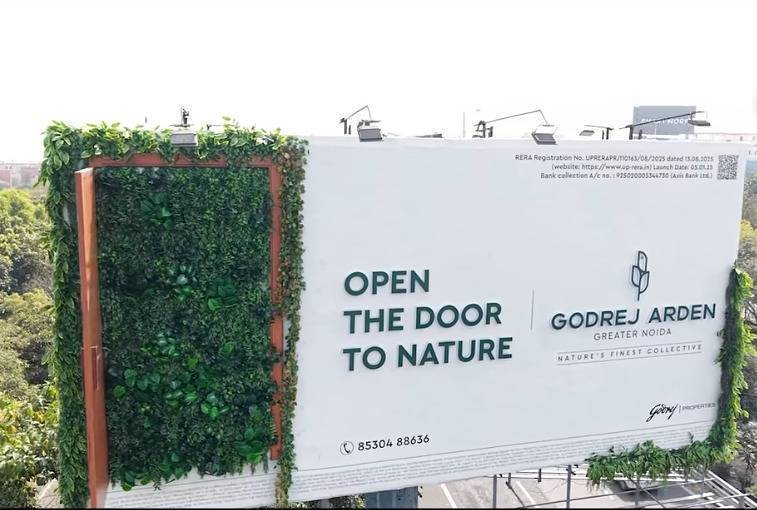
One of the most compelling representations of this idea is the installation designed for Godrej Arden in Greater Noida. This installation is designed as a symbolic ‘doorway to nature’ that provides a striking visual metaphor to encourage people to step into a more ‘green’ and ‘calmer’ space. The installation dissolves the boundary between built space and natural space to reflect the brand’s messaging around ‘nature-integrated living’ while also being a compelling public interaction.
What makes the #LiveWithNature campaign particularly effective, though, is its focus on functionality as well as messaging. These are not just decorative elements, nor are they simply adding greenery as a superficial layer. They are, rather, functional elements with a certain intent, working towards improving microclimatic conditions, at least at a small scale, through their provision of shade and plant life.
This aligns with broader architectural and urban design conversations, particularly around:
- Climate-responsive design
- Human-centric public spaces
- Integration of green infrastructure into cities
- Reducing the environmental footprint of urban elements
Besides the tangible installations, the campaign spreads through a participatory movement as well. People are really invited to submit their personal ideas and ways of living eco-friendly to the campaign through the #LiveWithNature hashtag. It is this element that is led by the community which changes the campaign from a mere brand initiative into a shared discussion on sustainability.
On the other hand, it also puts the spotlight on one very powerful notion: the transformation towards greener and sustainable cities is not the sole affair of developers, designers, or policymakers and in fact, individuals' actions along with the shared consciousness of the issue are the turning points that can lead to the creation of more responsible and resilient urban environments.
Importantly, the campaign reflects a larger shift in how real estate brands communicate their values. Rather than limiting its sustainability focus to a brochure or a project specification, Godrej Properties puts its philosophy in the public space. In doing so, it closes the gap between its promise and its practice.
In a broader sense, #LiveWithNature also reminds us that urbanization and sustainability don’t have to be mutually exclusive. Small interventions can lead to great impacts. A billboard, which might be seen as a purely functional and commercial space, can be re-imagined as a space that has a positive impact on its environment.
At its core, the campaign is about going beyond the visual and actually making an impact. It challenges the way we use space in the city, and the role of design in changing behavior. By using outdoor media as a means of providing shelter and inviting nature, it sets a precedent for how a brand can engage in a more responsible way with its environment.
It’s a reminder that, if the city can evolve, then perhaps we can too, in the ways we interact with it and the decisions we make on a daily basis.