
Andhra Pradesh Urban Land Market Values To Be Hiked- Key Highlights
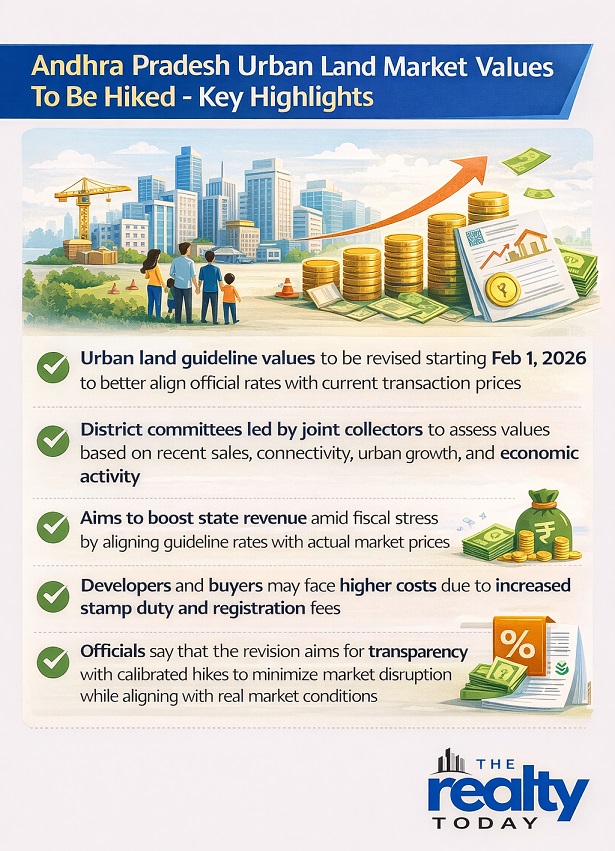
- The Andhra Pradesh government plans to revise urban land guideline values from February 1, 2026 to better align official rates with current transaction prices.
- District-level committees led by joint collectors and including representatives from the Registration, Municipal, and Revenue departments will assess values based on recent sales, infrastructure, connectivity, urban growth, and economic activity.
- The move aims to mobilize state revenue amid fiscal stress by reducing discrepancies between guideline rates and actual market prices.
- Developers and buyers, particularly first-time or middle-income homebuyers, may face higher purchase costs due to increased stamp duty and registration fees, potentially slowing transactions in price-sensitive segments.
- Officials emphasize that the revision is statutorily required and designed for transparency, with calibrated hikes intended to minimize market disruption while aligning rates with real market conditions.
To make the official guideline rates more in line with the current transaction prices and to boost the state revenues, the Andhra Pradesh government has suggested a revaluation of land market values in urban areas starting from February 1. The registration department has been given the task to complete the assessment and to finalise the new values within the prescribed time, the officials said.
The proposal to revise comes about a year after the last updating which was done in February 2025. Although the government is adamant about the necessity of regular reassessments to keep the reflection of the ground realities, the declaration has caused real estate developers, property dealers, and prospective homebuyers to raise their concerns.
Rationale behind the proposed revision
The decision is in the wake of the realization that there are considerable discrepancies existing between the guideline prices and the prices that are actually transacted across various urban, semi-urban, and rural centers across the state.
To settle this issue, evaluation committees will be formed in every district with the joint collector as the leader. Each evaluation committee will comprise the following representatives:
- The Registration Department
- Municipal administration
- Revenue department
The revised values would be based on various parameters, viz.,
- Recent sale transactions.
- Infrastructure development
- Road and Transport Connectivity
- Urban growth pattern
- Commercial and Economic Activities in the Area
Officials said the goal in mind is to align the guideline values with the prevailing market conditions more favorably.
Revenue considerations under financial constraint
Usually, the land markets revise their values every two years, but the State Government has chosen to revise the land prices due to fiscal stress.According to the State Government, the revision is expected to enable the State to mobilize revenue as the State coffers have experienced stress.
Nevertheless, the move has come under scrutiny from other stakeholders within the property market, as they feel that the rise in guideline values would result in rising transaction costs.
"Any sharp rise in such values will have implications for us in terms of purchase costs and decision-delays for the buyer in the middle-income segment," a real estate developer said as per ET Realty.
According to developers, since rates rise with a surge in the general level of market value, stamp duty and registration costs rise. It makes housing purchases costly when demand is slow in some urban markets.
The revision of the rates is also anticipated to have implications for individual buyers, such as those who intend to buy house sites or other smaller plots of land for residential purposes. It is to be understood that the rates for registration charges are determined on the basis of the government’s notified rate for the land.
For such buyers, it may involve a change to their finances or a delay in their purchasing decision. However, there are fears that the situation may eventually create a bottleneck or a snag in the short term in the flow of transactions, mainly in the price-sensitive sector.
Officials, however, have defended the proposal, stating that revising market values is a statutory requirement and essential for ensuring transparency.
“When guideline values are much lower than actual sale prices, it leads to undervaluation and loss of revenue for the govt. The revision will bring more transparency and fairness to the system,” a Senior Revenue official said.
The official also said that the Government is also mindful of market disturbances and is taking measures to ensure that fuel prices are not increased abruptly or excessively, especially in rural and economically weaker regions.
As the February 1 deadline draws near, the offices are filled with more rush, with buyers and sellers looking forward to settling their deals with the existing rates. According to the experts, such a rush is normal every time the rates are revised but is expected to die down soon once the new rates are implemented.
Whether the revision provides stability in the valuation of land as well as clarity in the revenues generated or continues to ease the market transactions will be understood in the coming months as the market adjusts to the updated guideline value






.png)