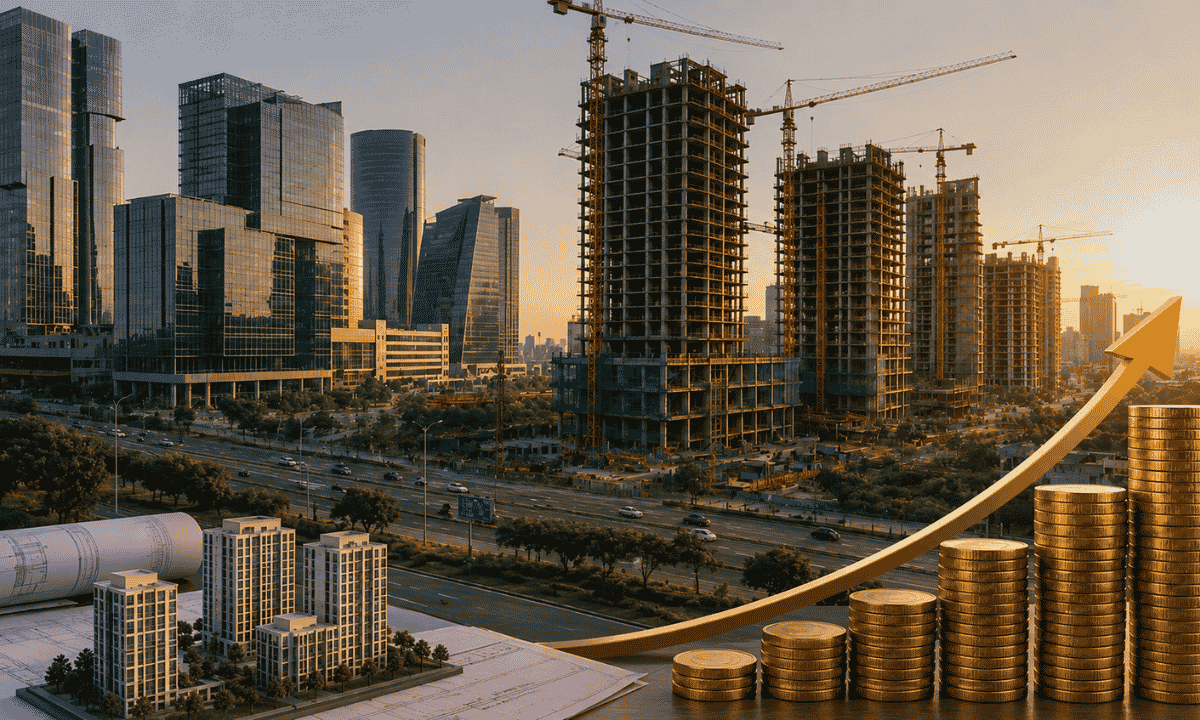

The Indian home-buying market has changed completely. In the past, people usually bought apartments from small, local builders. Today, buyers prefer large, trusted, publicly listed companies. This massive shift is reshaping the entire real estate sector in India.
By May 2026, official financial reports showed that India’s top four real estate companies—Godrej Properties, Prestige Estates, Lodha (Macrotech Developers), and DLF Ltd—achieved a historic milestone. Together, they sold a record ₹1.05 lakh crore (₹1.05 trillion) worth of residential properties in the 2025–26 financial year (FY26).
Building on this historic success, these "Big Four" real estate brands have set a combined housing sales target of ₹1.19 lakh crore (₹1.19 trillion) for the current financial year (FY27). If you are looking to understand the Indian property market, real estate trends, or where the housing sector is heading, this deep dive breaks down everything in simple terms.
1. The Big Four at a Glance: Last Year's Sales vs. This Year's Targets
Even with rising property prices across top Indian metros, the demand for high-quality housing remains exceptionally strong. Homebuyers are moving away from unknown developers and choosing well-known brands that guarantee they will finish buildings on time.
The table below shows exactly how much each company sold last year and what they plan to sell this year.
Real Estate Sales Performance Dashboard (FY26 vs FY27)
2. Why Are These Companies Called the "Big Four"?
In the Indian real estate market, these four companies stand far ahead of everyone else. They are called the "Big Four" because they dominate the property market in three major ways:
Massive Scale of Construction: They do not just build standalone apartments or single blocks. They build massive integrated townships, luxury skyscrapers, and smart mini-cities across India's largest metropolitan areas.
Stock Market Giants: All four are publicly listed on the National Stock Exchange (NSE) and Bombay Stock Exchange (BSE). This means their financial books, debt levels, and sales numbers are totally open to the public, creating an unmatched layer of buyer trust.
National Expansion: Unlike traditional regional builders who only work in one city, the Big Four have successfully expanded across the country. They have the money and manpower to build simultaneously in Mumbai, Bengaluru, Delhi-NCR, Hyderabad, and Pune.
3. The Consolidation Cycle: The Secret to Their Dominance
To easily understand how these four brands captured such a massive share of the market, we have to look at what experts call The Consolidation Cycle. This simple loop explains how changes in government rules and immense money power work together to favor big corporate names over small, local developers.
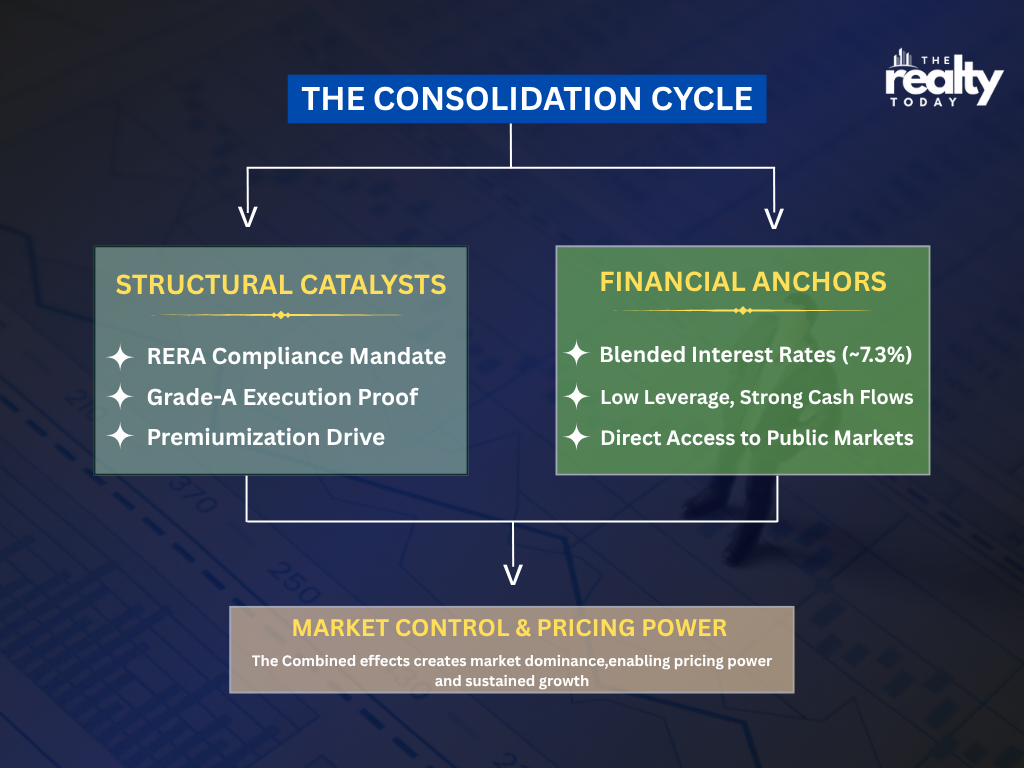
Pillar 1: Structural Catalysts (The Left Side)
These are shifts in customer habits and government safety laws that naturally protect buyers:
RERA Safety Rules: Government transparency laws strictly penalize builders who delay projects. The Big Four have robust legal and corporate setups to meet these rules perfectly, making them the safest bet for home buyers.
Proven Track Record: They possess "Grade-A" execution proof. This means they have a long history of successfully completing massive projects on time, eliminating the fear of stalled properties.
The Demand for Premium Spaces: Modern buyers want large, luxury layouts with open green spaces. The Big Four specialize in these complex designs.
Pillar 2: Financial Anchors (The Right Side)
This represents the massive capital power these giants use to edge out competition:
Cheaper Bank Loans (~7.3%): Because banks trust them, the Big Four borrow money at remarkably low interest rates (around 7.3%). Smaller, unlisted builders are forced to borrow from private lenders at painful rates between 14% and 18%. This gives the giants an unbeatable cost advantage.
Healthy Cash Flows: Because their projects sell fast, they keep massive amounts of actual cash flowing through their businesses without falling into deep, risky debt.
Direct Stock Market Funding: Being listed means they can raise thousands of crores directly from global investors whenever they want to purchase prime land parcels.
The Final Result: Total Market Control
When you combine consumer trust with cheap bank loans, it triggers a flywheel effect. The Big Four can buy the best land, build the highest-quality projects, and absorb rising steel or cement costs easily. Because there is little real competition at this massive scale, they gain Pricing Power—the unique ability to set stable market prices while smaller builders slowly disappear.
4. A Closer Look at Each Company's Strategy
Godrej Properties: The Volume Leader
Godrej Properties became India’s top-selling home builder last year, crossing the ₹34,000 crore mark in sales. Their business model relies on moving inventory quickly: buy land fast, launch projects quickly, and sell out apartments as soon as possible.
Aggressive Land Buying: Godrej bought nearly 20 new plots of land last year across India's biggest cities. According to corporate filings, these plots hold a future sales potential of over ₹42,000 crore.
Huge Upcoming Launches: For this current financial year, they have prepared new projects worth ₹48,000 crore. They are focusing heavily on major technology hubs in Bengaluru (such as premium developments like Godrej Vanantara on Bannerghatta Road and new entries in Yelahanka), alongside their core strongholds in Mumbai and Delhi-NCR.
Prestige Estates: The South Indian Giant
Based in Bengaluru, Prestige Estates saw an incredible 76% growth in sales last year, reaching ₹30,024 crore. This came after minor regulatory approval delays in previous quarters were successfully cleared.
Moving Beyond Bengaluru: Prestige is no longer just a South Indian brand. They have successfully expanded into Mumbai and Delhi. Market data reports that in Hyderabad alone, their newly launched Prestige Golden Grove project in Tellapur sold over ₹2,300 crore in its initial rollout weeks.
Focus on Premium Homes: They are targeting wealthy buyers and high-net-worth individuals (HNIs) with high-end apartments and premium plotted villa communities.
Lodha (Macrotech Developers): Expanding Nationwide
Lodha is famous for building iconic premium residential towers and luxury spaces, hitting ₹20,530 crore in sales last year.
Leaving the Comfort Zone: Historically, Lodha got almost all its money from the Mumbai Metropolitan Region (MMR). Now, their corporate strategy has shifted. They want one-third of their future business to come from other high-growth cities like Pune, Bengaluru, and Delhi-NCR.
Future Planning: Company statements show Lodha acquired 11 large pieces of land recently. They plan to build over 20 million square feet of housing space here, worth an estimated ₹58,800 crore in sales value over the coming years.
DLF Ltd: Quality and High Profit Over High Volumes
While Godrej and Prestige are trying to sell as many units as possible, Gurugram-based DLF is taking a highly conservative, margin-focused approach. They have intentionally kept a flat sales target of ₹20,000 crore for this year.
Profit Over Pure Numbers: DLF's management explained that they have enough land to sell ₹50,000 crore worth of homes if they wanted to. However, they prefer to focus on making more profit per home and ensuring their supply chain can deliver the buildings without construction delays.
The Ultra-Luxury Market Leader: A huge chunk of DLF's revenue this year comes from a single super-luxury project in Gurugram called The Dahlias. PropEquity data reveals that this project features ultra-premium apartments where introductory prices started at ₹60 crore and have now appreciated up to ₹135 crore per home.
5. Challenges and Risks Ahead for the Real Estate Sector
Even though these companies are making record-breaking sales, they must navigate clear macroeconomic challenges this year:
Rising Costs of Materials: The price of cement, structural steel, and specialized finishing materials is going up. If these costs keep rising, it will hurt the profit margins of developers who priced their units too aggressively early on.
Construction Speed and Supply Chains: Selling a house on paper is easy, but building a 50-story high-rise tower takes years. The biggest challenge for these companies is finding enough skilled labor, project managers, and engineers to finish construction within the strict 4-to-5-year RERA timelines.
High Prices in Luxury Hubs: In areas like Gurugram’s Golf Course Extension and premium parts of Mumbai, property prices have doubled over the last 36 months. If prices outpace the actual economic utility of the area, they run the risk of temporary investment stagnation.