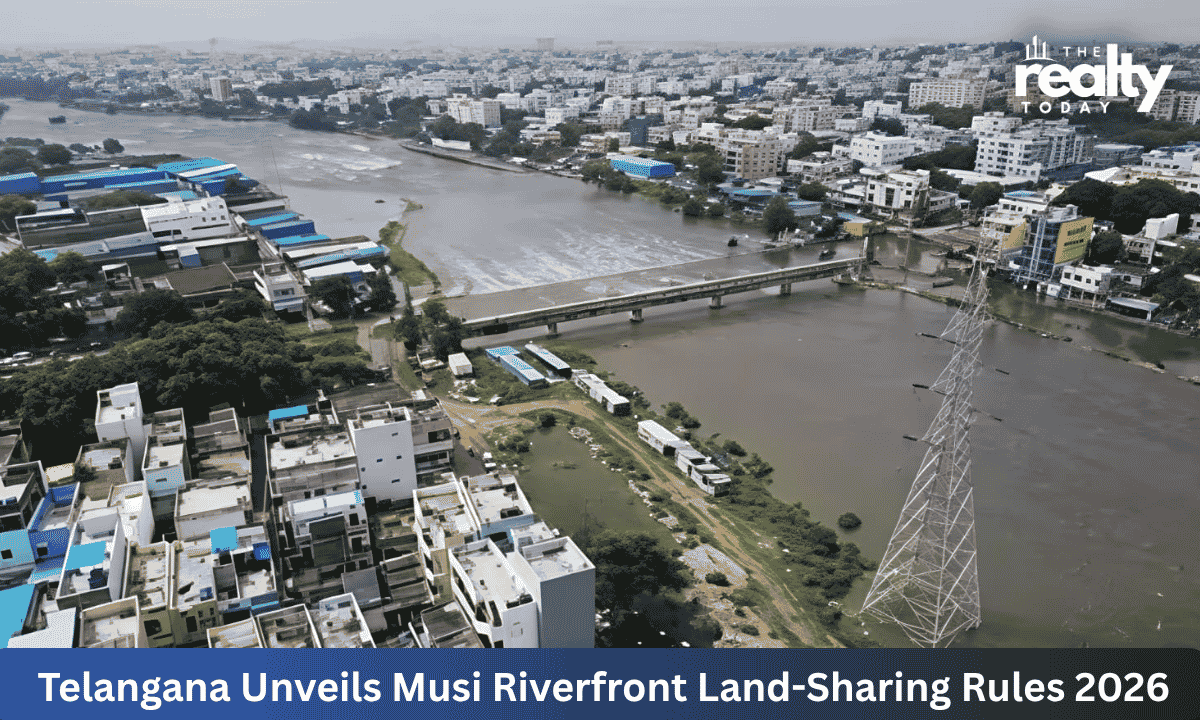
The Telangana government has finalised a separate land-pooling framework for the Musi Riverfront Development project in Hyderabad, setting out the land entitlements for owners and other eligible occupants. The initial exercise is proposed for the stretch between Nagole and Gowrelly, although the total area to be pooled is yet to be determined.
Under the arrangement, eligible participants will receive a share of developed land, a fixed plot entitlement or transferable development rights (TDR), depending on the category and location of their land. The framework also sets out the charges applicable to the development and differs from the land-pooling rules previously used by the Hyderabad Metropolitan Development Authority (HMDA).
Landowners to Receive Different Plot Entitlements
Patta landowners will be eligible for either a 50:50 share of the developable land or 1,400 square yards per acre after development, whichever is lower.
Separate provisions apply to land in restricted or designated areas. Owners of patta land in the buffer zone will be eligible for 800 square yards per acre or TDR, subject to eligibility. For patta land located in the riverbed or Full Tank Level (FTL) area, the provision is 400 square yards per acre or eligible TDR. The government had previously considered
housing and compensation measures for families affected by the Musi project, including house plots and 2BHK homes for eligible households.
People occupying government land through encroachment will be allotted 300 square yards per acre under the scheme. Assigned land will be considered separately, with the authority determining the amount of developed land to be returned in each case based on the holder's entitlement.
Multiple Use Zone Rules to Apply
The land pooled under the scheme will be treated as part of the Multiple Use Zone, with development governed by the applicable Master Plan zoning rules. The classification sets the planning rules for the pooled land, while the specific development permissions will remain subject to the relevant regulations.
A Special Impact Fee will be levied when building permission is granted, in addition to regular fees and charges. The framework also addresses costs associated with converting land and transferring developed plots back to eligible landowners.
The development entity will bear nala or conversion charges on patta land, along with charges related to changes in land use. It will also cover registration and stamp-duty costs for plots returned to landowners, with the applicable fee fixed at 0.5% of the market value.
Earlier HMDA Land-Pooling Rules Excluded
The new framework excludes certain provisions of HMDA's 2020 land-pooling order from applying to the Musi lands covered by the scheme. The earlier order included a 60:40 sharing arrangement for HMDA land-pooling projects, but that formula will not govern the land covered by the specific terms.
The separate provisions establish different entitlements according to land category and location, including for areas within the riverbed and buffer zone. Assigned land will also be assessed separately rather than being covered by a single uniform return.
The initial stretch between Nagole and Gowrelly is the proposed starting point for the exercise. However, with the total pooling area still being worked out, the extent of land covered and the number of owners who may participate remain unclear. The final implementation will depend on the identification of eligible land, the application of the specified terms and the planning rules governing the pooled areas.