
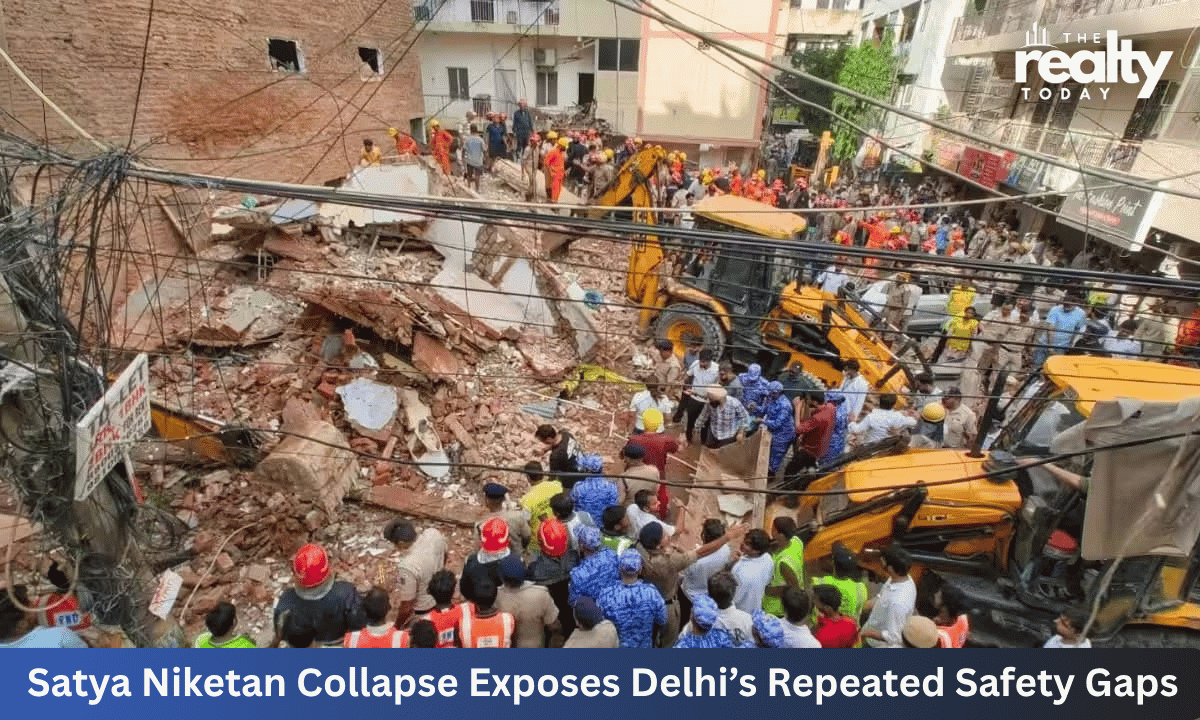
On September 6, 2026, a five-storey PG building came down in Satya Niketan, South Delhi, killing at least seven people and trapping others under the debris. The building housed students of Delhi University's South Campus. It had no sanctioned building plan, an unauthorised basement and no fire NOC, despite being packed with residents.
It's a familiar story. Too familiar. Look back through Delhi's civic record, and this is not an isolated failure, it, in fact, is a recurring one, in the same kind of buildings, for the same reasons and for years.
A pattern, not an accident
Lalita Park, Laxmi Nagar(2010): The deadliest reference point in Delhi's building-collapse history. A five-storey building, with an illegal fifth floor under construction, collapsed on November 15, 2010, killing at least 65 people and injuring over 100, the toll later climbed past 70. The building's foundation had been weakened by basement water accumulation and monsoon flooding. It stood in an unauthorised, later-regularised colony. The owner was booked for culpable homicide. [Source: Deccan Herald]
Satya Niketan, same colony(2022): A three-storey house under renovation collapsed in April 2022, killing two labourers. The building was being converted into a PG at the time. [Source: Deccan Herald]
Mustafabad(April-2025): A four-storey building, roughly 20 years old, standing in an unauthorised colony, collapsed in the early hours of April 19, 2025, killing 11 people, including a family of seven from one household. PM Modi and CM Rekha Gupta both issued condolences; the CM ordered a probe and called for identifying similar buildings citywide. [Source: PIB/News On Air]
Daryaganj(August 2025): A building being demolished near Sadbhavna Park collapsed on August 20, 2025, killing three migrant workers. The National Human Rights Commission took suo motu notice, calling it a serious human-rights concern for worker safety at construction sites. [Source: Tribune]
Subzi Mandi(September 2025): A four-storey, already-condemned building collapsed in Punjabi Basti, damaging two adjoining structures. MCD had declared it unsafe and vacated it weeks earlier — 22 people in the neighbouring buildings were rescued, no deaths. [Source: PTI/Deccan Herald]
Satya Niketan(September 2026): The building at the centre of this story: G+4, basement construction never sanctioned, no fire NOC, seven dead.
Five documented collapses across three localities, spanning sixteen years, all sharing the same fingerprints: unauthorised construction, ageing structures, water damage or basement work and, critically, prior knowledge on record that something was wrong before it fell.
The Tale of Two Surveys: What Delhi's Own Numbers Reveal
Why do these fragile structures go unnoticed until a disaster strikes? The answer lies in how the Municipal Corporation of Delhi (MCD) handles safety and enforcement. The city runs two completely separate processes, and the gap between them explains the core problem.
1. The Pre-Monsoon Visual Survey
Every year before the rains arrive, MCD inspection teams walk through neighbourhoods across the city to flag dangerous structures. Out of nearly 28 lakh buildings surveyed this summer, only 19 were marked as dangerous.
The problem? It is strictly a visual check from the street. Inspectors look for visible exterior cracks or leaning walls. No one steps inside to inspect load-bearing walls, foundation strength, or basement modifications. A building with severe underground weakness can easily pass without a single warning flag.
2. The Illegal Construction Drive
Between June and September, MCD demolished around 980 properties and sealed 460 others for illegal construction—mostly for unapproved extra floors or building without sanctioned plans.
This enforcement happens at scale, but it operates on a different logic. Almost none of the 980 demolished properties were on the list of 19 dangerous buildings. They were torn down for lacking proper paperwork, not because anyone tested their structural strength.
The result? The city aggressively enforces building paperwork, but it rarely tests building stability.
What Changes Are Coming Next?
In response to the tragedy, Delhi Chief Minister Rekha Gupta announced immediate citywide measures:
Immediate Sealing Drives: Authorities are moving to seal structures with unauthorised fifth floors across the capital.
Mandatory Safety Certifications: The government is drafting a policy requiring periodic structural audits and safety certificates for buildings used by the public including hostels, guest houses, schools and care facilities before they can operate legally.
Industry experts note that basic visual certificates will not prevent future failures. Hidden defects like removed load-bearing supports, rusted steel or foundation damage caused by basement excavation require deep engineering assessments. A certification regime will only work if third-party structural engineers are held personally accountable for their reports and civic authorities actively verify them.
What This Means for Owners, Operators and Buyers
Property Owners: Owners of older stock in converted or unauthorised colonies face shrinking options. Unapproved floor additions will become increasingly difficult to regularize once audit policies take effect.
Commercial & Residential Operators: Compliance costs are set to rise. Budgeting for formal structural audits, fire NOC clearances and potential modification fixes will become essential to running any multi-tenant facility.
Buyers and Investors: Property buyers must prioritise structural and legal due diligence. Unapproved modifications or missing plans are now far more likely to trigger government action or sealing rather than flying under the radar.
The Road Ahead
Breaking this decades-long cycle depends on two factors: establishing a clear compliance timeline for structural audits and ensuring enforcement lasts beyond the current headline cycle. Real safety in Delhi will require moving past quick visual walk-throughs toward an accountable, verified system for every structure in the city.