

The domestic real estate sector is entering a period of significant transformation, with technology increasingly shaping how assets are developed, marketed and transacted, highlights ‘FICCI-KPMG Report 'Reimagining India's Real Estate Landscape’, released during the 19th edition of the FICCI Real Estate Summit.
Real Estate continues to be one of the largest contributors to employment generation, capital formation, and urban development, underpinning strong growth prospects and the potential to scale beyond USD 5.8 trillion by 2047. As India advances towards the Viksit Bharat vision, the sector is emerging as a critical driver of growth, productivity and job creation, supported by a progressively enabling policy framework, expanding digital penetration and deeper participation from institutional and capital markets.
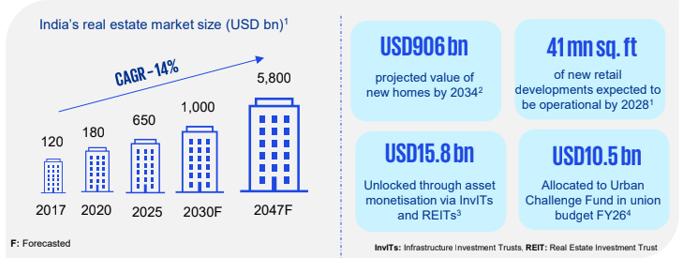
Source- FICCI-KPMG Report
The Report further states that the Indian real estate sector contributes 7.3 per cent to the national GDP, underlining its important role in economic development. As real estate projects grow in scale and complexity, technology adoption and governance are moving beyond front-end visibility towards end-to-end lifecycle integration across planning, execution and sales.
At the Summit, Mr Anand Kumar, Chairman, Real Estate Regulatory Authority (RERA), NCT of Delhi, urged all stakeholders to work together to make the Indian real estate sector more resilient, accelerate its development, and improve operational efficiency. "I urge all stakeholders to be honest, to move beyond individual interests, and to make this sector more efficient and transparent," he said, while stressing the need for greater awareness of the RERA Act among both buyers and sellers.
Mr Kumar commended the steps taken by the Government to support the development of the real estate sector, including efforts to unlock land potential and curb unauthorised ownership. He underlined the importance of focusing on the development of Tier 2 and Tier 3 cities to reduce migration to metropolitan centres. "We must be innovative and act as a catalyst to attract not just domestic but also foreign investments into the real estate sector and aim for higher growth rates of 20-25 per cent," he said.
Mr Sanjay R. Bhoosreddy, Chairman, Real Estate Regulatory Authority, Uttar Pradesh, spoke at length about the state's real estate progress, noting that the Government has envisioned Uttar Pradesh becoming a USD 1 trillion economy, with real estate set to play a significant role in achieving that goal. "The RERA Act of 2016 has ensured a level playing field for all promoters as well as between promoters and buyers. The State Government is putting in place investor-friendly policies to strengthen the sector further," he said.
Mr Bhoosreddy further stated that while the real estate sector is growing rapidly, protecting consumer trust remains paramount. He advocated establishing a dedicated 'Consumer Samadhan Divas' to address consumer grievances in a timely and structured manner. On the subject of new project approvals, he noted that UP RERA is on course to sanction 400 new projects in the current year, a considerable increase over preceding years. "UP RERA was sanctioning around 190 projects per annum till 2023. This increased to 259 projects in 2024, 308 in 2025, and we have already sanctioned 108 projects in the current year," he said, pointing to the steady strengthening of the Authority's regulatory capacity.
Mr Sandip Somany, Past President, FICCI & CMD, Somany Impresa Group, said, “India’s real estate sector is entering a new phase of growth, backed by rising investor confidence and steady demand. Its continued strength reflects the sector’s resilience and vital role in driving economic growth.”
Mr Raj Menda, Chairman, FICCI Committee on Urban Development and Real Estate & Chairman, Supervisory Board, RMZ said, “India's real estate sector has earned its place as one of the most consequential growth stories in the world. Sustaining that position now demands digital discipline, embedded not as a front-end tool but across the entire project lifecycle. The evidence is unambiguous: AI adoption in India's corporate real estate moved from under 5 per cent to 91 per cent in just two years. The sector has already made its collective judgment. Technology is no longer a point of differentiation; it is a condition for access to capital and trust. The platforms that build accordingly will define India's real estate leadership.”
Mr Vipul Roongta, Co-Chairman, FICCI Committee on Urban Development and Real Estate & HDFC Capital Advisors Ltd, said two-thirds of India’s real estate market is residential, and with a young and aspirational population, the demand for residential units will grow. “If any major economy has to grow, then it can do so on the back of the mortgage industry and residential industry,” he added.
During the event, the FICCI-KPMG Knowledge Report ‘Reimagining India’s Real Estate Landscape: The role of technology in value chain transformation’ was released.
As India’s real estate sector moves into a technology-driven growth phase, the focus is steadily shifting towards smarter governance, digital integration, and consumer-centric development models. The increasing adoption of AI, data-driven planning, digital approvals, and lifecycle-based project management is expected to redefine how real estate is developed, financed, and experienced in the coming years. Supported by regulatory reforms, institutional investments, and rising housing demand, the sector is poised to become a stronger contributor to economic growth, employment generation, and urban transformation. Going forward, the convergence of technology, transparency, and policy support will play a critical role in building a more efficient, resilient, and globally competitive real estate ecosystem aligned with India’s long-term Viksit Bharat vision.







.png)