The Indian real estate market is witnessing a trend that there is more value growth than volume growth in the Indian real estate market. Though the number of homes being sold has slightly declined, the transaction value in the Indian housing sector has touched new heights. Clearly, this indicates that a major transformation is taking place among home buyers and premium homes are leading this trend.
As per the India Housing Report 2026 compiled by CRE Matrix & NAR-INDIA, the average price of homes in the Indian real estate market has increased substantially and stands at around ₹1.47 crore. Clearly, it can be stated that home buyers now prefer big, luxurious homes at a premium price rather than just affordable homes.
Overview of the Market: Quality over Quantity
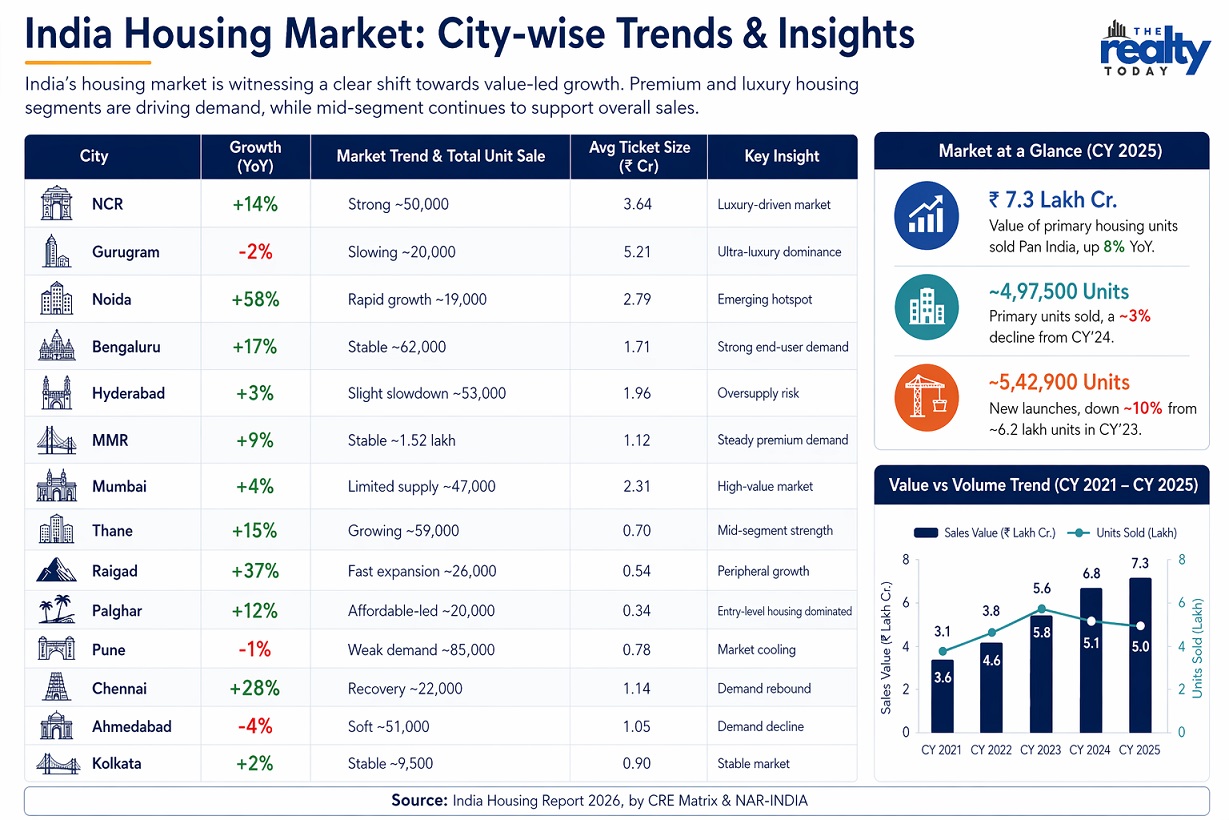
The residential real estate sector in India saw total primary sales valued at ₹7.3 lakh crore, which witnessed an 8% increase from last year. However, in terms of volume, the sector registered sales of approximately 4,97,500 units, witnessing a marginal drop of about 3% from last year. Moreover, new launches were observed to decrease by close to 10%.
Thus, a trend can be seen where despite lower volumes, higher values are being realized by the real estate market. This is because buyers seem willing to spend more on high-value properties even if the number of units purchased is lower.
Premiumization as Key Factor Behind Market Evolution
The growth of premium and luxury segments within the present day cycle in the housing market can be highlighted as one of the most distinct trends. Not only do these segments generate considerable value within overall sales revenue, but also influence market sentiments.
Current homebuyers value space, connectivity, and improved quality of life. The pandemic-driven increase in telecommuting has further spurred interest in spacious residences with designated areas for work purposes. Moreover, increased disposable income and aspirations play an influential role behind this trend.
City-wise Trends and Insights
The performance of the housing market varies across cities, with each region reflecting distinct dynamics:
- NCR (National Capital Region) has become a luxury market with 14% growth and average ticket size of ₹3.64 crore. NCR is continuing to draw rich people looking for premium properties.
- Gurugram has continued to remain the center of ultra-luxury real estate with an average ticket size of ₹5.21 crore. Yet the marginal decrease in growth rates signifies a consolidation phase after fast growth.
- There is an outstanding 58% growth in Noida due to its good infrastructure and accessibility. It is becoming one of the emerging destinations.
- The growth rate in Bengaluru is consistent at 17%, which can be attributed to robust end-user demand in the city owing to its booming IT industry.
- There has been moderate growth in Hyderabad at 3%. Still there are worries that an over-supply may happen in the future.
- Mumbai Metropolitan Region (MMR) remains one of the most significant contributors to housing demand, with steady growth of 9%. The market is supported by sustained demand for premium housing.
- Mumbai city itself is characterized by limited supply and high property values, maintaining its status as a high-value market.
- Thane, Raigad, and Palghar are witnessing strong growth, driven by affordability and peripheral expansion. These areas are increasingly attracting first-time buyers and mid-income households.
- Pune has seen a marginal decline, indicating a temporary cooling in demand.
- Chennai stands out with a 28% growth, reflecting a strong recovery and renewed buyer confidence.
- Ahmedabad and Kolkata have shown relatively stable or subdued performance, indicating steady but cautious market conditions.
Supply Dynamics and Developer Strategy
With a reduction in the number of new launches, it is apparent that the developers have become much more selective and demand-oriented in their strategy. Rather than saturating the market with an excess of supply, they have started concentrating on launching projects that cater to the existing trends of buyers, especially those from the luxury and near-luxury categories.
Apart from aiding in sustaining the prices, it ensures that there is effective management of inventory by the developers.
Sustained Growth with a Premium Focus
For future purposes, the outlook for India's housing industry is bright. Demand is anticipated to stay constant due to demographics, urbanization, and overall economic growth. Premium housing is expected to drive value growth, while mid-segment will continue driving volume growth.
NCR and MMR cities will lead in terms of value, while end-user demand will keep Bengaluru and Chennai strong. Peripheral markets will also pick up as affordability becomes one of the most important factors for many purchasers. In addition, today's buyers have started to become more selective. They care more about the quality of the product and its ability to yield profit in the long run.
One can see that India's housing industry is going through a transition towards becoming more value-driven. Premiumisation, growth in ticket sizes, and changes in buying behavior of consumers are among the main factors. Even though volumes might vary, the general trend is definitely upwards as quality and value have become two of the main criteria to consider when buying residential property in India.