Bengaluru emerged as Q1 2026's standout performer across all three dimensions - the simultaneous achievement of peak sequential sales growth, supply-sales near-parity, and the strongest YoY price appreciation nationally, according to the Real INSIGHT – Residential Q1 2026 report released by PropTiger (part of Aurum PropTech Limited).
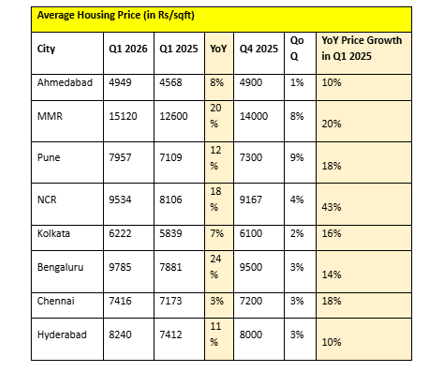
The average housing price in Bengaluru rose by 24% YoY and 3% QoQ to Rs 9785 per sq. ft. in Q1 2026 recording second highest average housing price behind Mumbai MMR at Rs 15,120 per sq. ft. Significant is the fact that as most cities cooled in Q1 2026, the average price growth of the city rose from 14% in Q1 2025.
“The GCC and startup employment engine continues to prove more durable than conventional IT hiring cycles, providing Bengaluru with a structurally differentiated demand base that is less susceptible to sector-specific disruption,” the report said.
The average housing price in India’s top 8 cities – Ahmedabad, Bengaluru, Chennai, Hyderabad, Kolkata, MMR, Pune and Delhi-NCR – jumped between 3%-24% YoY in Q1 2026.
On QoQ basis, average housing price grew between 1%-9%.
“Property prices across top eight cities sustained a broad-based upcycle in Q1 2026 registering positive year-on-year appreciation underscoring the depth and resilience of underlying demand,” according to the report.
Average prices in Q1 2025 in top eight cities had grown between 10%-43% YoY with Delhi-NCR recording 43% growth dipping significantly to 18% YoY growth at Rs 9534 per sq. ft. in Q1 2026.
“The combination of positive QoQ and YoY sales growth, supply running marginally below the prior quarter, and strong price appreciation points to a market where demand is structurally absorbing available premium inventory without creating overhang,” the report said.
Average prices in Mumbai MMR grew by 20% YoY and 8% QoQ to Rs 15120 per sq. ft. in Q1 2026. The city’s average price growth remained the same.
The weighted average of top eight cities reached a landmark Rs 10,050/sq ft in this quarter - the first time this historic benchmark has been crossed.
Prakash Tejwani, CEO, PropTiger, stated "The Indian residential market has transitioned into a structurally more disciplined phase. Growth today is increasingly being driven by demand quality, inventory discipline, and buyer confidence rather than speculative expansion."
The inventory dynamics revealed segment-level divergence.
“A disproportionate share of new launches in Q1 2026 - particularly in Mumbai MMR, Bengaluru, and Delhi NCR - remained concentrated in the premium and upper mid-income segments. Unsold stock in higher ticket-size categories is therefore expected to exhibit slower absorption cycles, given longer buyer decision timelines and lower transactional liquidity compared to mass-market housing.”
This does not signal systemic stress, but it does underscore the need for pricing discipline and targeted demand conversion in the luxury and near-luxury segments as the market progresses into H2 2026, the report said.
“Overall, the combination of near-flat supply growth, stable absorption, and continued price appreciation across all eight cities indicates that inventory levels remained well managed through Q1 2026. Developers demonstrated a preference for maintaining price integrity and project viability over volume-driven liquidation - a posture that is consistent with a maturing market operating within a broadly comfortable supply-demand equilibrium.”
The report said the remainder of 2026 will be defined by whether this equilibrium deepens into a new growth cycle or consolidates further at current volume levels. Navigating the tension between premium inventory absorption and mid-income affordability will be the defining challenge of H2 2026.
Sales and Supply Scenario:
Housing sales in India’s top 8 cities fell by 2.2% YoY and rose 1% QoQ to 95,973 units in Q1 2026 while supply fell 0.1% YoY and rose 1.1% to 93,065 units.
Sales on YoY basis rose in Bengaluru (33%), Chennai (43%), Hyderabad (25%) and Delhi-NCR (11%) while falling in MMR (15%), Pune (21%), Kolkata (24%) and Ahmedabad (23%). MMR remained the highest selling market with 26,116 units followed by Bengaluru with 15,603 units.
Supply on YoY basis rose in Ahmedabad (96%), Delhi-NCR (29%), Hyderabad (23%), Chennai (4%) and Pune (2%) while falling in Bengaluru (13%), MMR (13%) and Kolkata (24%). MMR remained the highest supplied market with 27,189 units followed by Bengaluru with 15,806 units.
Industry Expert Opinions

Bengaluru-based real estate developer Sanjeevini Group Chairman and Founder, Mr. Umesh Gowda H.A. said, “The growth price reflects the city’s strong structural demand drivers rather than speculative activity as it continues to benefit from a resilient technology ecosystem, expanding GCC presence, startup-led employment generation and sustained migration of high-income professionals. The current momentum is being led largely by end-users and first-home buyers.
Bengaluru continues to maintain healthy demand absorption despite rising prices, indicating that housing demand remains fundamentally linked to employment growth and long-term urban expansion. Infrastructure upgrades across the city are also creating new residential growth corridors.
Going forward, Bengaluru is likely to remain one of the most resilient residential markets in India due to its diversified economic base and sustained housing demand visibility.”

Lalit Parihar, MD, Aaiji Group, a Dholera-based real estate company, said, “India’s residential market is increasingly becoming more end-user driven and structurally resilient, with cities backed by strong employment generation, infrastructure growth and affordability continuing to outperform. Bengaluru’s sharp price appreciation highlights the strength of technology-led demand, while markets like Ahmedabad demonstrate the importance of affordability and balanced supply. What is encouraging is that in several cities, housing sales continue to remain at par with or ahead of new launches, indicating healthy inventory absorption rather than speculative excess. The market today is far more disciplined compared to previous cycles, with both developers and homebuyers focusing on long-term sustainability and execution credibility.”
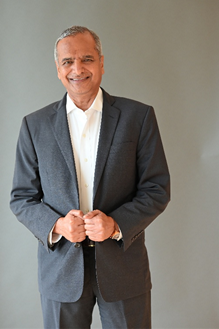
Sh. Shrivallabh Goyal, CEO and WTD at Reliance Model Economic Township, said, "The sustained rise in housing prices across India’s top eight cities tells us something important about how urban demand is being reshaped. For years, the housing market took its cues from city centres and central business districts. That equation is changing. Price formation today is increasingly tied to where employment is being created, and employment itself has dispersed well beyond traditional cores. In Delhi NCR, this is showing up clearly in micro-markets that did not feature prominently a decade ago. Satellite townships along major employment corridors are absorbing a meaningful share of new housing demand. The healthier part of the current cycle is that price growth is being driven by end-user demand rather than speculation. When households buy close to workplaces, they tend to hold. This price cycle supports both household wealth and the supply pipeline, and the task ahead is keeping it within reach of the salaried buyers who anchor demand. Over the last one year, the supply of affordable housing has witnessed a significant decline, making it imperative to accelerate fresh development in this segment. Satellite townships can play a pivotal role in addressing this challenge by offering large-scale, well-planned, and infrastructure-led affordable housing solutions for the growing urban population."
Going forward, India’s residential real estate market is expected to remain on a stable growth trajectory, supported by strong urbanisation, infrastructure expansion, and sustained end-user demand. Cities with diversified employment ecosystems such as Bengaluru, Hyderabad, and Delhi-NCR are likely to continue attracting both homebuyers and long-term investors. The sector is gradually shifting from speculative activity toward a more mature, demand-driven cycle where inventory discipline and project execution will play a crucial role.