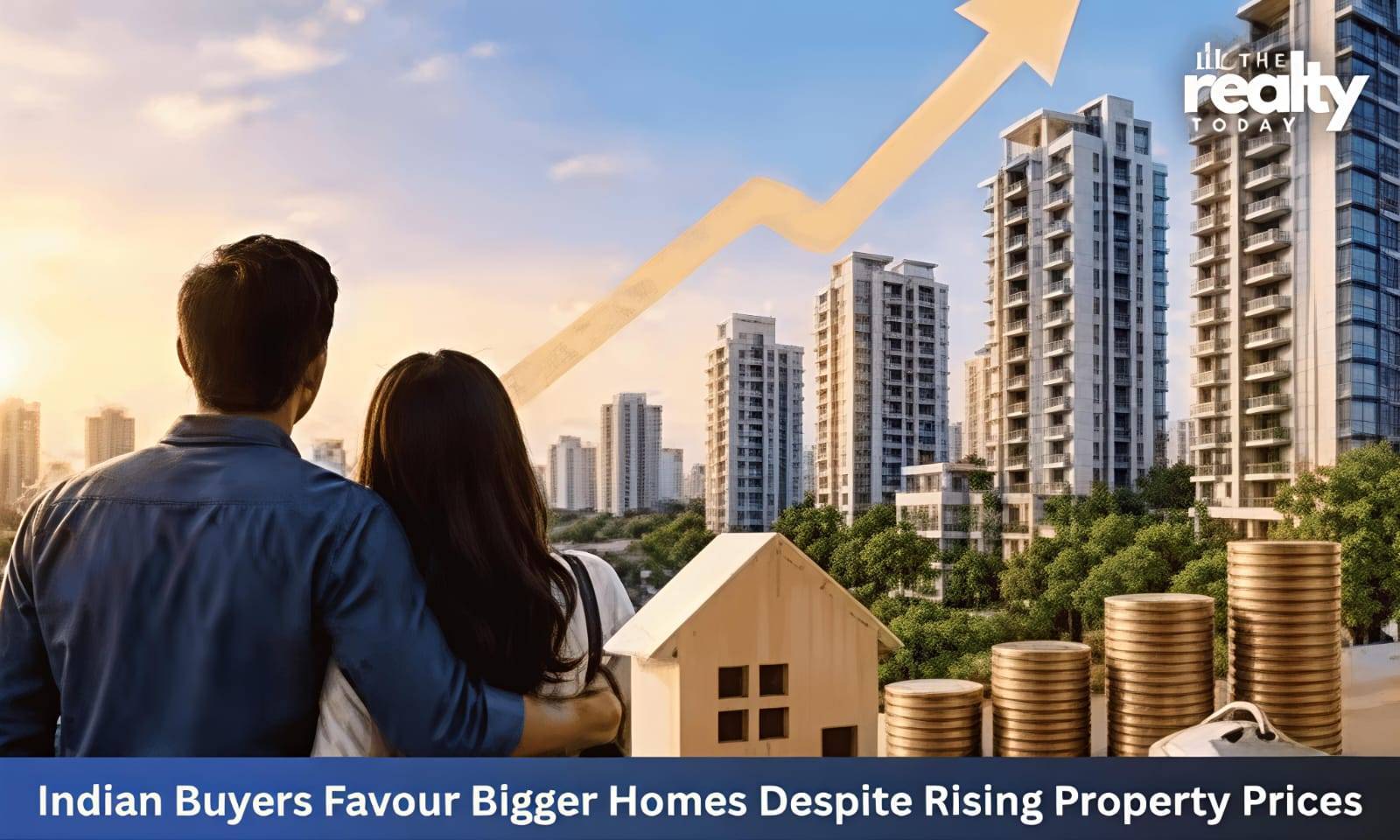

In 2025, the Indian real estate sector demonstrated exceptional resilience and momentum, driven by robust demand, rising aspirations, and supportive government-led initiatives, positioning it as one of the most dynamic and fastest-growing markets globally. The recent rate cut has also aided in strengthening market confidence and serves as a strong signal of policy support for the real estate sector and the broader economy and will play a crucial role in sustaining homebuyer confidence in the coming year. Home buyer confidence is at an all-time high, urging consumers to invest in their dream homes, driving sustained demand. Rising homeownership amongst millennials and Gen-Z, supported by higher disposable income and the desire to upgrade to larger, luxurious spaces is also a major trend influencing demand for luxury housing. As India's economy continues to grow, there is an increasing interest among the homebuyers to continue to invest in residential real estate for long-term returns. While the residential real estate sector continues to show robust performance in 2025, we definitely hope to see lower interest rates next year which will help drive growth. The Indian real estate market is on an upward trajectory and the sustained demand will solidify the sectors position well into 2026.
Industry Expert Opinions
Mr. Ramani Sastri - Chairman & MD, Sterling Developers
"In 2025, luxury real estate in India clearly moved beyond just being about size or pricing. Buyers became far more focused on the overall living experience - location quality, thoughtful design, privacy and the way a building actually functions once people move in. In Mumbai, this was especially visible in established neighborhoods like Bandra, Juhu and Santacruz where limited supply and redevelopment led projects continued to see strong traction. For HNIs and UHNIs, the attraction to luxury housing has been driven by a mix of confidence and clarity. Stable economic conditions, strong capital markets and greater transparency over the last few years have made real estate a more predictable asset class. At the same time, luxury homes are increasingly viewed as personal spaces that offer comfort, security and long-term value rather than purely speculative investments. We have also seen growing interest from celebrities and high-net worth investors in commercial real estate, largely because of the appeal of well-managed Grade A assets that offer steady rental income and long-term stability. Looking ahead to 2026, the luxury segment is likely to become more selective. Buyers will place greater importance on construction quality, sustainability, design integrity and post-handover service, rewarding developers who focus on consistency rather than scale."
Mr.Harsh Jagwani, Managing Director, Notandas Realty
"Coworking spaces are becoming a major force in reshaping India’s commercial real estate landscape. As organizations seek to create dynamic, future-ready workplaces, investing in high-quality, well-designed office spaces has emerged as a strategic imperative. Contemporary spaces with ergonomic layout, abundant natural light, and designated spaces for teamwork promote innovation, enhance employee satisfaction, and raise overall productivity. As these industries scale operations, attract global mandates, and drive innovation, they are increasingly opting for agile, future-ready work environments that offer scalability, cost-efficiency, and access to talent. Flexible space is no longer a cutting-edge trend in this sense; it is now the core of business strategy. With the shift towards hybrid work models and employee-centric workplaces, demand for premium, technology-enabled, and green office space is picking up steam. Workplaces today are becoming active seekers of workplaces that accommodate their social and environmental agendas too. As competition grows and organizations place greater emphasis on employee well-being and operational efficiency, A-grade office spaces are set to play a defining role in the future of work. This trend is also being significantly fueled by the expansion of Global Capability Centers (GCCs), which have emerged as a major demand driver for the sector. While major metro cities have been the key markets for coworking spaces, there's a growing demand in tier-2 and tier-3 cities too, making the market more diverse. As players in the flexible workspace sector continue to grow their footprint at record speed, it's clear that organizations in all sectors now recognize agile real estate not as a temporary solution, but as a long-term strategic priority."
Mr. Manas Mehrotra, Founder, 315Work Avenue, a leading coworking player
"As we wrap up 2025, India’s real estate and infrastructure sector has shown remarkable resilience despite macroeconomic headwinds. Key structural reforms and demand-supportive policies have strengthened fundamentals, and the GST rationalisation announced this year stands out as a particularly positive development. By cutting GST on critical building materials such as cement from 28 % to 18 % and lowering rates on stone, brick, and finish materials, the government has meaningfully eased input costs for builders, thereby creating a firmer platform for demand recovery across housing segments. Looking to 2026, we are optimistic about sustained momentum in the sector. Urbanisation trends combined with targeted tax relief and continued policy support will help bolster consumer confidence and enhance affordability. At M5 Mahendra Group, we remain committed to delivering high-quality, customer-centric projects that respond to evolving expectations. We believe 2026 will be a year where demand strengthens further, project execution accelerates, and meaningful value is created for homeowners."
Mr. Mahendra Nagaraj - Vice President, M5 Mahendra Group
“As we move into 2026, luxury housing is increasingly being shaped by fundamentals such as quality of planning, environmental performance and hospitality-oriented, service-led living, all of which play a decisive role in long-term liveability and asset value. The sector is seeing a clear shift toward well-conceived, exclusive communities where strong design, open spaces and a serviced-residence mindset come together to elevate everyday living. At Central Park, our focus continues to be on these core pillars, creating thoughtfully managed environments that deliver enduring value for both residents and investors.”
Mr. Parish Kapse, Co-Founder and Director, TOA
"With the onset of 2025, we saw the trends shift to smart, intelligent, and environmentally responsible design. Sustainability is now reshaping how workplaces look, feel, and function, with buildings using more energy-efficient systems and greener materials. However, as the year progressed, sustainability became more than a checkbox, as one of the most important aspects of how spaces are designed and built today. The shift has accelerated the move toward sustainable materials, smart and efficient technologies that enhance both wellbeing and design.
In 2026, we forecast the momentum would significantly grow, with sustainable designs becoming the key focus to creating workplaces that are healthier, adaptive, and truly future-ready. We are likely to see the emphasis on buildings that actively support a more climate-resilient environment."
Mr. Aditya Yamsanwar, Director, TOA
"2025 marked a pivotal year in the way organisations think about the workplace. There is a significant transition from periodic redesigns to agile ecosystems built for speed and creativity. Today, we are building resilient campuses that can adapt to new technologies, new work models, and expanding teams without disruption, especially for greenfield GCCs setting up in India.
As offices take on more strategic roles, workspace design is increasingly centred on flexibility, tech integration, and experience-driven layouts that unlock innovation and problem-solving. Looking ahead to 2026, we expect this transformation to deepen, with workplaces evolving into high-performance, modular, and intelligent environments that not only enable productivity but accelerate critical growth and long-term enterprise KPIs."
Mr. Sheeshram Yadav, Managing Director, Yugen Infra
"As we enter the final stages of the year 2025, the international and Indian real estate markets are exhibiting tangible resilience in the face of affordability pressures and changing consumer sentiments. The American residential real estate market has been observing low sales, with existing-home sales touching record lows, recording just 2.8% sales in the year 2025 amid inadequate demand due to higher mortgage rates ranging from 6% to 7% since 2022. However, industry predictions indicate that the existing-home sales will recover slightly by 1.7% in 2026.
Moving forward, there is reason for hope, with some economists feeling that projections show a possible 14% increase for home sales in 2026 in the U.S. and even a rise in home prices as the pressures of higher rates are relieved.
In India, the residential sector is performing well, driven by strong demand and changing preferences. Luxury segment housing registered more than 36% demand in the first half of 2025, up almost twice as much as pre-COVID, and sales above ₹4 crore have registered a 28% jump on a year-on-year basis. The overall home sales value is expected to record a historic high of US$74.98 billion in FY26, up a staggering 19% YoY. Experts also predict that, going ahead, average prices for Indian housing stocks are expected to grow 5% to 10% every year.
Overall, 2026 is anticipated to be a year of gradual stabilization, offset by strong affordability trends on a global level and dynamic demand trends in the India residential market."
Mr. Robin Mangla, President M3M India
"As 2025 draws to a close, India’s real estate sector stands at its strongest inflection point driven by unprecedented homeownership demand, rapid infrastructure delivery, and a clear transition toward experiential, future-ready living.
This year also witnessed a structural shift with the launch and acceptance of branded residences as the next leap of luxury for India, redefining how affluent buyers perceive value, personalization, and global-standard services. The sector’s evolution reflects a market that is more confident, transparent, and innovation-led than ever before.
At M3M India, 2025 has been a landmark year marked by operational excellence, strengthened financial discipline, and the successful rollout of developments aligned with new-age lifestyle expectations- and the launch of high end luxury branded residences, mixed use commercial spaces, mega integrated city etc. As we move into 2026, we remain committed to leading with vision, engineering world-class communities, and shaping India’s next chapter of real estate growth."
Mr. Rohit Kishore, CEO, Hero Realty
" In 2025, the NCR real estate market has thrived thanks to strong buyer interest and investment. Improved infrastructure, especially the Dwarka Expressway and UER-II launched by Prime Minister Modi, has enhanced connectivity and increased the region's appeal. Tier-2 cities like Ludhiana, Mohali, Lucknow, Dehradun, and Haridwar are also experiencing growing demand for high-quality developments, indicating a shift toward emerging urban centers. As we look to 2026, the sector is set for continued growth, backed by better infrastructure and a focus on sustainable, lifestyle-oriented communities. Developers are well-positioned to meet evolving homebuyer needs and deliver lasting value."
Mr. Aakash Ohri, Joint Managing Director and Chief Business Officer, DLF Homes
“The year began with considerable discussion around a potential market slowdown, declining consumer sentiment, price stabilisation, and concerns of oversupply and muted demand. However, our experience at DLF has been quite the opposite. The overwhelming success of Privana North in Gurugram (April) and our maiden Mumbai project, The West Park (July), both of which were sold out within a week of launch, generating ₹11,000 crore and ₹2,300 crore respectively, clearly demonstrated that quality real estate continues to command robust demand. These outcomes not only countered the prevailing market assumptions but also reinforced a key message: demand remains strong for high-quality, high-trust, high-value projects, and there is never a “wrong time” to invest in real estate when the fundamentals are right.
While Gurugram has always been a strong market for us, many questioned whether DLF could replicate similar results in Mumbai. The success of our debut project in the city was a powerful validation that consumer aspirations remain consistent across geographies. They seek superior products, value for money, and the assurance of a trustworthy brand.
For DLF Homes, 2025 was an exceptional year not only because of the performance of our projects but also because it marked a major milestone: our formal entry into Mumbai. Additionally, our super-luxury development, The Dahlias, continued to set new benchmarks, attracting clients from across India and overseas, with landmark transactions which have set national and international benchmarks. Nearly 50% of the project is absorbed pre–formal launch, just within our network of family and friends. For the first time in this category, priced upward of ₹75 crore, we are witnessing strong demand from markets such as Mumbai – which is new to us, Kolkata, Ludhiana, and several other cities. This signifies that ultra–high-net-worth buyers today prioritise product excellence over location and are willing to invest in the very best offerings nationwide. These are new and encouraging trends for us.
NRI investments, too, continued to deliver stable and substantial contributions across our portfolio, spanning plotted developments, independent floors, and premium high-rise residences from Mumbai to Gurugram and from Panchkula to Chennai. NRI confidence in India, its economic trajectory, and the Indian real estate sector is at an all-time high, despite global geopolitical uncertainties. The India growth story, coupled with product offerings that now match global standards, is drawing NRIs back to invest in their home country. This year, nearly 25% of our overall sales came from NRI markets.
We are also witnessing rising participation from Tier 2 and Tier 3 cities. These markets possess significant purchasing power, coupled with strong aspirations for upward mobility, better lifestyles, and high-quality homes. Notably, younger buyers are entering the market earlier than ever often in their 20s and 30s. They are unwilling to compromise on quality and increasingly influence family purchase decisions; many are also upgrading to luxury products sooner in their life journeys.
The luxury segment, in particular, has demonstrated exceptional resilience across major cities. Whether it is the Privana community with ticket sizes of ₹8–10 crore or The Dahlias at ₹70 crore and above, demand has been consistently strong. This momentum is driven by lifestyle upgradation and a shift towards long-term value creation rather than transactional buying.
Luxury housing outperformed all other segments in 2025. Homeownership continues to rise in importance, supported by sustained consumer confidence and significant price appreciation in key NCR micro-markets. Real estate has outpaced other asset classes in capital growth and rental yields, making it a preferred investment avenue for HNIs, UHNIs, and NRIs. Demand for amenity-rich, and high-quality luxury projects has grown sharply due to limited supply and rising aspirations. Luxury real estate in India has evolved into a holistic experience, buyers no longer seek merely a residence but an ecosystem that mirrors global standards of convenience, wellness, and everyday indulgence. Integrated access to fitness, wellness, dining, retail, and business facilities, reducing daily friction and saving time, has become the new definition of luxury."
Mr. Ankur Jalan, CEO, Golden Growth Fund (GGF), a category II Real Estate focused Alternative Investment Fund (AIF)
“Institutional investment crossing the $10 billion mark in 2025 marks a defining moment for the real estate sector. It reflects renewed investor confidence supported by improving macroeconomic stability, evolving demand, and the sector’s ability to deliver steady, risk-adjusted returns. Institutional capital is increasingly targeting high-quality assets, resilient income streams, and long-term growth opportunities. This milestone also signals a maturing market, where transparency, governance, and sustainability are becoming central to investment decisions. Overall, the scale of investment highlights real estate’s continued relevance as a core asset class in diversified institutional portfolios.”
Mr. Lalit Parihar, MD, Aaiji Group, a Dholera-based real estate company
“The year 2025 has been a mixed one for India’s real estate sector. While most top metropolitan markets witnessed a moderation in housing sales and new launches—largely due to elevated home prices, selective buyer sentiment and cautious investor behaviour—several cities in Gujarat stood out for their sustained performance. Markets such as Ahmedabad, Vadodara, Surat and Gandhinagar continued to show resilience, supported by relatively better affordability, steady growth in white-collar employment, rising demand from both local and migratory populations, strong corporate investment inflows and accelerated infrastructure development.
Among the key catalysts shaping Gujarat’s real estate has been the emergence of Dholera as one of India’s most closely watched real estate and industrial destinations and the announcement of Ahmedabad as a host city for the upcoming Commonwealth Games. These two factors have significantly strengthened long-term growth expectations for the state’s property markets.
Some of the infrastructure and industrial projects like Ahmedabad–Dholera Expressway, upcoming Dholera International Airport, infrastructure spending linked to the Commonwealth Games, robust pipeline of investment commitments in Dholera estimated at around ₹3.3 lakh crore including the ₹91,000-crore semiconductor fabrication facility by the Tata Group, along with significant investments in logistics, power and allied infrastructure, continued expansion of employment-generating industries, is expected to spur migration, further deepen the region’s economic base and create a strong foundation for long-term real estate demand.
Investor interest in Dholera’s real estate market, particularly plots, has been noteworthy, with participation extending beyond Gujarat to NRIs and buyers from North Indian markets such as Delhi-NCR, Punjab and Haryana. The heightened demand is reflected from the fact that land prices in the region have reportedly increased nearly ten-fold over the past decade. There is strong demand for plots within Dholera Smart City RERA-approved plotting projects as well as in surrounding villages like Rojka, Kamiyala, and Shela. Demand in these villages is particularly high.
As industrial and infrastructure projects move closer to operationalisation over the next few years, Gujarat’s urban markets - and Dholera in particular - appear well-placed to enter the next phase of sustained, end-user-led real estate growth.”
Mr. Vijay Harsh Jha, founder and CEO of property brokerage firm VS Realtors
“ The year has been marked by the resilience shown by real estate developers. Despite a dip in sales and new launches over the past two years, there is little cause for concern. Homebuyers continue to gravitate toward developers with a proven ability to execute projects, generate returns, and create long-term capital value. The groundwork for a strong upturn is clearly visible, driven by robust domestic consumption and supported by policy measures such as GST rationalisation, income tax cuts, low-interest rate regime amid falling inflation. These factors are expected to strengthen buyer sentiment and liquidity, paving the way for a positive 2026. Markets like Gurugram are well positioned to lead this upward momentum, supported by infrastructure growth, end-user demand, and sustained investor interest.”
Mr. Rajat Khandelwal, Group CEO, Tribeca Developers
“This year has been exceptionally strong for Luxury residences and branded homes across all major markets, especially Gurgaon, Pune, and Mumbai, with buyers prioritising better-designed living environments, credible developers, and curated lifestyle experiences. In Gurgaon, especially along SPR where Trump Residences Gurgaon is progressing, demand has remained steady and discerning. Pune continues to gain momentum with the infrastructure push including Outer Ring Road, Pune Metro, flyovers, etc catalysing residential appetite, while Mumbai’s new connectivity projects, including the Coastal road, Trans Harbour Link, etc are already translating into heightened buyer confidence and faster decision-making.
We witnessed this surge first-hand when Trump Residences Gurgaon sell out happened within hours of launch, with a tremendous share of bookings coming from repeat Tribeca buyers. It is a powerful indicator that customers today are seeking not just a home, but a global-quality lifestyle defined by design excellence, hospitality-driven service, and a strong sense of community. The surge in repeat buyers from Trump Tower NCR, in Trump Residences Gurugram, especially reinforces that branded residences are not an experiment; it is a segment that already commands high level of customer trust and aspiration.
Beyond the metros, in markets such as Hyderabad and Noida, globally exposed homebuyers, are looking forward to embrace higher end of luxury including inernational branded residences and are willing to pay a premium for the differentiated offerings. Looking ahead to 2026, we expect branded residences to move firmly into the mainstream, supported by maturing infrastructure, professional property management, and customers increasingly seeking long-term value backed by strong developer pedigree.”
Looking forward, the real estate sector in India is set to grow steadily and in a broad, based manner. This growth is expected to happen because of the factors such as strong end, user demand, improving affordability, and continued policy and infrastructure support which are spread across both residential and commercial segments. Quality, led development will become the main theme of the sector this being characterized by better design, sustainability, transparency, and post, handover service thus, credible developers and well, governed assets will be the ones getting the most loyalty. The rise of luxury and premium housing, availability of flexible and Grade A office spaces, GCC, driven demand, and the unfolding of the new opportunities in the Tier, 2 and Tier, 3 cities are anticipated to be the main growth engines. The sector is in a good position to further its growth momentum and generate long, term value till 2026 and further, thanks to the factors such as the expectation of easing of interest rates, increased participation of institutional and NRI, and a clear preference for experiential, future, ready living and working environments.