
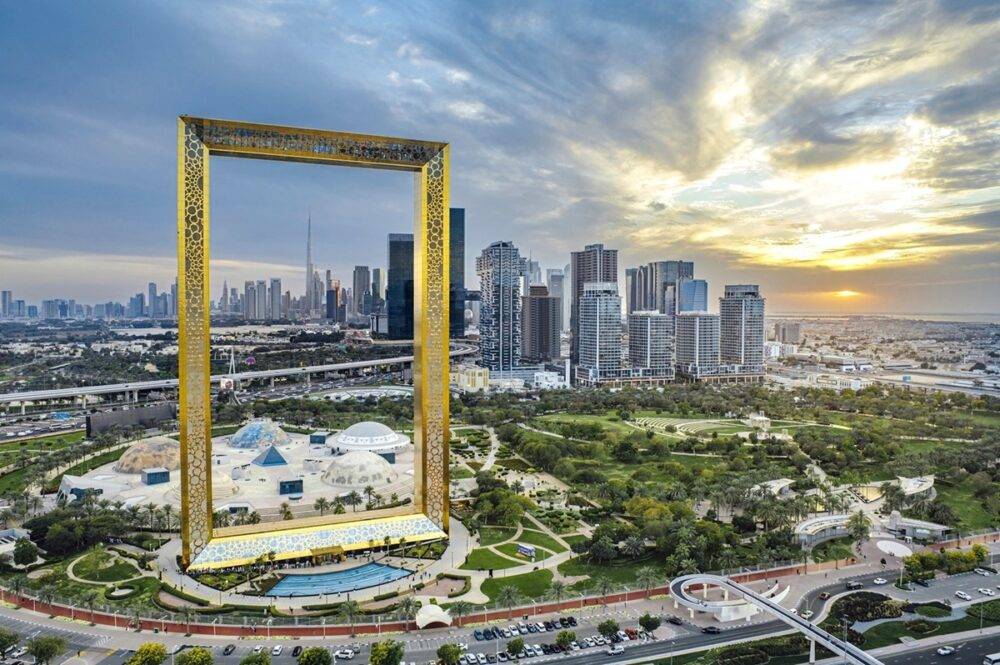
For the past three years, Dubai’s real estate market has grown at an exceptional pace. Prices rose steadily, transactions surged, and investor confidence remained high. However, as of March 2026, the market is facing a new test. Record supply levels and rising regional tensions are reshaping sentiment.
The market is no longer driven by “FOMO” (Fear of Missing Out). Instead, it has entered a clear “wait-and-watch” phase.
After a historic 2025, when sales reached $187 billion across 215,000 transactions, 2026 has begun with a visible pause in investor decision-making, both from local and overseas buyers.
1. The Supply-Sentiment Divergence: A "Moment of Reckoning"
The most important story of 2026 is the gap between new supply and buyer confidence.
The Forecast vs. Reality: While more than 120,000 units are officially scheduled for delivery in 2026, the “Completion Threshold Framework” suggests that only 48 percent, around 34,740 units, are realistically expected to be handed over this year (Source: Morgan’s International Realty / Day of Dubai, March 2026).
The Concentration Risk: A large share of this supply is concentrated in communities such as Jumeirah Village Circle (JVC), where 16,852 units are scheduled for delivery between 2025 and 2027 (Source: Elias Hannoush, MD of Morgan’s International Realty).
Pricing Pressure: In mid-market clusters, buyers now have stronger negotiating power. Discounts between 2 percent and 7 percent are being seen during final deal closures as buyers take a more cautious approach (Source: Sands of Wealth / DLD Data, Jan 2026).
This reflects a shift from urgency to selectivity.
2. The Geopolitical Pause: Sentiment vs. Structure
The current regional crisis has created caution, but not panic.
The 72-Hour Rule: According to Ritu Kant Ojha, CEO of Proact Luxury Real Estate, geopolitical events typically create a 48 to 72 hour pause in transaction activity as investors assess headlines (Source: Proact Luxury Real Estate / Hindustan Times, March 2026). This impact is stronger among new investors who are more sensitive to global volatility.
The Strategic Window: At the same time, experienced and liquid investors often see this slowdown as an opportunity. They believe the UAE’s economic fundamentals remain stable and use lower competition to secure premium assets (Source: Ritu Kant Ojha, Real Estate Strategist).
Impact on International Capital: Analysts suggest that investors from India and Pakistan are unlikely to exit the market. However, some may delay negotiations or postpone closures until there is more clarity on the regional situation (Source: Sector Analysts / HT Real Estate Update).
3. Investor Behavioral Analysis: From "Frenzy" to "Logic"
In 2025, many buyers acted quickly due to strong momentum. In 2026, buying decisions are more calculated.
Safe-Haven Appeal: Despite short-term caution, Dubai continues to benefit from its tax-friendly environment and residency-linked investment framework. Historically, investor confidence has rebounded once regional situations stabilised (Source: UAE-based Real Estate Consultants).
Yield Resilience: Dubai remains competitive globally in terms of rental returns. Apartment yields range between 8 percent and 9.5 percent in mid-market areas, while villas offer between 5 percent and 8.4 percent (Source: Reliant Surveyors, Jan 2026).
The Cash King: In January 2026, AED 43 billion, nearly 60 percent of total residential transaction value, came from cash deals. This high level of liquidity provides a cushion against market shocks (Source: DLD / Reliant Surveyors Report).
The shift is clear. Investors are focusing on fundamentals rather than momentum.
4. Strategic Outlook: The "Resilience Zones"
Current data suggests that Dubai’s property market is not declining broadly. Instead, it is becoming segmented.
Ultra-Luxury Stability: The 10 million dollar plus segment remains strong. In January 2026 alone, 990 homes priced above AED 10 million were sold. This indicates that high-net-worth buyers remain active and are less influenced by mid-market caution (Source: Excel Properties / DLD Data).
Structural Demand: With Dubai’s population crossing 4 million, housing demand remains supported by long-term growth. Experts state that while sales activity may slow in the short term, major price declines are not immediately expected due to strong underlying demand (Source: Economy Middle East / DLD 2025 Review).
Conclusion: Cautious, Not Cracking
Dubai’s safe-haven status appears intact. While geopolitical tensions have slowed decision-making, the city’s core strengths remain unchanged. These include zero income tax, investor-friendly residency options, strong infrastructure, and rental yields that compare favourably with other global markets.
Past periods of regional instability have shown a similar pattern. Activity slows temporarily and recovers once clarity returns. Investors may pause, but they do not typically withdraw unless instability becomes prolonged and widespread.
Outlook: Slower Pace, Not a Sudden Fall
The ongoing US–Israel–Iran tensions have added uncertainty. However, experts suggest the market is more likely to moderate than collapse. In the short term, buyers may delay purchases, negotiate more firmly, and extend transaction timelines. This could lead to mild price adjustments in certain mid-market segments. A sustained drop in prices or rents would likely require a broader and longer regional escalation.
For now, Dubai’s real estate market is moving from a high-speed growth phase to a more balanced and data-driven cycle. The fundamentals remain stable, even as sentiment becomes more cautious. The story of 2026 is not about decline. It is about recalibration.



.png)