

More than 100 Japanese firms have set up or expanded their Global Capability Centres (GCCs) in India, and the tendency indicates that they are increasingly focused on AI, engineering, product development and digital innovation, that Japanese businesses are looking to increase their technological competencies and overcome talent shortages. Their operations in India are shifting from being back-office support to being more involved in engineering and digital innovation.
The trend can have an impact on the commercial real estate market in India, as the GCCs take more specialized roles, there may be a growing demand for office space, technology parks and workspaces that cater to engineering and digital operations. Bengaluru, Hyderabad and Pune have been the favored destinations for Japanese companies, due to technology ecosystems and availability of skilled professionals.
Japanese Firms Move Beyond Back-Office Work
Japanese companies are turning to their Indian GCCs to perform work that plays an active role in their global business, rather than just supporting functions. They intend to play an active role in areas such as artificial intelligence and automation, cybersecurity, analytics, digital products development and engineering solutions.
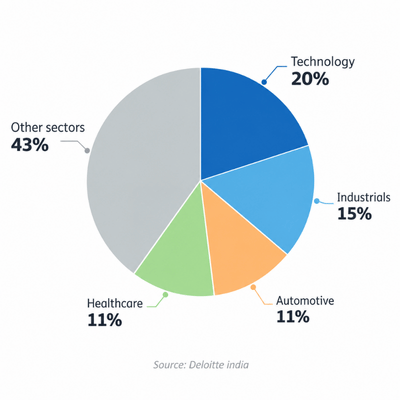
The change reflects a shift in how Japanese enterprises view their Indian operations, moving from seeing them as just support services to being more involved in the development and decision-making around new technology and products as part of their global operations. Companies are looking to build capabilities and support their own digital transformation.
The move also reflects Japan's need to address talent shortages and adopt new technologies and the opportunity in India's engineering and digital workforce to build products, strengthen functions and support international operations.
India’s Talent Pool Attracts Japanese Companies
India produces an estimated 2.5 million to 2.8 million science, technology, engineering and mathematics (STEM) graduates each year, representing a huge potential talent pool for companies needing specialised technical skills. Availability of engineers and digital professionals is one reason why Japanese GCCs are expanding.
Alongside talent, established office infrastructure, technology clusters and a developed business ecosystem are also facilitating companies’ setting up and scaling of operations. This is especially true for centres engaged in engineering, software development and other activities requiring access to both a pool of specialised employees and supporting infrastructure.The expansion is not driven by cost considerations alone. Japanese companies are increasingly looking to India for capabilities that can contribute to innovation and global business growth. As responsibilities widen, their Indian operations are becoming more closely connected to the companies' broader technology and product strategies.
Bengaluru, Hyderabad and Pune Remain Key Hubs
Bengaluru, Hyderabad and Pune continue to be key destinations for Japanese GCCs. Their well-established technology and business ecosystem makes them relevant choices for companies searching for engineering, digital and technology talent. Japanese companies have also used managed office spaces in Bengaluru, including through Urban Vault, which has Japanese firms such as Nachi, Pioneer and Komatsu.
The availability of office space and supporting business infrastructure is also an important consideration for companies establishing new centres or expanding their existing operations. As GCCs begin to take on more specialized roles, companies may seek workplaces that are suited to supporting technology teams, engineering operations and collaborative product development.
Japanese companies are also looking to emerging talent markets for specialized skills and to support future expansion which will lead to the GCC footprint being found in a broader range of geographical locations. However, the speed and scale of such expansion will depend on individual company requirements.
GCC Expansion Creates Opportunities for Office Real Estate
The expansion of Japanese GCCs adds another source of potential demand for India's office market. These centres require workspaces for technology, engineering and business functions, while more specialised operations may also need access to established technology parks and supporting infrastructure.
For commercial real estate, the trend creates opportunities for office landlords, developers and workspace operators to cater to companies setting up or scaling their Indian operations. However, the number of Japanese companies operating GCCs does not by itself establish how much additional office space they will lease. Actual demand will depend on the size of each centre, its workforce and whether expansion takes place through new leases or existing premises.
Japanese investment is also extending into office campuses, technology parks and real estate platforms that support the wider innovation ecosystem. As companies assign more strategic responsibilities to their Indian centres, the relationship between GCC expansion and office infrastructure is likely to remain an important part of the country's commercial real estate landscape.