
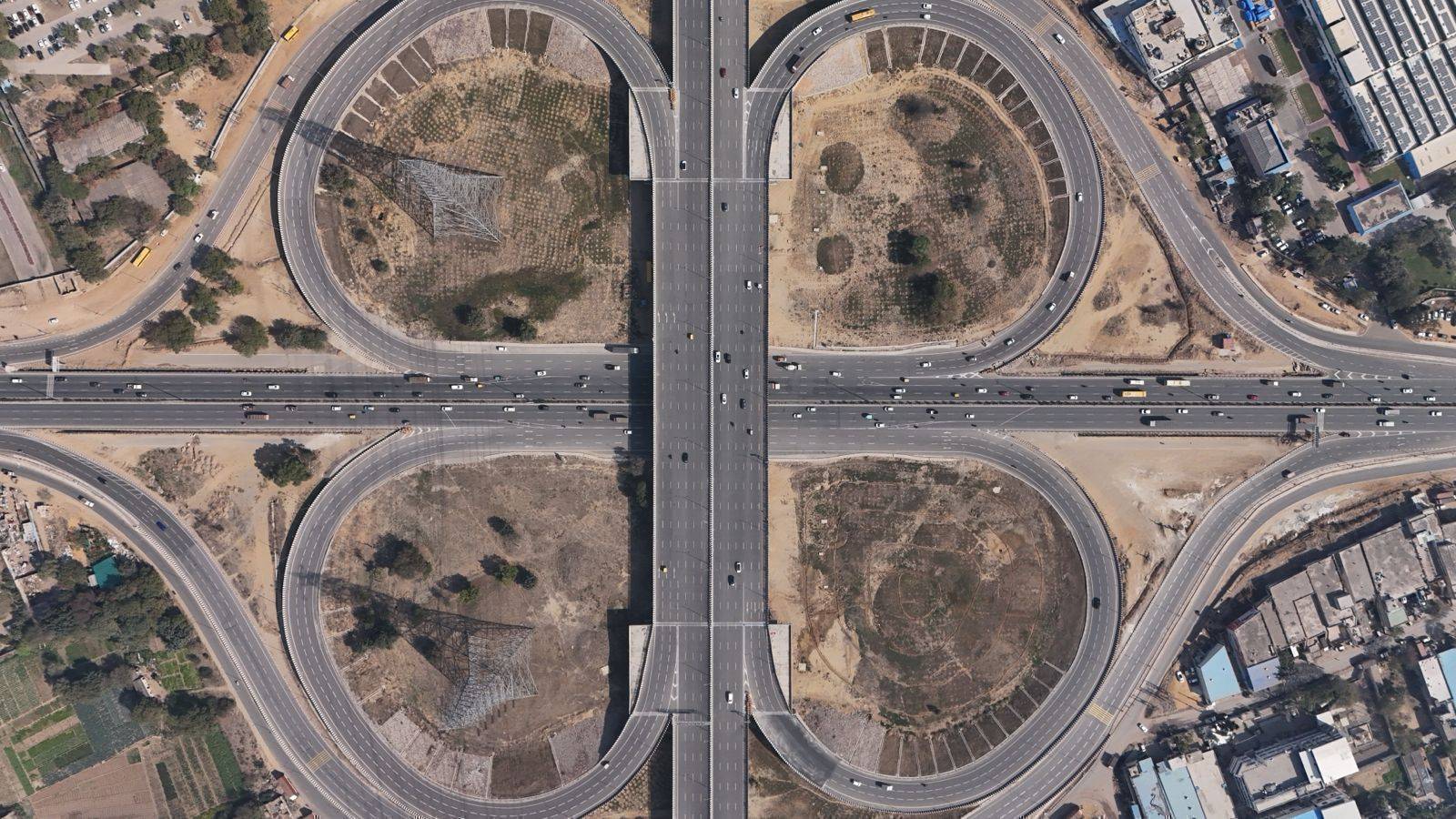
Real estate people talk a lot about timing. Get the location right, get the timing right, and everything else tends to follow. What they talk about less is the years in between, when the location is right but the timing has not caught up yet, and you are left explaining to sceptical buyers why a half-built flyover is actually a reason to buy, not a reason to walk away.
Anyone who sold property in Sector 95 through the 2010s knows that conversation well.
The Dwarka Expressway opened fully in 2025, and with it came a kind of quiet vindication for everyone who had held their ground on this corridor. The numbers are now well documented: a 29-kilometre stretch, 16 lanes, a 5.1-kilometre tunnel feeding directly into Indira Gandhi International Airport. On paper, those are engineering statistics. On the ground, they mean a Sector 95 resident can be at the departure terminal in twenty minutes on a regular weekday morning. The Friday evening airport run, once a logistical exercise, is now an errand.¹
Within the Dwarka Expressway story, Sector 95 holds a position that not every sector on the corridor can claim. It sits where three roads meet: the expressway itself, National Highway 48, and Pataudi Road. That triple access does not come up in most marketing conversations, but it matters in ways that accumulate over time. When one road has a bad morning, there are two others. When demand comes from Gurugram's southern end, from Delhi, and from the Pataudi side simultaneously, the sector absorbs it in a way that a single-access location simply cannot. Connectivity of this kind does not produce dramatic price spikes. It produces steady, durable demand, which is the harder thing to build and the more valuable thing to own.
The price trajectory on this corridor is worth a closer look. Values sat at around Rs 6,300 per sq ft in 2020. By late 2025, the same stretches were trading at Rs 21,700-24,000 per sq ft, roughly 3.5 times over in five years.
The CREDAI-Colliers-Liases Foras Housing Price Tracker recorded a 58 per cent year-on-year increase on Dwarka Expressway in Q4 2024-25, the sharpest movement of any micro-market across India's eight major cities in that period. Luxury and ultra-luxury products made up 82 per cent of new residential supply in the NCR during Q2 2025. The market has not been chasing a story. It has been priced in a reality that the infrastructure has finally made legible.
The more telling shift is in the room when a buyer walks into a site office. Three or four years ago, the questions were about risk. Is the road actually going to be finished? What does the possession clause say? Can we trust the timeline? Those questions have gone. Buyers today want to know about the tree cover in the layout, the ceiling heights, whether the pool is heated, and how the society is managed. These are not the questions of someone taking a calculated risk on an unproven location. They are the questions of someone deciding between two good options, both of which happen to be here.
JMS Group has watched this transition from the inside. Our presence in Sector 95 spans plotted developments under the Deen Dayal Jan Awas Yojna, residential floors, and, more recently, high-rise apartments aimed at a buyer who expects considerably more from a home than their predecessors did. The same piece of land that once required a detailed explanation of future potential now sells on present reality. That is not a small shift.
Where the corridor goes next is less about roads and more about the texture of daily life. A neighbourhood becomes genuinely liveable when you can put your child in a school nearby without compromise, when the hospital down the road has the specialist you need, and when Saturday does not require driving to another part of the city to feel like you live somewhere complete. Sector 95 is not entirely there yet, but the gap is closing, and the residential density now surrounding the sector makes serious institutional investment a near-term probability rather than a distant aspiration.
The Metro extension is also still to come. The proposed Delhi Metro Phase 4 line that would run through this corridor has not been built yet.⁵ It will be, and when it is, the repricing that follows will be sharp and fast, as it always is when a metro station becomes real rather than proposed. The window between proposed and operational is usually where the better returns are made.
The hard years on this corridor are behind us. What is ahead is the business of building on ground that has already proven itself.