
Avenue Supermarts Limited, the parent company of DMart, has purchased multiple floors in a commercial building in Panathur village, Varthur Hobli, Bengaluru East, for ₹106.2 crore, according to property registration documents accessed by CRE Matrix and reported by multiple outlets. The transaction was registered on April 13, 2026, and involved a stamp duty payment of ₹2.12 crore. The asset sits in Block-A of the building and includes the ground, first, second and third floors, along with the terrace and basement.
What the deal includes
The purchase covers a built-up area of about 1.70 lakh sq ft and includes an undivided land share of 4,046.85 sq m, which is roughly 43,560 sq ft. The ground floor measures 2,363 sq m, while the first and second floors are each 3,051 sq m. The third floor spans 3,112 sq m, the terrace measures 103 sq m, and the basement which includes parking measures 4,128 sq m. The seller group was not identified in the publicly cited reporting and DMart had not responded at the time the stories were published.
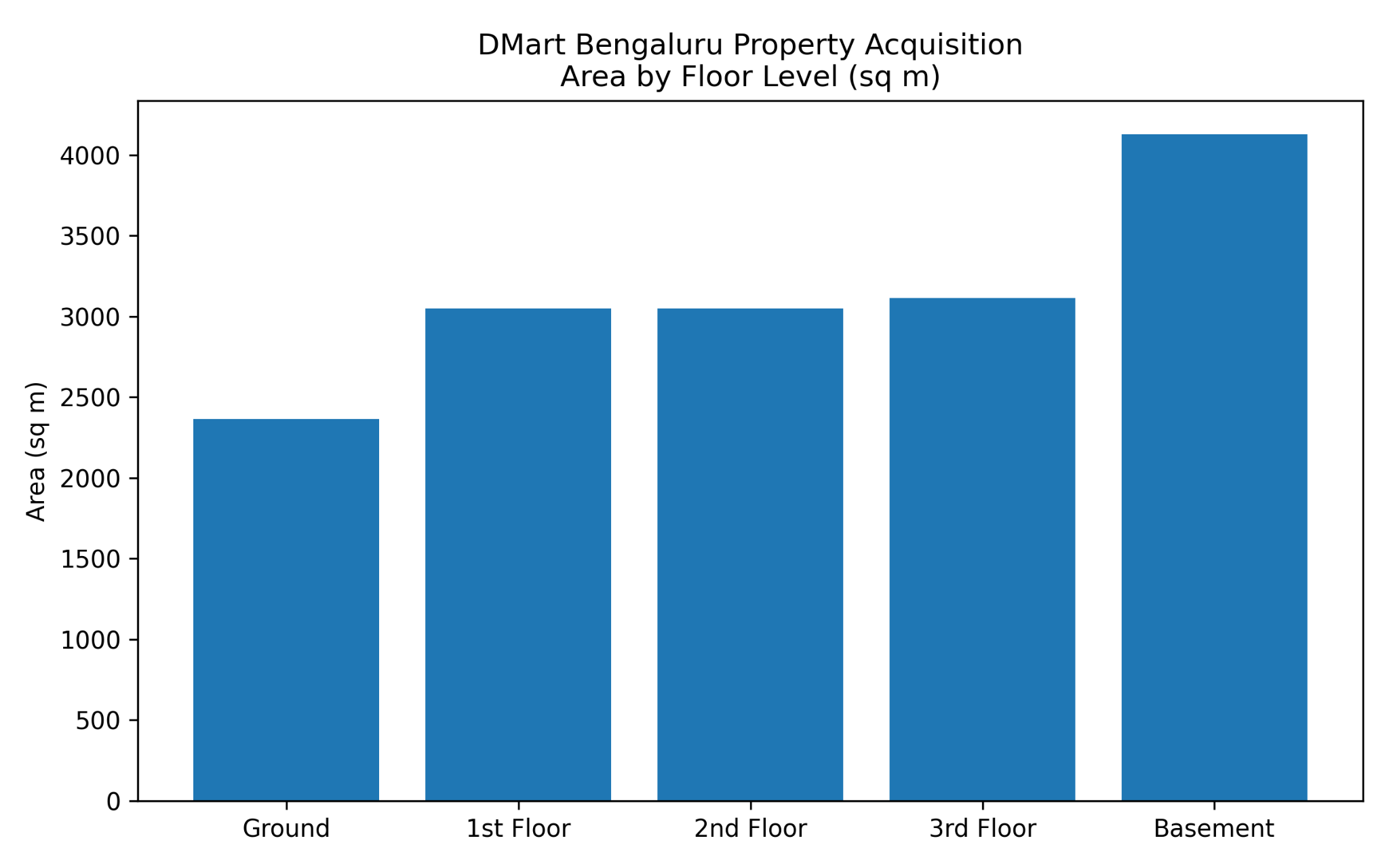
Chart: Floor-wise Area Distribution of DMart's Bengaluru Commercial Asset
The location is significant. Panathur, in East Bengaluru, lies within one of the city’s most active commercial and IT-linked micro-markets, where office, retail and residential demand have all been reshaping land values over the past few years. The acquisition therefore appears to do more than simply add an office-style asset to DMart’s books; it places the retailer inside a corridor that has become increasingly attractive for large occupiers seeking long-term presence in a growth zone. That reading is consistent with how the transaction has been framed in the market coverage so far.
Why Bengaluru matters in DMart’s playbook
DMart is already a national supermarket chain with a broad footprint, and its property buys reflect the scale of the business rather than a one-off opportunistic transaction. As of December 31, 2024, the company had 387 stores across India, with presence in states including Maharashtra, Gujarat, Telangana, Andhra Pradesh, Karnataka, Tamil Nadu, Madhya Pradesh, Rajasthan, Punjab, NCR, Chhattisgarh and Daman. The chain, which opened its first store in Mumbai in 2002, continues to expand beyond its western India base.
For a retailer of DMart’s size, ownership or control over strategic commercial space can support operational flexibility over the long term. It can also reduce dependence on leased premises in key business districts, especially in markets where land and built-up commercial stock are tightly held. The Bengaluru deal fits into that broader pattern of asset deployment, even though the company has not publicly detailed any immediate store-opening plan linked specifically to this purchase.
A transaction that fits a wider pattern
The Bengaluru purchase is not DMart’s only recent large-ticket real estate move. In December 2025, Avenue Supermarts leased 66,250 sq ft of warehousing space from Adani Logistics in Raigad near Mumbai for 28 years, with the total rent for the tenure reported at over ₹100 crore. The agreement included a starting monthly rent of ₹20.20 lakh, a security deposit of ₹1.21 crore, a six-year lock-in and 12% rent escalation every three years. In another recent transaction, a Damani-linked firm leased a luxury apartment in Mumbai’s Worli for ₹27.5 lakh a month.
Taken together, these deals suggest a consistent approach: locking in strategic real estate where scale, location and operational utility matter. While the Bengaluru acquisition is smaller than some headline land or warehousing transactions seen in the market, its structure multiple floors in a commercial building, a sizeable built-up area and a location inside a fast-growing eastern corridor — indicates a deliberate asset play rather than a passive investment. That is why market coverage has interpreted the deal as a sign of larger expansion intent.
What the deal could mean for the market
For Bengaluru’s commercial real estate market, the transaction adds another validation point for East Bengaluru’s investment appeal. Panathur and adjoining micro-markets have increasingly benefited from their proximity to major employment hubs, road connectivity improvements and the spillover of demand from office and residential users. A purchase of this size by a blue-chip retailer can reinforce confidence among developers, brokers and investors tracking absorption in the corridor.
At the same time, the deal should not be read as a blanket signal that all commercial assets will see similar demand. The strength of East Bengaluru remains tied to micro-location, access, building quality and tenant profile. DMart’s purchase highlights the kind of asset that can attract long-term institutional interest: a large, contiguous, well-located space with parking and land share, rather than a fragmented or speculative buy. For the retailer, the move is likely to be judged by operational value over time, not just by near-term market sentiment.
In a market where large retailers are becoming more selective about where they place capital, DMart’s ₹106.2-crore Bengaluru acquisition stands out less as a flashy headline and more as a calculated real-estate decision. It reinforces the company’s scale, underlines East Bengaluru’s continuing relevance, and adds one more data point to the growing list of sizable transactions involving India’s most closely watched retail names