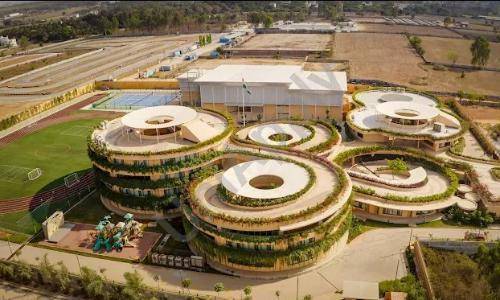

The Anthill is a 650 square metre residential structure designed by Kaushal Tatiya Architects situated in Ahilyanagar, Maharashtra. In designing this residential building, inspiration was derived from the innate knowledge of ants within an anthill. Thus, The Anthill is a project that converts biological functions into an architectural building that takes into consideration climatic, environmental and ventilation factors. The structure does not view the building as individual components but as a living organism.
In essence, The Anthill is a reaction to the extreme hot weather conditions experienced in the region. The architects endeavoured to minimize the use of artificial means in order to cool the building. This means that they designed a house that utilizes natural methods of maintaining temperature in relation to the climate, for example, through cross-ventilation, shade, thermal mass and air circulation through voids.
Concept: Learning from Ant Hills
The basic concept that informs this project involves an analysis of ant hills not in terms of mounds, but as intelligent climatic systems. Ant hills manage their internal environment using chambers, tunnels, and air cavities to control temperature and air flow.
Important conceptual translations to architectural design include:
- Chambers: Rooms should be “cavities,” not boxes
- Perforated building mass: Air cavities, openings, and voids for circulation and light
- Gradual transitions: Flow from one part of the house to another is done gradually
- Organic form: The building should consist of curved walls and organic shapes rather than orthogonal design
In explaining the project, the architect says they are trying to go beyond traditional notions of walls and rooms, designing the house more as an “excavated space.”
Spatial Planning and Experience
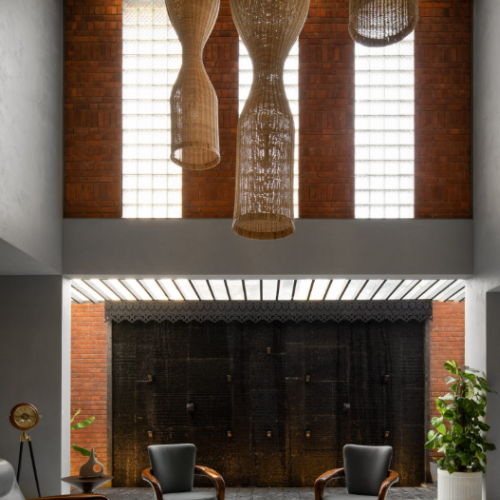
There is an organization of spaces based on a central atrium that forms the core of the building. The atrium space gets diffused light from various circular openings in the ceiling and light flows through various layers and provides illumination in other interior spaces.
Around the core space, there are several “breathing spaces,” including private spaces like bedrooms and lounges, semi-private rooms like lounges and corridors. There are balconies that shade interiors, provide outdoor extension to interior spaces, and aid ventilation.
The side passage that stretches across the home is an open-air corridor with a water feature flowing down. This provides not only a cooling effect on air but also an additional experience of sound and movement.
Materials: Earthy, Tangible, and Sensible to Climate
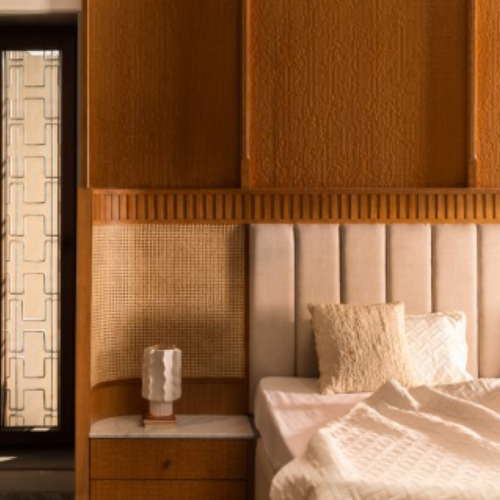
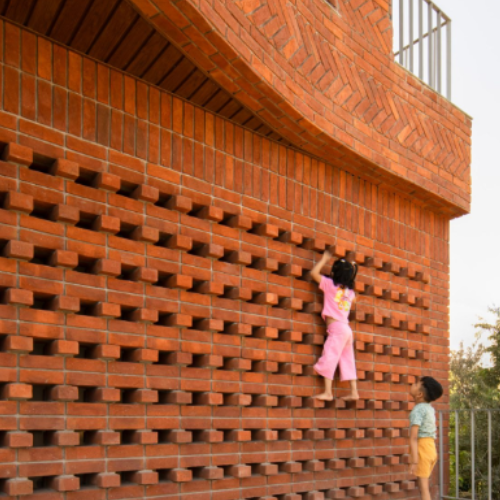
The material vocabulary consists of earthy materials that respond sensitively to the context, and bricks become the dominant material for both structure and aesthetics. Bricks are preferred because of their high thermal mass and durable nature, as well as the capacity to mold them in curvilinear and organic forms that give the house its unique identity. The façade is made up of textured and perforated brick walls drawing inspiration from Indian jali screens that provide filtered light and cross ventilation along with privacy. Timber is used carefully in bedrooms and living rooms to create a warm and contrasting effect with the rough texture of bricks, but the rest of the interior materials remain unassuming.
Climate Strategy and Passive Design
The Anthill is a climate-based architectural design that makes use of passive cooling methods extensively instead of mechanical devices. Cross-ventilation is possible using the voids and openings that exist inside the design, which allows for air flow in different areas. The stack effect uses skylights and voids to help in allowing hot air to escape upwards while letting cooler air flow into the house. Deep balconies minimize solar radiation while the use of holes in bricks controls light and helps with airflow. The addition of water to the circulation pathway facilitates evaporation.
Key strategies used are:
- Cross Ventilation: Flowing of air via interconnected cavities and passageways
- Stack Effect Ventilation: Using skylights and vertical vents to assist hot air in exiting
- Shaded Balconies: Preventing exposure to sun inside the building
- Brick screen with perforations: Filtering light and allowing air flow
- Water body: To aid evaporation for cooling of air
Form, Expression, and Architectural Identity
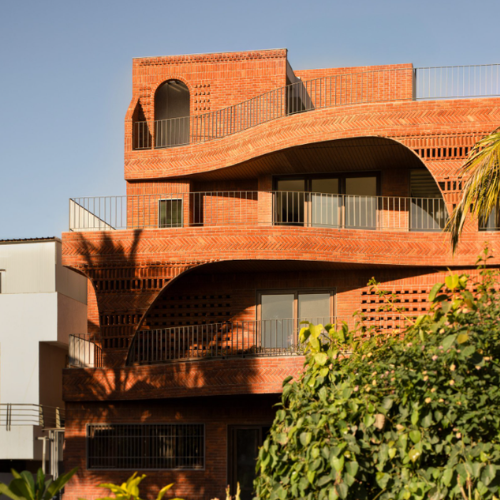
Overall, the form of The Anthill is sculpted and organic, intentionally devoid of rigid geometry. Its curved façade looks as if it is eroding away, suggesting that its form developed through natural forces. The feeling of erosion is supported by the texture of the brick walls, its openings, and terraces.
Expression in architecture follows the concept that the building should seem to have“emerged from the ground,”.
The Anthill, designed by Kaushal Tatiya Architects, stands out as a remarkable example of architecture that takes into account the climate as well as the inspiration drawn from nature. This innovative architectural design is a reinterpretation of home design using nature’s intelligence. It uses the air, light, and movement principles within anthills to build an innovative architectural masterpiece. The Anthill represents an ingenious use of natural material, such as brick, to build eco-friendly living spaces.
Images- aveshgaur.com